
Sarah Mills: A respectful way to highlight a life well lived
Sarah Mills says funerals often now include video montages of the person's life. These are heartfelt ways to acknowledge...
The homeless encampment at Avenue K South and 20th Street West in Saskatoon was dismantled by the city last week, raising questions about where the people who were living there will go next.
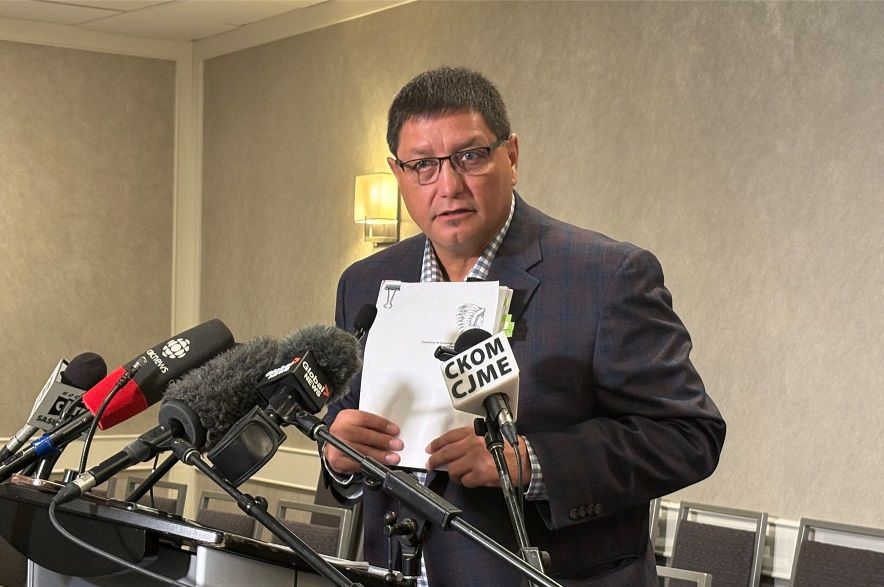
A disproportionate number of the camp’s residents were Indigenous. As a result, the issue has been at the top of Saskatoon Tribal Council Chief Mark Arcand’s mind. He joined The Evan Bray Show on Tuesday to share his thoughts on the camp and the city’s issues with homelessness.
Read more:
The following questions and answers have been edited for length and clarity.
EVAN BRAY: There are no easy answers with this encampment in Saskatoon. It came down last week. Do you have thoughts on the encampment being dismantled?
MARK ARCAND: My first thought is I support the encampment being removed because, number one, they’re not safe. Number two, there’s negative things that are going on there. There’s drug use. There’s assaults. There’s violence. There’s no security that watches these, compared to all of our facilities that we run. I can go through our emergency wellness centre that has all the safety measures in place. Is it perfect? No, but it’s not a free-wheeling organization. Our women’s warm-up shelter has security. Our drop-in, our bathroom project – all these facilities have security to keep the area safe and clean. When I was down at the encampment, I spoke to somebody, and I’m not going to mention his name, but I told him, “If I were running this facility, we wouldn’t have an encampment because nobody would want to follow the rules.” That’s why everybody’s being evicted from our facilities and other facilities – because they don’t want to follow rules.
I support what the fire department has done to keep our community safe. And, let’s be honest, the weather’s changing here. Nobody should be sleeping on the ground. Nobody wants that for their family members, for their relatives, so I think we have to get people help. There were 120 people in the encampment and only two wanted support. What does that tell people? We’ve got a bigger issue here. They don’t trust the system. To give you a good example, when our staff are out there on the streets and they’re bringing somebody back from an overdose, they call 9-1-1 and they the ambulance comes and they bring everybody back from their overdose. They refuse to go with the ambulance. So why are they making these decisions to refuse service?
At your emergency shelter facility, for example, you don’t put up with drug use there, and if someone uses drugs or tries to sell drugs, they’re banned from the facility. We had a call on the show last week suggesting that First Nations will try and protect their First Nation by banning certain people when it comes to drugs. I know you don’t represent a First Nation, but you are the chief of Saskatoon Tribal Council, representing many. Can you talk about what a banning process might look like for a First Nation? Who might get banned?
ARCAND: Working with our seven chiefs and other community leaders that we talk to on a daily basis, they’re having the same issues. They have drug dealers, whether it’s people from their community, not from their community, so somebody that’s married in, whatever it may be. They’re selling drugs in their community. So they, as chief and council, have to make some decisions. And I think there’s a lot of First Nations that are saying “We don’t want drug dealers in our community because it’s harming our people.” It’s causing chaos. It leads to violence, leads to gangs, leads to all these negative things, and they want a safe community. Drug dealers being banned from their communities, they go through a process. I don’t think they’re banning people for using drugs. They’re trying to get them as much support as they can, and it’s up to the individual if they want that support. When somebody gets banned, they’re coming to, let’s say an urban centre, and carrying on what they’re doing in a different location. And you’ve got to remember, in the city of Saskatoon if somebody’s selling drugs here, police are on them right away. But in a rural community or a First Nations community, RCMP services are more limited, so they may not get to that situation in the same time frame as compared to the City of Saskatoon or the City of Regina.
When we talk about homelessness, while there is a concerted effort to try and find ways to solve a problem that many people say is almost unsolvable, we also see some finger pointing, right? Municipalities will say, “Well, this is provincial jurisdiction,” and the province will say, “Well, the feds own this part of it, and you know the cities should be handling this.” What role should First Nations communities play in the issue of homelessness?
ARCAND: Unfortunately, in Saskatoon the majority of homeless people are First Nations people, but there’s other races that are homeless as well, right? We have people that just can’t afford rent or food, that aren’t addicted, that are homeless. We get that. Then there’s people that are right to the extreme, where drug use is a daily thing, and they don’t want any services. They’re walking around in psychosis, and there’s everybody else in between, right? So when we think about this whole perspective of homelessness, we always say in our culture, kinship and family are important. When are we all going to take the responsibility and say “How do we help people? How do we make sure that they’re not living on the street?”
I’ll give you an example. One of my communities, they came to the encampment. They picked up their people. Brought them back to their community. Within five days, they left the community because they didn’t want to follow the structure. They didn’t want the same thing that everybody else has, and they came back to the city and indulged in the same things as before. If people aren’t ready to make change, we’ve got to find a way to support those individuals. And I always say, is it under medical care, however we do it. I’m a big supporter of compassionate care from the province, because if somebody’s refusing medical service or not wanting to get help, are they a prime candidate to be in that facility? And how do we get families to come and say, “Hey, come and talk to your individual.”
I always use my son as a good example. He’s 36 years old. He’s been incarcerated several times. I always say I’m one of the guys that had to help him get arrested to save his life, because he told me “It was either jail or I’m gonna die. So I took jail so I could work on the rehabilitation every day.” To this day, he phones me and he tells me he loves me because he wants to change his life. That’s how much I had to do, as a father, to take care of my son and to try to change his life. He got out of the addiction. I think the lesson to everybody about trying to help people, the family will tell you, “Hey, so-and-so doesn’t want to get help. What do we do? Whose responsibility does it become if they leave our household and they go into an urban setting or a rural setting or wherever it is, and they become homeless?” Well, then the system, I would say, compassionate care or something like that, has to support them.
Look at our Idylwyld facility in Saskatoon, a 24-hour detox. In my opinion it’s helping, but it’s not changing the system because it’s like a Band-Aid solution. It’s not long enough. People are just staying in there for the required 24 hours, and then they come back, they do the same thing, and they end up back in there. It’s a difficult topic, but if we need more shelters then we need more shelters. I think the amount of homeless people in Saskatoon has grown tremendously. It’s unfortunate we couldn’t get a point-in-time count, but I think the numbers and the visual that people are seeing, it’s really bad out there. And I think we have to hold some people accountable for their actions. And rules are rules. And if we don’t have rules, we have chaos. And when you look at encampments, you’ve seen the pictures of the needles, the garbage. That’s not how our city should be. The old saying goes: “If you give a man a fish, he’ll eat for a day. But if you teach him how to fish, he’ll eat forever.'” And the whole point is, how do we get these people to teach them to get off the addictions and move into a healthy place, so they’re healthy and just really wanting to be good family members and being part of society? We have some challenges, but I think we’ve really got to focus on helping people in a difficult circumstance here. And it’s a tough job. It’s not an easy job, and if everybody had a magic wand, we’d get it done.
Let’s say we could house everyone in some sort of supportive housing or emergency shelter, and an emergency shelter should be taken as just that. It’s not long term. This is just a way to get you off of an unsafe on-the-street living situation until you’re back on your feet. Are we doing enough to help those people? And you run an emergency shelter, a wellness centre in Saskatoon. Are we doing enough to help those people get back on their feet? And if not, what needs to change?
ARCAND: I really appreciate somebody saying, “Hey, you know what? I’m going to bring you some food. I’m going to bring you a blanket,” but we’re not solving the issue. We’ve got to really dig down deep into the issue, which is what is causing the trauma, what is causing the pain, the hurt, and how do we help these people? We need more supports for shelters to get people into the second step, which is independent living or wrap-around services for any type of facility. If somebody needs transportation, how do we support them through wrap-around services? If somebody’s at the really high level of psychosis, how do we get them wrap-around services? Everything has to be about wrap-around services to support people. Just because we get somebody housed doesn’t mean we leave them. We keep working with them to say, “Hey, how you doing? Did you trip? Did you fall?” And if they trip and fall, we keep working with them to say, “Hey, it’s OK. You know, nobody’s perfect.”
It’s just like everybody says on January 1 for their New Year’s resolution: “I’m going to the gym every day.” Well, we know people don’t go to the gym every day. It’s ebbs and flows. Same thing with addictions. Some people are falling off. Some people are trying. It’s just a question of how do we keep supporting them? We need more supports for wrap-around services for individuals. We need more facilities, and it’s a reality of how we’re going to change the system slowly. We don’t wish our kids to be on drugs and alcohol every day, so they can’t function. We want our people to be healthy, all people, and I think that’s going to be our goal. And say we’ve got to hold our family members accountable, and say this is not a good way of life. And I think that’s a good starting point.