The parallels between parenting and péquistes
Murray Wood says a child's obstreperousness and separatism are analogous.
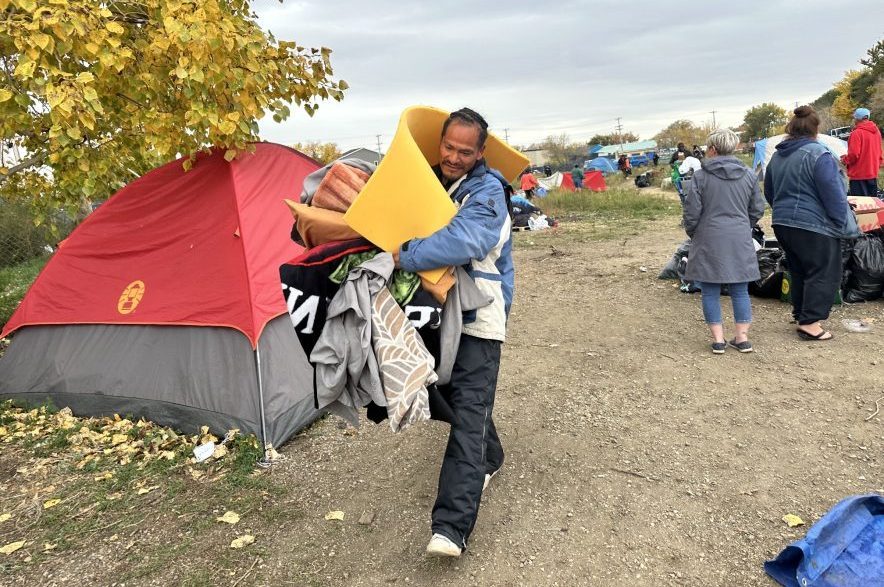
Even with all the shelter support said to be available to former residents of the Avenue K South encampment, those living in the tent city didn’t know where to turn Thursday morning.
On the morning of Oct. 8, the City of Saskatoon announced it was already dismantling the camp, despite a second injunction application filed in an effort to allow it to remain.
Read more:
As a line of police officers made its way across the field, clearing people and their belongings, those in the area could hear the following announcement: “Attention! This is private property. Please move your belongings and vehicles off the property as soon as possible. If you are able, please assist others with helping to move their belongings.”
In response, encampment resident Amena Stene shouted back, “Where are we gonna go? There’s nowhere to go!”
Stene described Thursday morning as “a rude awakening,” sharing how she didn’t believe what was happening at first.
According to Stene, while living outside isn’t easy, being outdoors gives people a sense of independence.
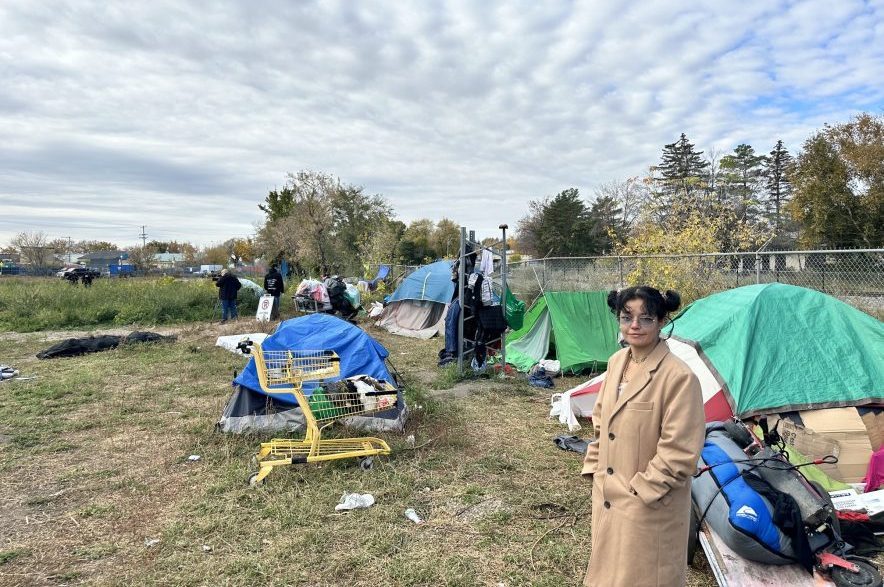
Amena Stene stands in front of her tent in the encampment as police clear the far side of the field on Oct. 8, 2026. (Libby Gray/650 CKOM)
It’s a space where they can be alone and “kind of feel like how it felt when you had a home,” she said.
Plus, many people remaining in the encampment don’t trust shelters.
“I don’t trust what I can’t control myself,” she said.
Stene has experience using Saskatoon’s housing resources, having stayed with the Central Urban Métis Federation Inc. She said it didn’t work out because there was a lot of drama.
For Stene, it was confusing why the tent city had to be torn down. She said residents kept quiet at night, didn’t throw parties, and weren’t the ones acting aggressively toward law enforcement.
“They’re all standing there. They have batons. They look like they’re ready to fight,” Stene said about police.
“But we’re not trying to fight. We just want to live. We just want a place to call our own,” she added.
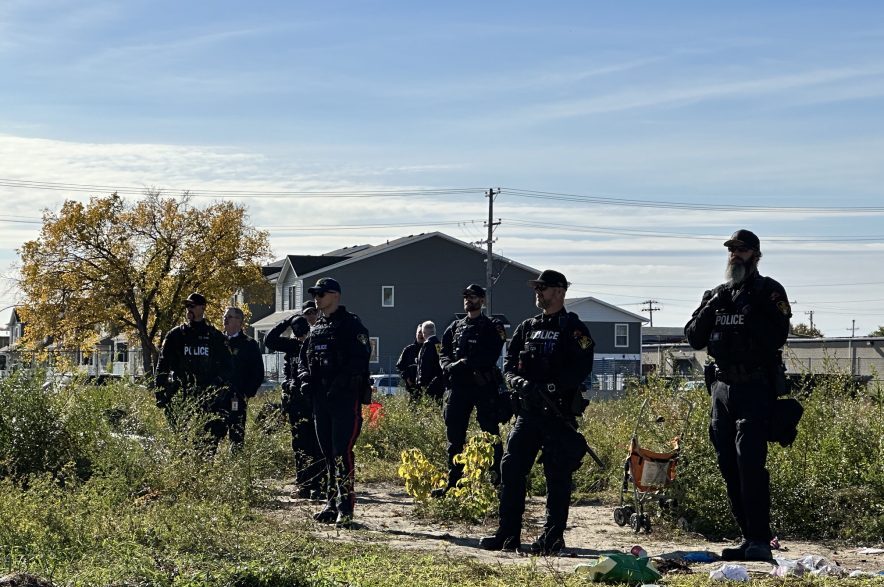
Various Saskatoon police officers hold the line at the Avenue K and 20th Street encampment clean up on Oct. 8, 2026. (Libby Gray/650 CKOM)
According to Saskatoon police, two people were arrested and charged at the encampment with Criminal Code mischief. Most of the removal, though, happened without incident.
The destruction of tent city left Stene wondering where to go next.
Catriona Kaiser-Derrick and Nicholas Blenkinsop, lawyers with Community Legal Assistance Services for Saskatoon Inner City, say they’re hoping a challenge to the constitutionality of the Saskatoon bylaws will be heard in court.
Speaking in front of their offices on 20th Street West on Thursday, Kaiser-Derrick said their services were retained by several members of the encampment last weekend, including activist and encampment member David Fineday.
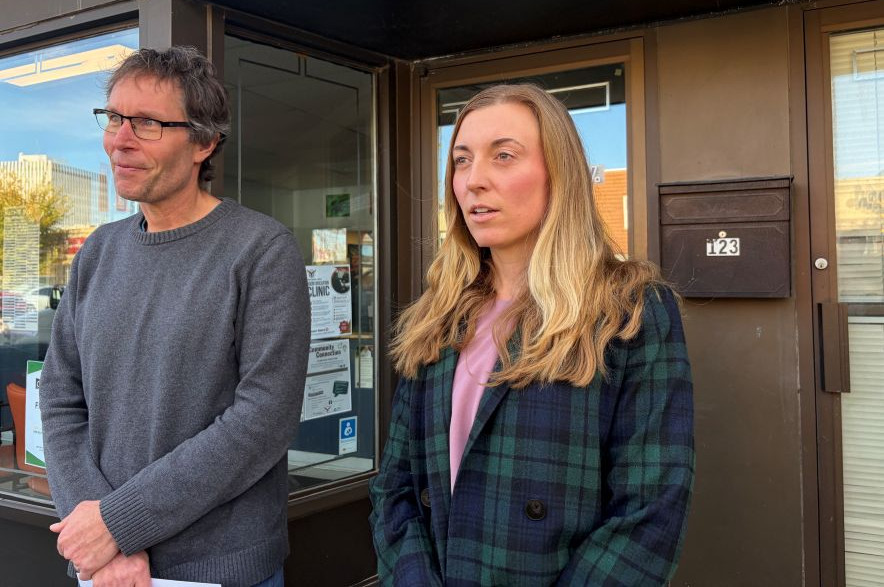
Nicholas Blenkinsop and Catriona Kaiser-Derrick, lawyers with Community Legal Assistance Services for Saskatoon Inner City, speaking in front of their offices on 20th Street West on Thursday. (Lara Fominoff/650 CKOM)
“We now have a pending legal challenge, that is our underlying application of a notice of constitutional question, challenging the constitutionality of the bylaws,” she said.
Kaiser-Derrick specified that the city bylaws violate her clients’ rights to life, liberty and security of the person, along with encampment members’ rights to equality, and that city bylaws often characterize homelessness as a “nuisance issue.”
“I raise the question of where are these people supposed to exist?
“Encampments often gather a lot of negative attention because they make the problem of homelessness completely visible and unavoidable to those in the community,” she said.
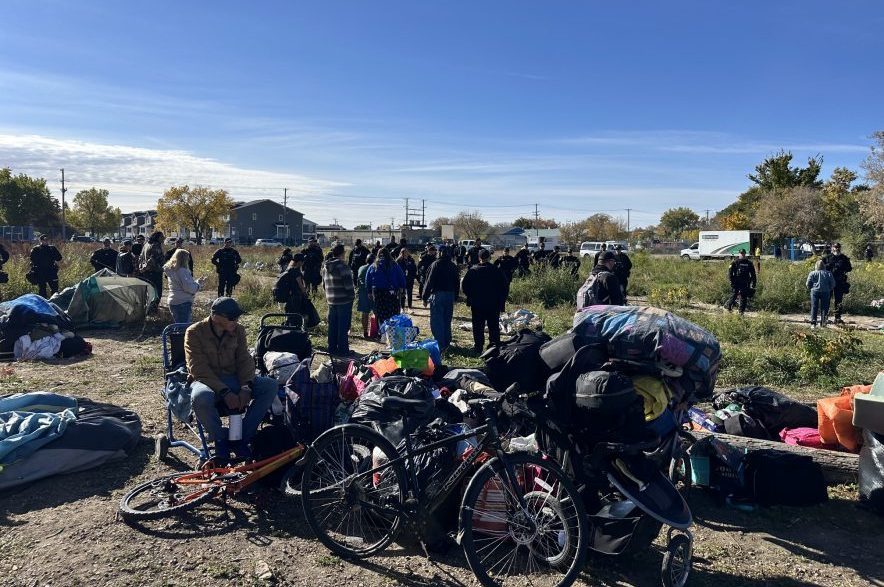
Encampment residents, their belongings and supporters face a line of police stretching across the width of the property as the site is cleared by officers and crews on Oct. 8, 2026. (Libby Gray/650 CKOM)
Scattering an encampment, therefore, makes the issue less visible, but doesn’t solve the underlying issue, she argued.
“The lack of access to justice for the people living in the encampment and others in the community is concerning and heartbreaking. Those who are most in need of justice, have the least access to it,” added Blenkinsop.
Both lawyers also expressed concern over the arrest of activist and encampment resident David Fineday.
Kaiser-Derrick said they expect to make a first appearance on the “notice of constitutional question challenge” Oct. 27. However, she didn’t expect the matter to be concluded the same day.
—with files from 650 CKOM’s Lara Fominoff & Libby Gray