

The parallels between parenting and péquistes
Murray Wood says a child's obstreperousness and separatism are analogous.
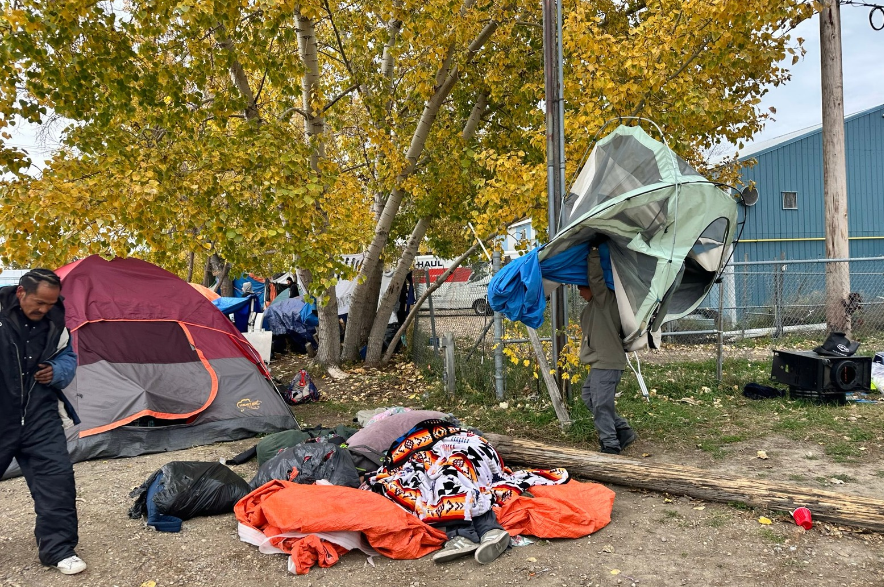
Work to dismantle the homeless encampment on 20th Street and Avenue K South in Saskatoon began on Thursday morning.
According to the City of Saskatoon, the removal is a co-ordinated effort by “several community-based, Indigenous and provincial government organizations.”
Read more:
The city said partner agencies recognize that the situation is emotional and complex, and are working to ensure the camp is removed with “respect and compassion.”
Breaking: The encampment in Saskatoon is being cleared this morning. A wall of police — with one side of the encampment now fenced off — is making its way across the field where the encampment is at 20th St & Ave K, clearing people and their belongings as they do. @CKOMNews https://t.co/IBf8TEO3dt
— Libby Gray (@libby_gray9) October 8, 2026
It also stressed that these partners are there to help in the form of housing and transportation.
“Today, there are community organizations able to provide social service and sheltering opportunities for anyone at the encampment who wants them and transportation to connect people to these important supports,” the city said on Thursday.
Additionally, it said staff from the Ministry of Social Services will help people with income support and emergency shelter options. That includes connecting people with mental health and addictions support.
“While the closure of an encampment is never the complete solution, I’m hopeful that this is an important step in connecting people to housing and supports,” Shirley Isbister, President of the Central Urban Métis Federation Inc. said.
The city emphasized that encampments pose safety risks to those who live in them, and concerns about sanitation, gang activity, drug use and fires only escalate as the sites grow.
@CKOMNews People from the encampment are upset, yelling “you suck” and “you’re ugly” to police. A truck is collecting all the things left behind the police line in the field as the line moves forward @CKOMNews https://t.co/sG632j6DVs
— Libby Gray (@libby_gray9) October 8, 2026
Yvonne Raymer, Saskatoon’s deputy fire chief, said the fire department has responded to four fires at encampments since midnight on Monday. None of them were at the Avenue K site, although a couple were close by.
She said one fire destroyed a tent and spread to nearby trees in Optimist Park, another spread to brush and trees in the same park six hours later, and a third fire in the backyard of a vacant property destroyed a makeshift shelter. Then, last night a fire got out of control in a park off Idylwyld Drive.
“Every agency involved in this has the same goal: to ensure people are safe, and that they are living in a safe environment. We connect people to housing, shelter, health services and other supports as part of addressing the serious safety concerns of the encampment site,” Raymer told reporters.
The city said encampments are not a long-term housing solution and can be fatal as temperatures start to drop. It reiterated that’s why the response is a co-ordinated effort with partner organizations, who can help those from the site navigate their next steps.

Deputy fire chief Yvonne Raymer addresses reporters on Oct. 8, 2026. (Brittany Caffet/650 CKOM)
Raymer noted that homeless camps like the one on Avenue K represent a significant drain on the fire department’s limited resources.
“Our six fire bylaw (staff) – that’s all we have – are fully committed, unfortunately, to encampments,” she said.
“We are currently 60 reports behind, so it is resource heavy.”
Asked what might happen to residents of the camp who refuse to leave, Raymer directed the question to police, but emphasized that those living in the camp will need to move on Thursday.
Despite ongoing efforts to connect residents of the camp to various services, Raymer said those living there “continued to decline supports” on Thursday.
“While we recognize the challenges people face, we also have an obligation to address significant wider community safety risks and work toward safer, more sustainable alternatives,” the city said.
A group offering legal assistance to low-income residents of Saskatoon had applied for an injunction, asking the courts to keep the camp in place while also arguing the city bylaws that allow the site to be cleared violate the Charter.
Community Legal Assistance Services for Saskatoon Inner City Inc. (CLASSIC) said its lawyers filed the injunction on Monday at the Court of King’s Bench.
The group said it has also filed affidavits from “several encampment residents” describing their efforts to obtain housing in the city and the barriers they face, including poverty, mental health issues, addiction and struggles to obtain references from landlords.
“Several also describe difficulties securing rental housing while receiving income assistance,” the organization said.
CLASSIC said the camp provides “a sense of community, safety, and stability as they seek longer-term housing in advance of the cold winter months,” and said clearing it would cause “unnecessary and irreparable harm” to its residents due to a lack of available shelter.
Last week, a judge struck down a request for a different injunction that would have prevented the camp from being cleared. The application was filed by lawyer Crystal Fafard, who asked for the injunction to remain in place until every resident living in the tent city had access to adequate housing.
The emergency application for an interim injunction was denied by the Court of King’s Bench on Tuesday. According to a statement from CLASSIC, the reason given for the denial was that the City of Saskatoon was entitled to notice.
The statement from CLASSIC noted: “The City of Saskatoon had been served with our applications, but given that we were retained over the weekend, we were not able to give full 14 days’ notice for the injunction application.”
In the statement, CLASSIC said the injunction was requested to prevent the city from taking action against the encampment until the constitutional challenge could be heard Oct. 27.
“We are disappointed that we did not get the opportunity to address the urgent need for an injunction in Court.”
CLASSIC said that the organization understands the issues associated with the encampment are complex and that it agreed with the city that: “any solution requires coordinated action between governments and organizations, but right now, there are insufficient resources, affordable housing, and supportive shelter in Saskatoon.”
“The issues facing unhoused individuals in Saskatoon are serious and they will not disappear because an encampment is removed,” the statement read.