Murray Wood: When words fail, stuffed animals can say a lot
Murray Wood says people in Foam Lake and communities across Saskatchewan are putting stuffed animals outside to remember...
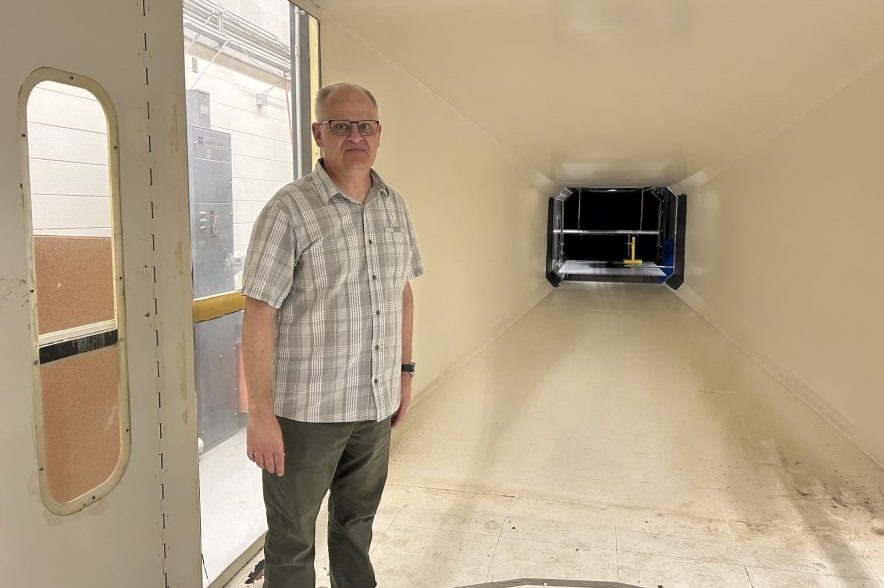
There are few things more ‘Saskatchewan’ than complaining about the wind.
It’s the invisible hand that slams the car door shut. It makes a perfectly ordinary trip from the parking lot to a building feel like a battle. It finds the gap between your scarf and your coat collar with astonishing precision.
We spend a lot of time here trying to get out of it.
But inside a lab at the University of Saskatchewan, they’re doing the opposite.
They make it. On purpose.
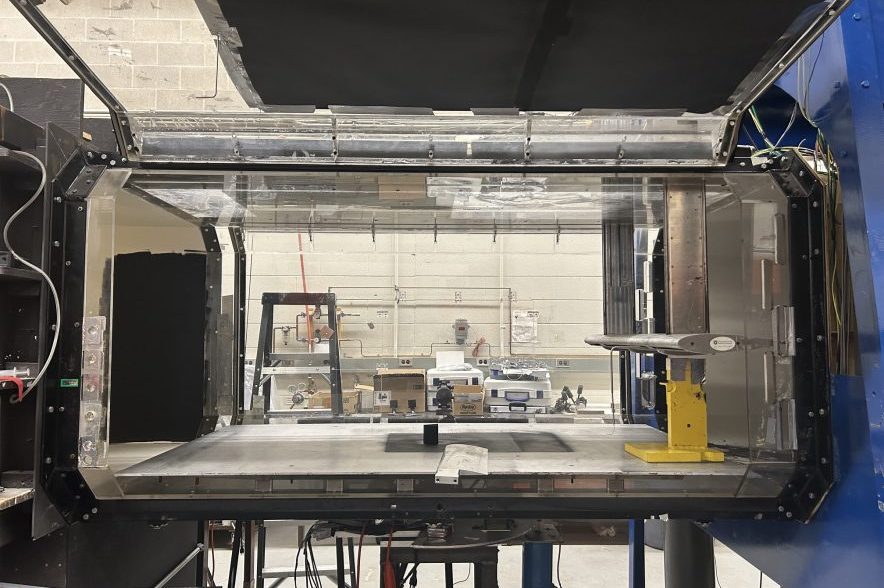
Small objects and scale models are placed in this test section. Researchers use the data they collect to better understand how wind flows around structures. (Brittany Caffet/650 CKOM)
“We need a wind tunnel to be able to study how air flows around structures,” said Dr. David Sumner, a professor of mechanical engineering. “What we need is a controlled-flow environment where we can do measurements of airspeed, pressure, drag force, lift force, around and study the flow around these structures.”
The university’s wind tunnel can push air at speeds of up to about 150 kilometres an hour. Inside, researchers can put models of buildings, vehicles, wind turbines and other objects into a carefully controlled artificial windstorm and watch what happens.
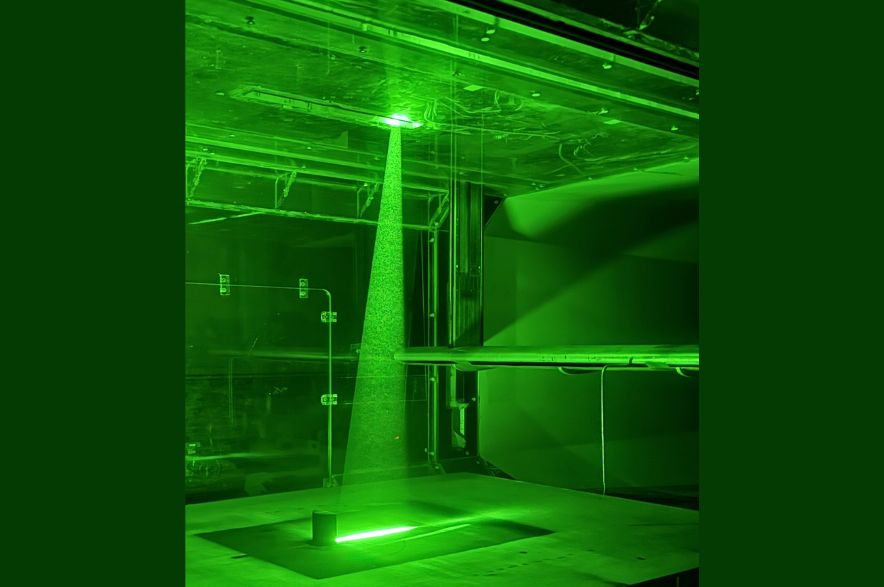
Air is invisible, which creates a bit of a problem when you’re trying to study exactly what it is doing. So how do you observe something you can’t see? Easy. Add a little fog. “The same thing you’d see at a dance club or something,” Dr. David Sumner said with a smile. Tiny droplets produced by a fog machine are suspended in the air. Then a powerful laser creates a razor-thin sheet of light through the tunnel, illuminating those particles. A camera takes two pictures a few microseconds apart. Compare the images and researchers can see how the air was moving. (Connor Stevens/Submitted)
The existing wind tunnel dates back to 1982. It was built by a team of professors, laboratory engineers and graduate students who had research funding and, apparently, the willingness to build a very large scientific machine themselves.
A large fan — “similar to a HVAC system,” Sumner explained — pushes air through the tunnel. The air travels through progressively smaller sections, causing it to speed up before entering the test section, where experiments take place.
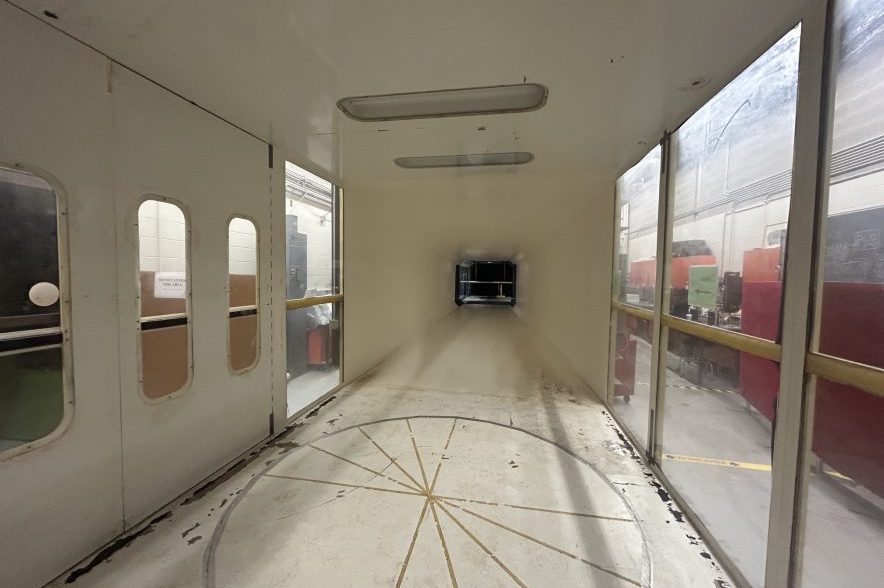
While we had the opportunity to step inside the wind tunnel, Dr. Sumner made it clear that no people are permitted inside while it is operating. (Brittany Caffet/650 CKOM)
Now, after more than 40 years, the old tunnel is nearing the end of its run. The U of S is building a new one, and it is going to be a very different kind of wind machine.
While the old tunnel has one big fan, the new one will have 900 small ones.
That sounds excessive until Sumner explains exactly what those fans can do.
“We can control the speed of each fan individually using a control system, a computer control system,” he said. “If we want to generate wind shear or a wind gust, we can generate that wind profile with these 900 fans.”
Instead of simply turning the wind up or down, researchers will be able to create conditions that more closely mimic the real world.
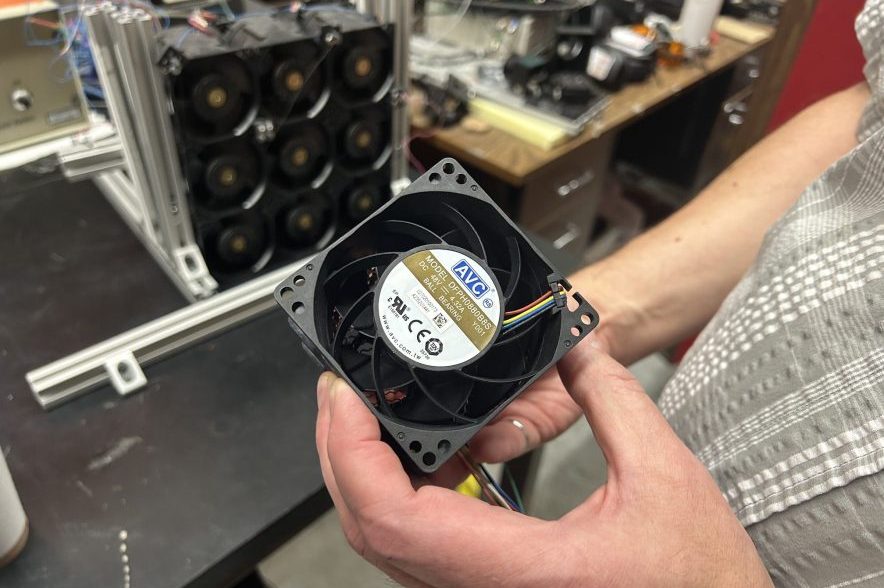
The new wind tunnel will include 900 of these small fans. (Brittany Caffet/650 CKOM)
The new wind tunnel is being designed as a modular system, meaning its configuration can be changed depending on what researchers want to test.
It will take three years to build and will cost about $1.5 million, with roughly half a million dollars coming from the Canada Foundation for Innovation.
The new tunnel is an elaborate way of creating something Saskatchewan already has in abundance. The difference here is control.
That matters when you’re trying to understand something as ordinary, and as complicated, as the way air moves around a vehicle.
The goal isn’t simply to understand the wind. It’s to figure out how to design things that work better in it.
“If we have a road vehicle, if we can minimize aerodynamic drag, we can potentially save on fuel consumption, reduce our fuel consumption,” Sumner explained. “And if it’s an electric car, we could again extend the range of that electric car.”
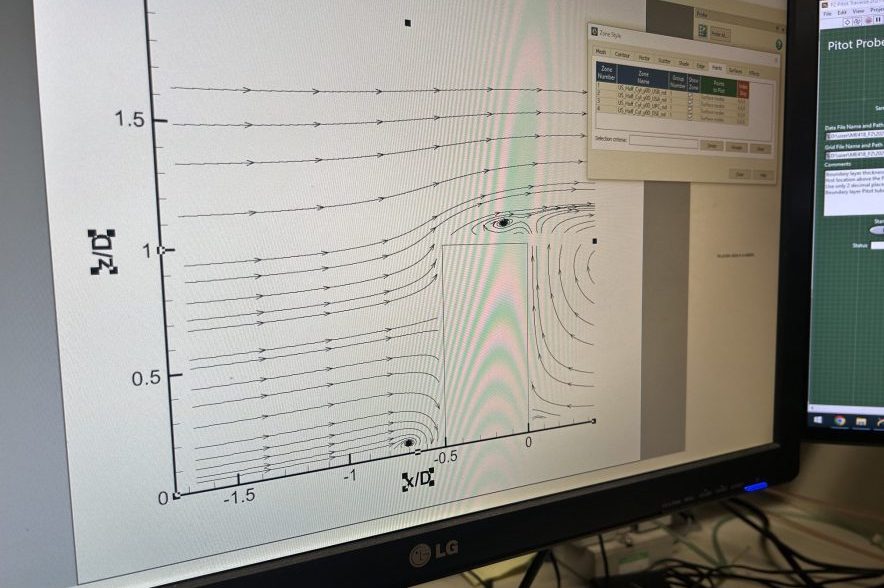
All of the data Dr. Sumner’s students collect from their experiments is uploaded into a computer, creating a visual representation of the air flow. (Brittany Caffet/650 CKOM)
The old wind tunnel has been useful for understanding the basic physics of how air behaves. The new one could put that knowledge to work on some very Saskatchewan problems.
Take wheat, for example.
Sometimes a crop stands tall in one part of a field and falls over somewhere else. Agricultural researchers call the phenomenon “lodging.”
“With a new wind tunnel, we’ll be able to bring in pallets of soil with wheat growing, put it into the wind tunnel, and look at the flow,” Sumner said.
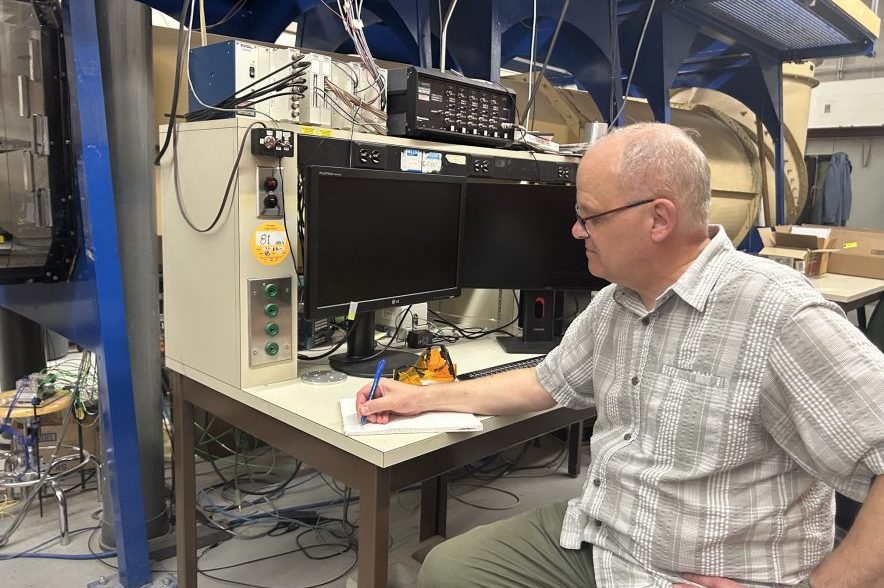
Dr. Sumner explained that the new wind tunnel will be modular, allowing much more freedom and creativity when it comes to the experiments conducted. (Brittany Caffet/650 CKOM)
Then there is spraying.
Modern agriculture has several ways of getting a chemical or other product onto a crop: large ground sprayers, drones and airplanes.
But once a droplet leaves a nozzle, the wind gets a vote in where it lands.
“Spray drift is a problem, right? If what you’re spraying is not going where you want it to go on your plants, but it’s going to another field, that’s a problem,” Sumner said. “We also want to reduce the amount of spray we actually have to use.”
The new wind tunnel will allow researchers to put spray equipment into the tunnel and track the motion of individual droplets.
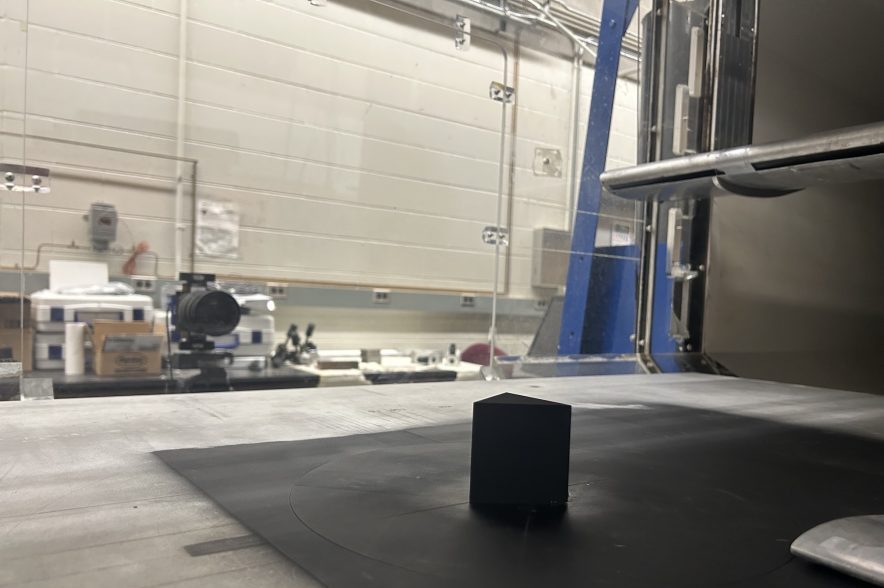
In the current wind tunnel, researchers use small objects and scale replicas of structures and items to analyze wind flow. (Brittany Caffet/650 CKOM)
And this is where the wind tunnel becomes much more than a giant machine for making air move.
It becomes a way of testing ideas before they are deployed across thousands of acres.
Soon, Saskatchewan will have a machine capable of making the wind do something it rarely does on its own: behave.
Outside, the wind is something to endure. But inside this lab, it’s something to understand.
Saskatchewan has more than enough wind. So why build a machine to make even more? Dr. David Sumner says the answer involves 900 fans, wheat fields, spray droplets and a whole lot of science. (Brittany Caffet/650 CKOM)