Evan Bray: Fall is the my pick of the seasons
It isn't quite fall yet - the season officially changes next week - but Evan Bray says fall is his favourite season, wit...
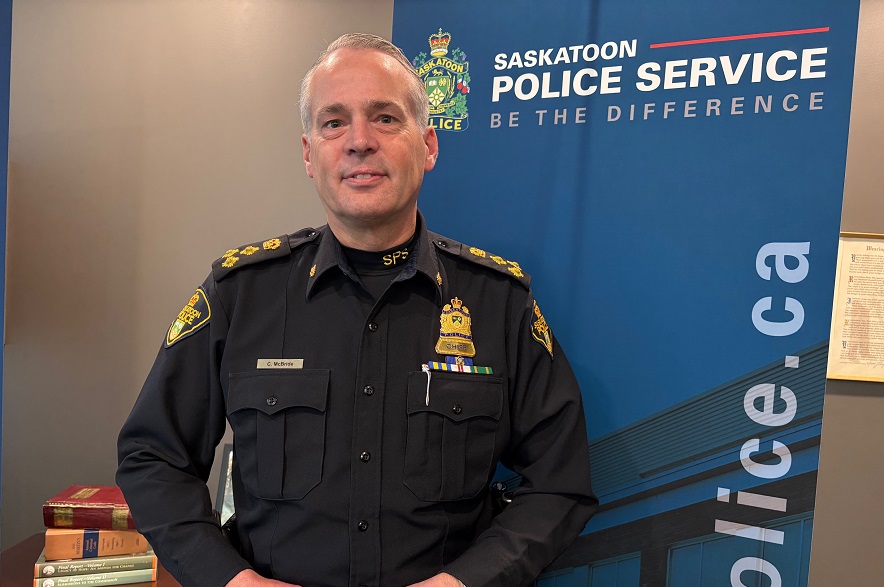
It was a busy summer for law enforcement in the Bridge City according to Saskatoon’s Chief of Police, Cam McBride.
He joined the Evan Bray Show on Sept. 16 to discuss local crime statistics, how the city is doing in 2026, and the service’s policing priorities.
Read more:
This transcript has been edited for length and clarity.
EVAN BRAY: I remember my time in the chief’s chair. Summer is a busy time. You get through summer. You do a bit of a reflection. How did we make out? What were the crime stats like?
CAM MCBRIDE: It was a busy summer, and interestingly, looking at the statistics, it was similar in 2025. We actually started off the year with some high statistics that we weren’t expecting, and as the year’s gone by, we’ve actually seen some of our stats dropping. Violent crime, actually, year to date, we’re significantly lower than 2025, and property crimes on par, and so we’re keeping an eye out for those things. We’ve got some fantastic programs that we’re running and doing our best to keep things in check. But it was an amazing summer for sure. Lots of great things happening.
From a policing lens, what are the pressure points and what are your strategies to deal with them?
MCBRIDE: One of the biggest pressure points that we’re seeing for sure is still within the realm of social disorder that results from individuals in the community who are either experiencing mental health problems or caught in active addiction, or a combination of those things, living in poverty. It’s challenging working with individuals who have complex needs, and it’s definitely not a police-specific circumstance to deal with. We’re in partnership. We’re collaborating with other organizations, including certainly the provincial government, to figure out how we move forward. But we’ve simply seen the number of individuals who are in that circumstance grow significantly again in 2026, and so that’s consuming quite a bit of our time. And definitely, we’ve seen it in the media recently. You know some of the issues around encampments and some of the effects that the population of individuals is having on business and feelings of being safe. And so, it’s a very, very large issue we’re seeking to tackle together with all of our stakeholders.
Let’s talk about that for a second because in Regina it’s been a hot topic of conversation. There are a few businesses that have had numerous break-ins. They are right across the street from an encampment in a park near downtown Regina. So, are you seeing that same sort of increase in crime around encampments? What do you attribute that to, and what are you going to do about it?
MCBRIDE: In Saskatoon, up until now, we haven’t had the same circumstance as Regina, where there’s an established and growing encampment. Here in Saskatoon, the Saskatoon Fire Department is utilizing legislation that they’re responsible to enforce around safe housing. And so using that legislation around safe housing they’re going in, they’re providing outreach, they are working to move those who are camping on either private property or on city-owned public property. Certainly the legislation does not allow for that to occur, and so they are enforcing that legislation. And as the police were in circumstances where it dictates there may be violence or there is violence, then we also play an active role in supporting them in that work. I think there’s a misconception that police are out there charging homeless people and ticketing homeless people, and that’s certainly untrue. That is not a correct statement to be made. But where you have individuals who are living day-to-day, and they’ve got sometimes seemingly insurmountable challenges in life, and perhaps addictions, perhaps they’re high for significant periods of the day, they need to feed those addictions, there are those who will turn to crime. And as that number of individuals grows, the crimes associated to that grow. That’s exactly what we’re seeing in the city of Saskatoon. We’re providing outreach, we’re providing supports, and what’s really disconcerting is the number of individuals who we run across who don’t want support. At face value, it looks like well surely they would accept supports and yet we’re turned down. And that’s where we really have to turn to our partners in the work because when police offer supports some people are far less likely to accept from the police as a result of trauma, past experience. But, where organizations, and often community-based organizations offer supports, they have a lot more success. So, that’s kind of a glimpse into the current Saskatoon circumstance.
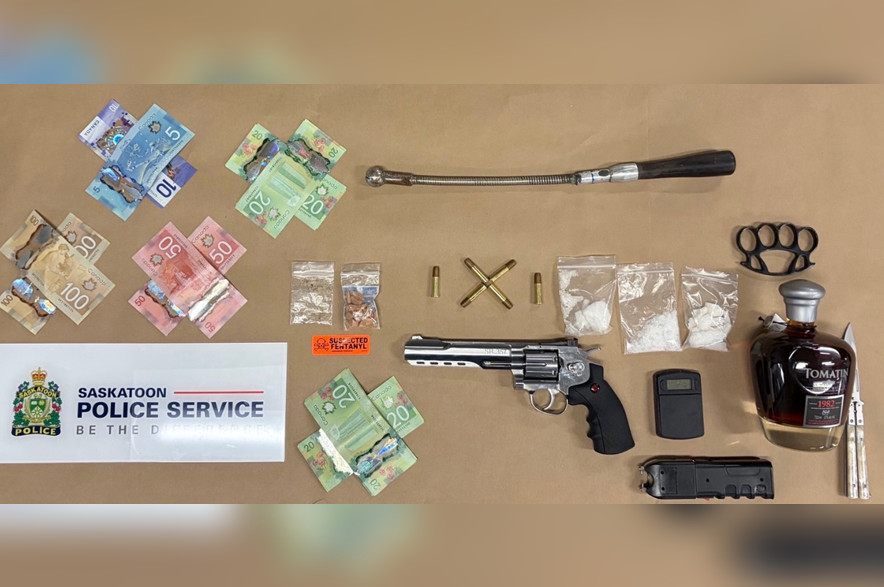
Items seized during a drug investigation in Saskatoon on July 17, 2026. (Saskatoon Police Service/submitted)
Why don’t police arrest or at the very least confiscate the drugs from people in the downtown area, or wherever in Saskatoon, that are using them openly?
MCBRIDE: Great question, actually, and it’s something that we’re thinking about literally every day. Changes to the public prosecution’s policy really affected the way that we do business around drug enforcement. We entered into kind of a gray area where we didn’t really have the authority that we believed we needed. Now, with the provincial legislation around safe public spaces, we can ticket people, we can confiscate crystal meth and fentanyl, as it’s defined as a street weapon within that legislation. For the first while, we took a very conservative approach. And over time, we’ve been ramping up that approach. And so, we are far more engaged in that enforcement work today than we were this time last year. I think some people think “well you should just be out arresting everybody,” and we simply can’t do that. We have to use a balanced approach. We have to consider the best interest of an individual and balance that against accountability and enforcement, and we have to consider space. If we just went out and arrested everybody, we would have nowhere to put them, and so we have to figure out a better way. How do we direct people towards services? How do we engage? How do we outreach and do our best to steer people in a better path, but also bringing accountability and enforcing the law where we need to? It’s not an easy black-and-white circumstance.
Federal prosecution, drug prosecutors, don’t want simple possession drug charges laid in most cases. There is the provincial legislation you referred to that allows you to seize some of these items. Do you keep stats around that? Are you able to report on how often that is happening in Saskatoon?
MCBRIDE: I don’t have the stats at my fingertips, but I can say that as of April of this year, 2026, we really started to ramp up our enforcement efforts around safe public spaces legislation. I wish I had that number for you right now, but definitely we’re utilizing that legislation and we’re enforcing the law where we can. But there are circumstances where a police officer might be going to take a report of a significant assault, and they’ll drive by an individual who’s openly using drugs, and the circumstance doesn’t allow for us to engage with that person in that moment. And to the general public, it looks like we’re apathetic, like we don’t care, like we’re just driving past, and that may not always be the case when you dig into what that officer is actually doing.
What happens to all the seized items after a drug bust? I’d like to hear your thoughts on where those items go, what they’re used for.
MCBRIDE: Yeah, for sure. I can bring a little bit of clarification to that. So, anything that is property that is either acquired as a result of crime or is utilized to facilitate crime can be forfeit to the crown if the court proceedings support that. That then goes to the province of Saskatchewan. It’s liquidated, and there’s a program where we can actually apply for funding from the funds that are generated through that. Money is simply turned over to the province eventually, and weapons like knives and bear spray and stuff, that’s eventually destroyed. And firearms, actually, we go through a process, run them through the national database to see if they’re linked to any other crimes, and then they can be ordered to be destroyed as well.
And there’s a link to victim programming as well through that civil forfeiture program.
MCBRIDE: Yeah, absolutely. Basically, the program’s desire is to take what was meant for bad and turn it into good, and that doesn’t just mean policing. There are lots of initiatives that can benefit from it.
How common is human trafficking in Saskatoon in the province and what does it look like? How does it manifest itself in the community?
MCBRIDE: Great question. I think people have a misconception that they receive through watching TV and movies and stuff that human trafficking involves people loaded into semi-trucks or trains and crossing the border and all that kind of stuff. Although it happens, that’s simply not the Saskatoon or Saskatchewan experience. Human trafficking usually involves sex trafficking, but we do see labour trafficking as well. It’s basically taking an individual who is in a vulnerable place, manipulating them to a point where they can be trafficked for a purpose, and it’s very common. In fact (in) 2025 I know that we had 178 interventions where our victim services and human trafficking responders were able to assist individuals who were either trafficked or at risk of being trafficked. This year, our vice unit has 12 human trafficking files, and they’re working hard on those files. And quite often a file might lead to multiple victims, and so they’re often very hard to investigate because the individuals who are victimized are vulnerable and fearful. Often hard to fully understand what’s going on, build trust with them, and that is really where the human trafficking responders come in. They are just very genuine, kind people who are there to help and support, and educate, and they do an incredible job.
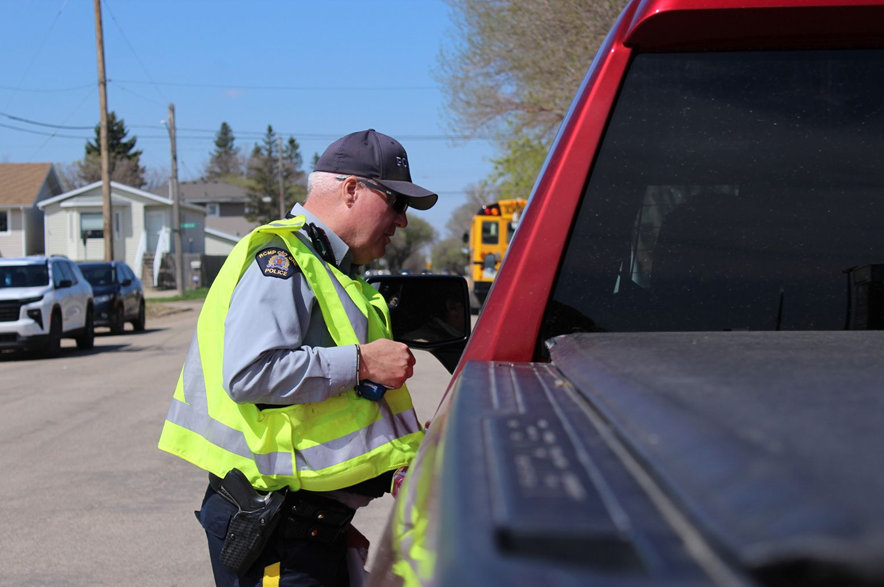
Police during a traffic enforcement blitz in Saskatoon in 2026. (Brittany Caffet/650 CKOM)
Give us your thoughts on the amount of traffic control you do as opposed to digging into some of these issues that are caused with maybe more social problems, drug-related problems, whatever it might be in downtown and other neighbourhoods.
MCBRIDE: So, the Saskatoon Police Service receives zero funding through revenue generated from traffic enforcement. So, that’s I think the first thing that is a misconception. The second thing is we’ve got two traffic units. Our Combined Traffic Services Saskatchewan, they are paid for by the province of Saskatchewan, and they have a very specific mandate to be predominantly outside the city limits. There are staff, we receive benefits in the city, but they’re predominantly outside the city. And then our own Saskatoon Police Service Traffic Unit, they work in the city. They have developed over time, as a direct response to what the public has asked and, in some cases, demanded. When we have polled the citizens of Saskatoon over many many years, one of the biggest things that keeps coming back is traffic safety. They want traffic safety. They want to reduce fatalities from traffic. They want to decrease impaired driving in Saskatoon, and so we’ve responded to that. But as a result of that response, another sector of the population is saying, “Why are you doing all this traffic enforcement? You know, you’re doing the wrong things.” And so we believe we’re doing the right things based on what the citizens of Saskatoon have told us they expect us to do. And is that out of balance? Well, maybe in 2026 on this day, maybe it is.
Read more: