

Sarah Mills: You never forget the memories of your first teacher
Teacher Appreciation Week has wrapped up in Saskatchewan, but Sarah Mills says the memories of the classroom, especially...
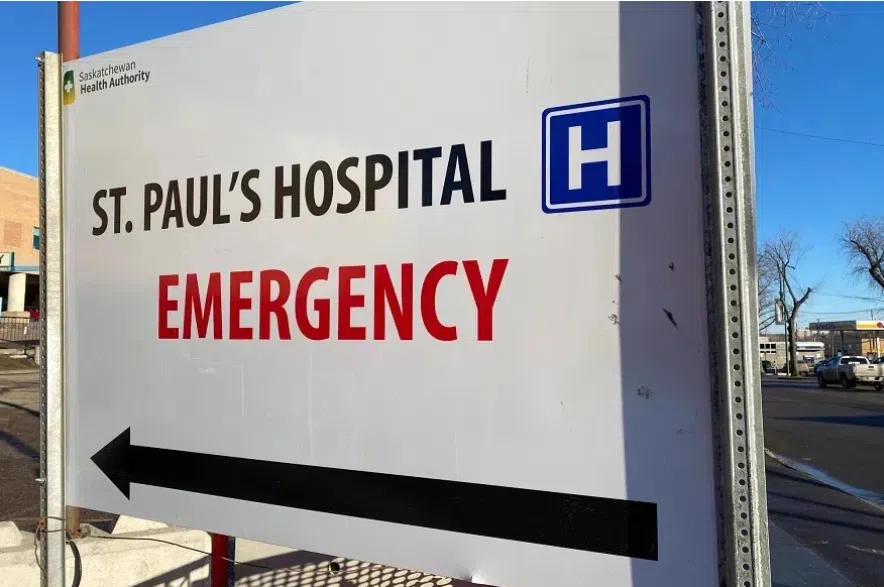
Health-care union representatives are calling for better security after a man allegedly brought a shotgun into Saskatoon’s St. Paul’s Hospital.
Last week, the Saskatchewan Union of Nurses (SUN) shared a letter on its Facebook page, detailing how the alleged incident happened on Nov. 27.
Read more:
In a video, Bryce Boynton, the union’s president, said the patient showed up to St. Paul’s “with a sawed-off shotgun and several rounds of ammunition, threatening nurses, staff and patients.”
While health-care workers were able to “isolate” the person “away from his gun, he continued to utter threats,” according to Boynton.
That included threatening to stab a health-care worker, slit their throat, and murder them and their children, Boynton alleged.
Later on, Boynton said the man was also found to have multiple knives on him, which were tucked away into his groin area.
This comes months after St. Paul’s was supposed to have a metal detector installed, which Boynton said ended up going to another facility instead.
The entire situation points to “the importance” of having them, he said.
But, it’s not just metal detectors that are needed.
Both Boynton and Lisa Zunti, the president of SEIU-West, said hospitals need more security guards.
Speaking from personal experience, Zunti, who spent most of her career at St. Paul’s Hospital, said during her years there weapons were brought in many times.
“Sometimes patients or family members can have these weapons, or weapon-type objects, in our regular nursing units for hours or days before we actually find them,” she said.
It’s meant that those working in the hospital always have to be on “guard,” according to Zunti.
“You can’t trust anything and you can’t take anything for granted,” she said.
Unsafe work environments are a problem for health-care workers across the province, not just St. Paul’s.
“This happens in rural hospitals as well. This happens in outlying health facilities as well. Anytime you’re in a place where tensions run high and emotions run high and you’re serving the general public, it’s going to happen,” Zunti said.
What’s needed is more security guards to protect those working in these facilities, she said.
If there’s no one, “to screen the people through the metal detectors, then all kinds of things are getting through anyway,” Zunti said about why detectors aren’t enough on their own.
In an ideal world, though, she said she wants to see the root causes of safety incidents getting addressed — like unstable housing, mental health, and addictions — because those are the reasons people bring a weapon into the hospital in the first place.
Her reminder to the provincial government is that health-care workers are continuously putting themselves at risk for the safety of their patients.
“I don’t know a single health-care worker that wouldn’t put themselves in between someone with a weapon and their patient, and I think that just speaks volumes for the people in the system,” Zunti said.
In an emailed response, the Saskatchewan Health Authority (SHA) wrote that it’s “committed to providing a safe and secure environment for patients and health-care teams.”
In order to reinforce safety, the SHA detailed how it provides client risk assessment training, where staff can “assess and communicate the risk and history of violence” for a patient.
The health authority also provides violence prevention training and created a Violence Prevention Advisory group to work on ways to enhance safety for care providers, with one of the members being SUN.
Currently, the SHA is piloting the use of AI to assist with the detection of weapons at Saskatoon’s Royal University Hospital.
That pilot will guide how it’s deployed, “across urban emergency departments” and support the work of security.
Read more: