

Murray Wood: Scott Moe as Mark Carney's western wingman?
Murray Wood says Scott Moe might not consider himself Mark Carney's wingman, but a recent editorial says the premier des...
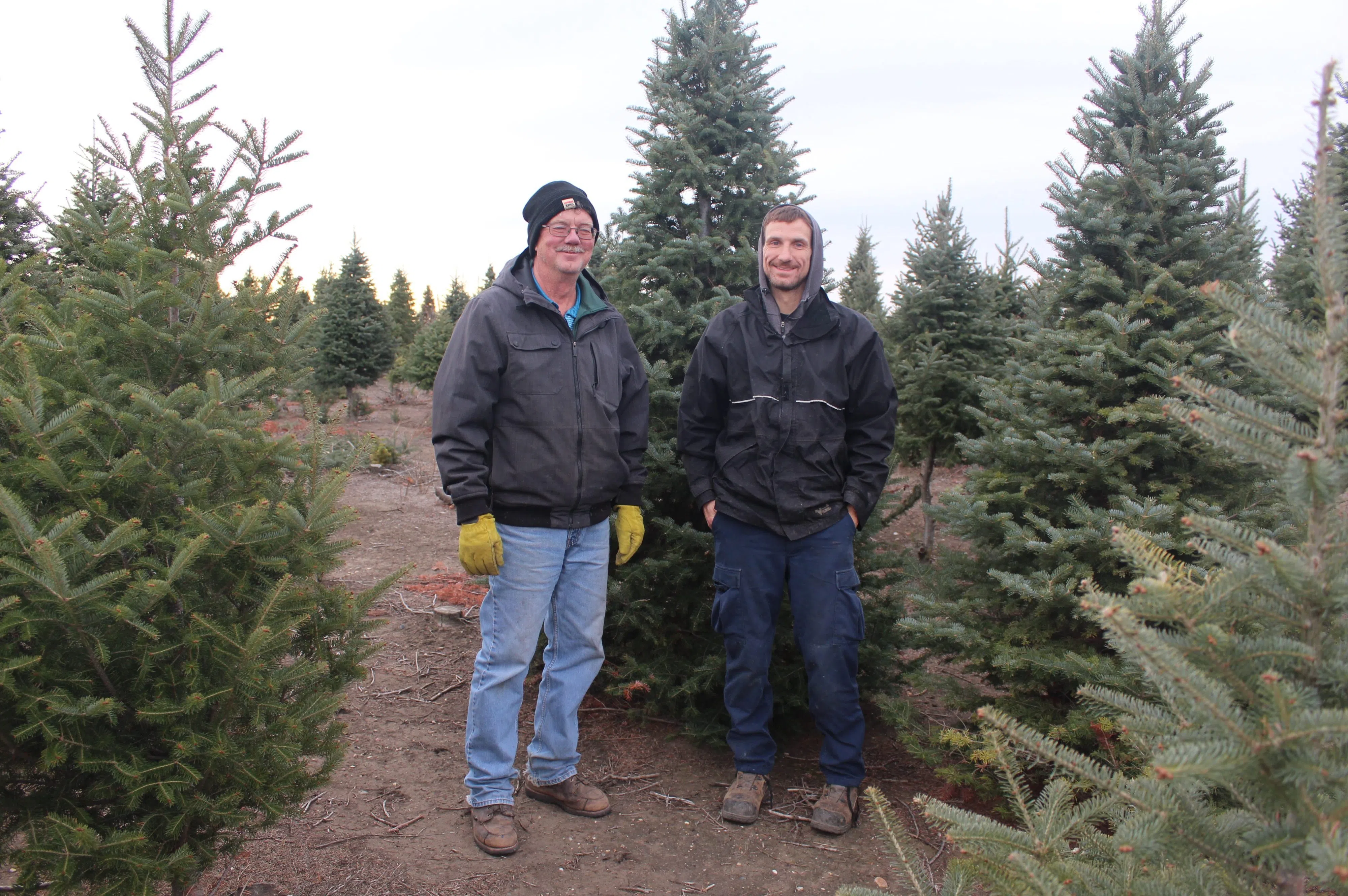
When Geordie McKay was a boy, Christmas looked different depending on which door he walked through.
At home, the season unfolded around a tidy, practical artificial tree. Green plastic needles, perfectly symmetrical and smelling faintly of cardboard after eleven months tucked away in a box.
Read more:
It was Christmas, yes… but not quite magic.
Then there was the other tree.
The one at his grandparents’ house.
“We used to go to my grandpa’s and grandma’s,” Geordie recalled in an interview with 650 CKOM, “and they always had a real tree.”
His grandparents’ Christmas tree looked like it was plucked right out of the forest and set in the living room. Chances are, it had been.
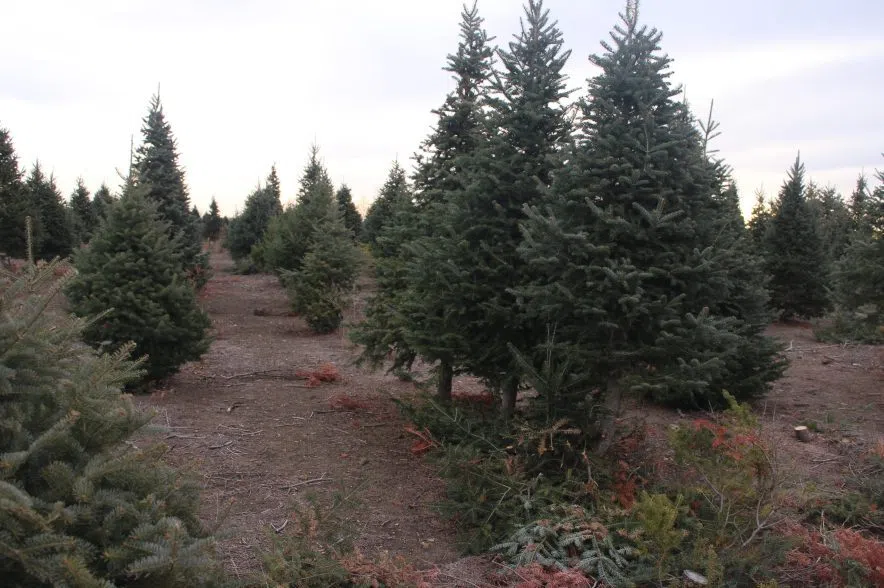
One of Geordie McKay’s favourite things about his tree farm is all of the wildlife who call these trees home. From birds to big game, it’s a haven for critters of all shapes and sizes. (Brittany Caffet/650 CKOM)
Needles fell softly onto the carpet. The branches were slightly uneven, each one bending naturally under its own weight. The whole house carried that unmistakable smell of a real tree.
It wasn’t polished. It wasn’t perfect. But it was alive.
And after experiencing the joy a real Christmas tree can bring year after year, an idea took root.
Literally.
“I realized there was no one growing Christmas trees in Saskatchewan,” he said. “So I started the first Christmas tree farm here 42 years ago.”
To many, it sounded like he was chasing a Christmas miracle.
“When I first started this business people thought I was crazy,” he said with a wry smile. “Not no more.”
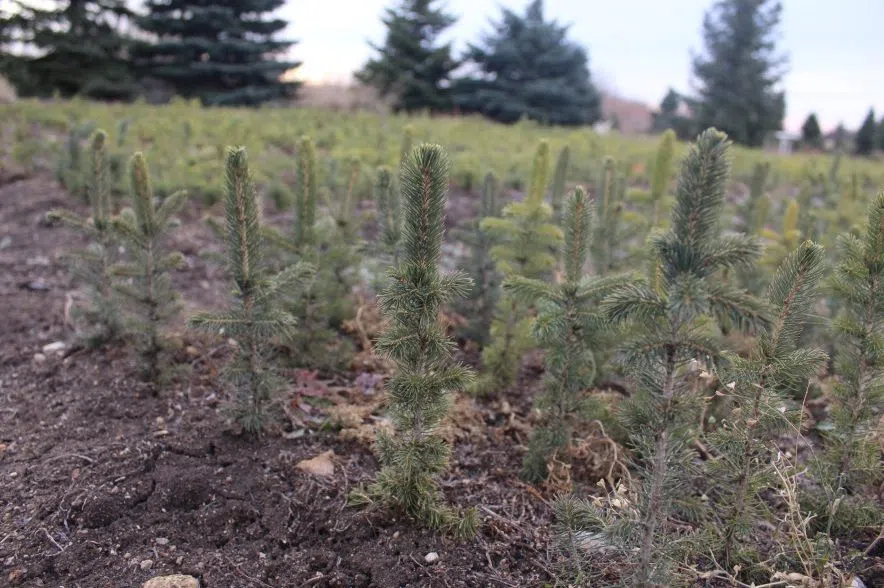
The seedlings are carefully tended to until they are hardy enough to be planted amongst the larger trees. Here, they are watered and fertilized. Once in the field, they are left in the hands of nature. (Brittany Caffet/650 CKOM)
Today, the McKay Tree Farm near the Battlefords is unlike any other farm in the area.
There are no fields of canola or neat rows of wheat. Instead, thousands of firs stretch as far as the eye can see, seedlings sheltering under taller trees, wildlife slipping quietly between the rows.
Where most farms roar with combines, here only the hum of chainsaws marks the rhythm of the land.
From late October into December, the farm turns into a rush of movement as Geordie and his son Rylee push through their busiest season.
“It’s go, go, go,” Rylee said. “If it rains or wet snows, it shuts us down. So it’s very busy — seven days a week — and we hire extra staff just to make sure everything’s done in time.”

Not your average Saskatchewan crop. The fields at McKay Tree Farm hold more than 50,000 trees. (Brittany Caffet/650 CKOM)
From their fields, the trees travel to Christmas tree lots across Saskatchewan. Mall parking lots, shopping centres, places where families wander with mittened hands and hopeful eyes.
Here, under strings of twinkling lights, the farm’s work transforms into something far bigger than agriculture. It becomes part of holiday traditions, a chance for families to create memories they’ll carry for years.
As Rylee said, “There aren’t too many grumpy customers buying a Christmas tree.”
The McKay trees begin their lives in seedling beds, irrigated, fertilized and carefully tended to.
“Once they get to be about a foot tall, they go right into the field,” Rylee explained.
From that point on, the trees grow mostly on their own. They rely on rain and natural weather patterns, with fertilizers applied only when needed.
“It takes at least eight years, sometimes 10 or more, for a tree to reach full size here,” Rylee said. “They grow slowly on the prairies, but they grow strong.”
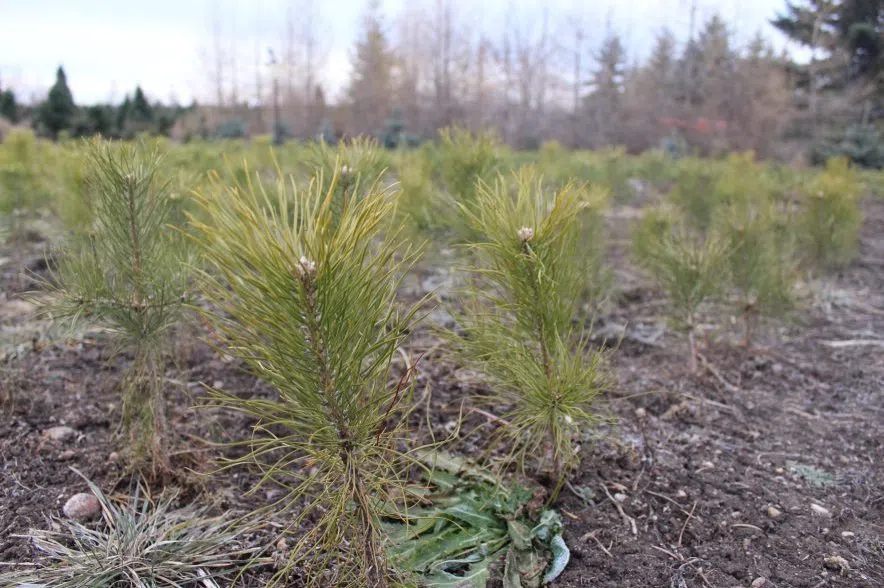
While about 90 per cent of their crop is made of fir trees, they do also offer some pine and spruce. (Brittany Caffet/650 CKOM)
Each year, the McKays harvest about 5,000 trees from roughly 50,000 on their property.
Geordie estimates that about 90 per cent of those trees are fir, with a few pine and spruce added to the mix.
And even in the offseason, the work continues: every tree is carefully trimmed with a chainsaw, one at a time, shaping the branches to create the perfect Christmas tree.
It’s a process of patience and careful management, shaped by both the land and the hands that tend it.
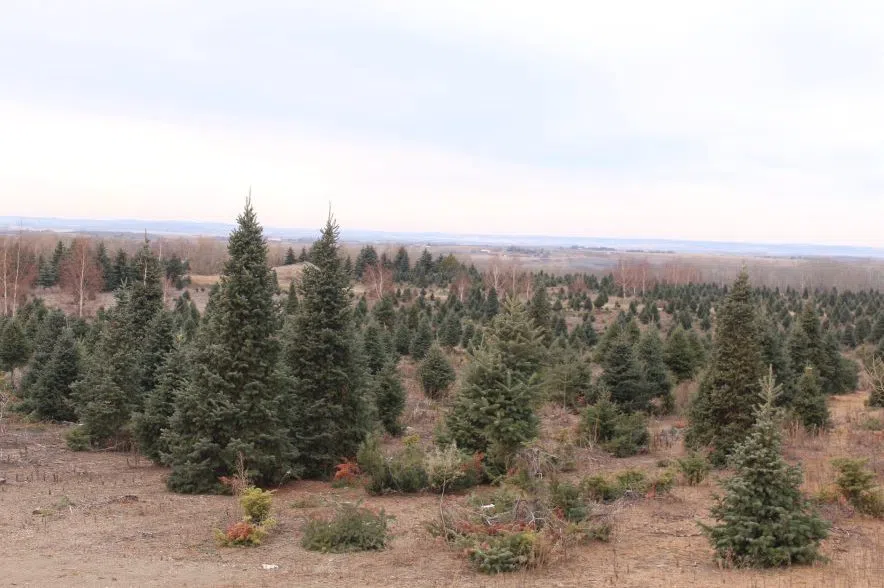
The trees here aren’t planted in neat rows. The McKays infill with seedlings each year, mimicking a natural forest.(Brittany Caffet/650 CKOM)
But nature, of course, doesn’t always co-operate. Harsh winters can kill seedlings. Winds can uproot trees.
And deer, hungry in the long, cold Saskatchewan winter, pose a threat that can devastate years of work.
“One year close to $50,000 worth of pine were eaten by the deer,” Rylee recalled. “My dad was pretty upset, but there’s nothing you can do. They’re just trying to survive.”
Still, the McKays replant, trim, nurture and hope, shaping each tree as carefully as they do their family’s holiday memories.
Rylee, who has spent his life amongst the branches of his father’s crop, knows exactly what people look for in a good Christmas tree.
“Symmetry,” he said. “A nice straight trunk, a nice top. Longevity wise, you can expect five to six weeks if it’s cared for. Just put a fresh cut on the bottom and give it clean water.”
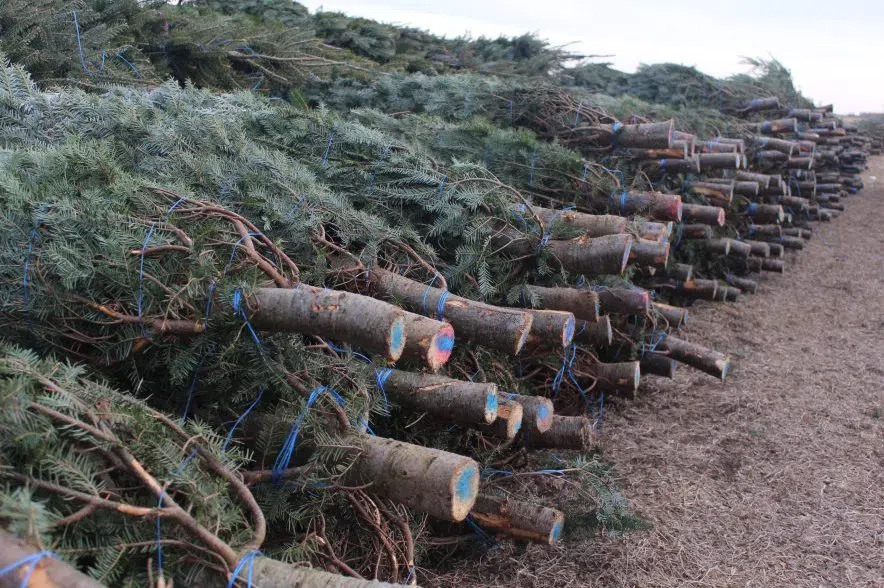
Approximately 5,000 trees from McKay tree farm will be harvested and sent to Christmas tree lots around the province this year. (Brittany Caffet/650 CKOM)
After more than four decades, Geordie’s childhood memory still stands at the heart of this family business.
He grew a forest so other families could feel the same thing he felt in his grandparents’ living room: pure Christmas magic.
And that feeling lives on in the next generation.
Ask Rylee what kind of tree he’ll have in his own house this year, and he doesn’t hesitate.
“Would I ever put an artificial tree in my house?” he said, shaking his head with a smile. “Absolutely not. It just doesn’t compare.”
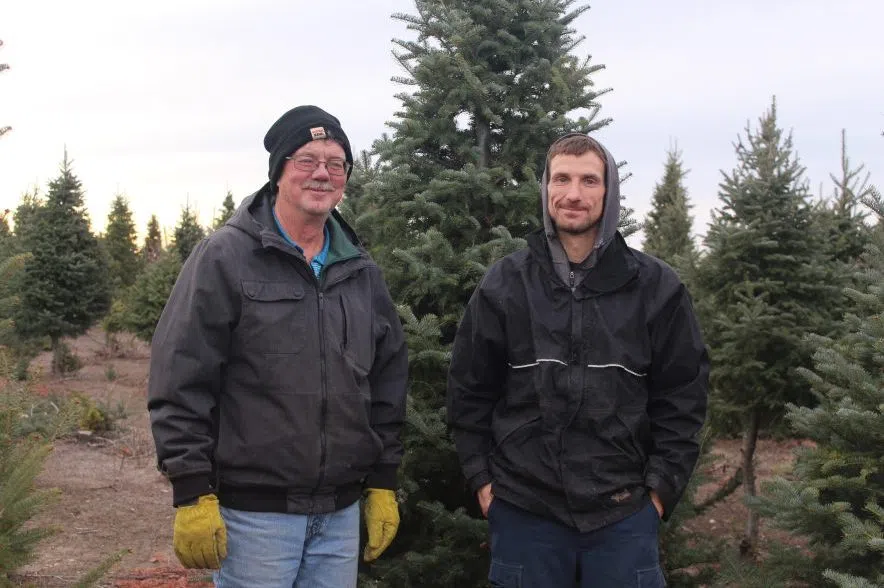
Geordie and Rylee McKay both say they will never have an artificial Christmas tree in their homes. (Brittany Caffet/650 CKOM)