

Sarah Mills: LEGO prices are becoming ridiculous
Gone are the days of a basic LEGO set. Sarah Mills says sets for adults are so intricate and large they run up to $1,000...
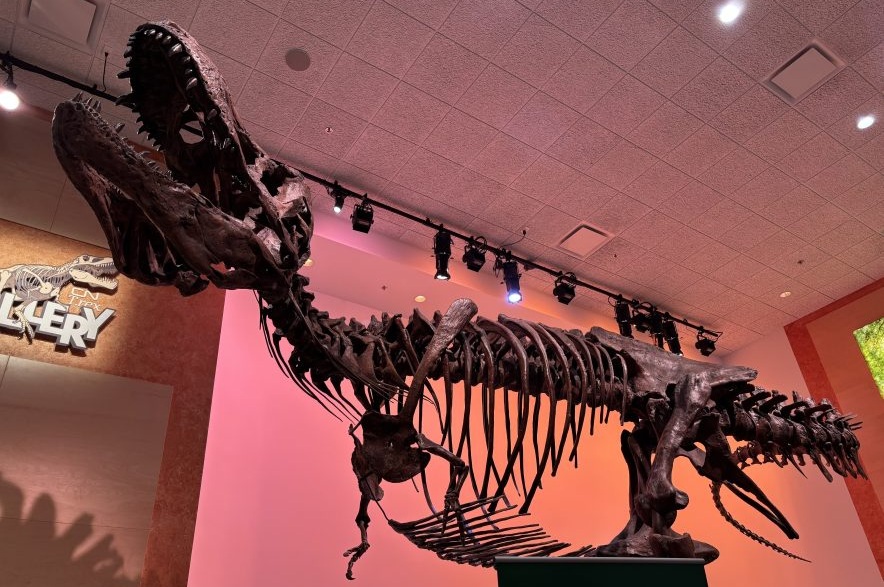
Forget ghosts and goblins, it’s time to make way for dinosaurs.
Dinovember has stomped its way back to Regina’s Royal Saskatchewan Museum, bringing a month of prehistoric discoveries, scavenger hunts and dinosaur-themed fun for the whole family.
Read more:
The annual celebration kicked off Monday with a look at activities planned throughout November, along with a special fossil the museum staff stumbled upon while searching for an entirely different dinosaur.
A piece of a young Triceratops skull, discovered in Grasslands National Park’s East Block in June 2025, is getting its moment in the spotlight as part of a temporary display.
Wes Long, paleontology collections manager at the Royal Saskatchewan Museum, said the discovery came as a surprise.
“What we’ve been digging up in that dig site is an Edmontosaurus, or a large duck-billed dinosaur, and then all of a sudden this big bone turns up in there, and it’s part of a young Triceratops,” Long said.
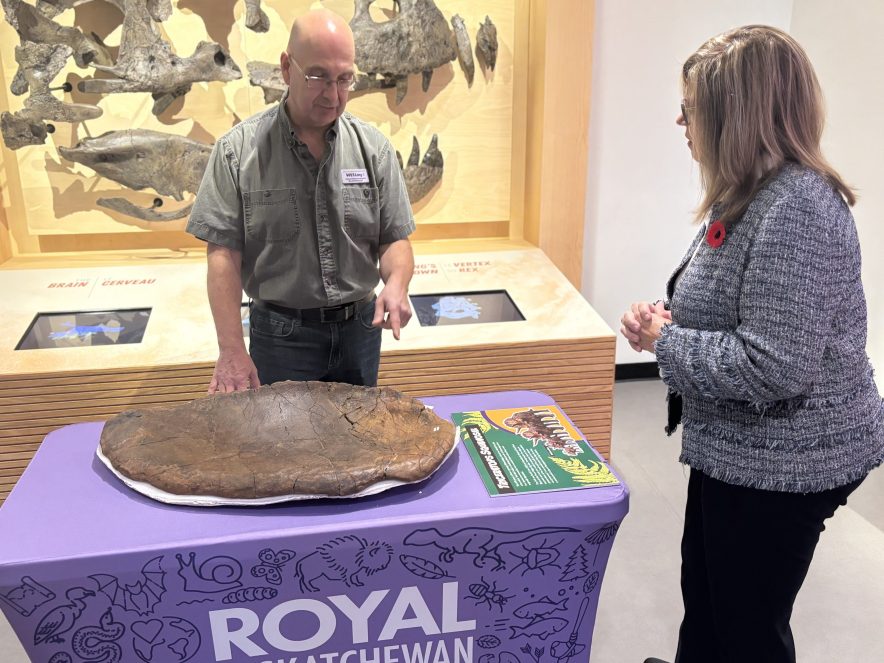
Royal Saskatchewan Museum paleontology collections manager Wes Long shows Parks, Culture and Sport Minister Alana Ross a fossilized piece of a young Triceratops skull during the launch of Dinovember in Regina on Nov. 2, 2026. (Jacob Bamhour/980 CJME)
The fossil is part of the large frill at the back of the dinosaur’s skull. Long estimates the animal was about two-thirds grown.
He said the team hopes more of the Triceratops is waiting to be uncovered.
“We’re really hoping that there’s more of the animal in there because the bone is beautifully preserved, and it’s a really nice dig site to work in because it’s nice soft sand,” he said.
“So preparation of the fossil goes quite rapidly. It only took 10 days to prepare that entire fossil.”
The site has already produced several exciting finds, including parts of an Edmontosaurus skeleton and a turtle fossil discovered just centimetres above the dinosaur bones.
Long said getting those discoveries ready for the public takes plenty of work.
“We usually go out there in June and we’ll prep the site for a week, and so that involves doing hill removal. All by hand, picks and shovels, and a lot of sweat,” he said.
The team then prepares the site for August, when members of the public can participate in the Fossil Fever event at Grasslands National Park.
For Long, seeing the fossils eventually make their way into museum galleries is one of the most rewarding parts of the job.
“It’s just exciting to see children’s excitement at seeing the fossils and getting them interested in fossils, and that’s so rewarding to see that happen,” he said.
“And it’s great to see things go on display so the public can see the work that we’ve been doing behind the scenes.”
But visitors won’t need to pick up a shovel to make discoveries of their own.
The museum is offering several activities during its Dinovember Wild Weekends, including a scavenger hunt that challenges visitors to figure out which prehistoric creatures were actually dinosaurs.
Rebecca Hay, the museum’s earth science program specialist, said the goal is to challenge some common misconceptions.
“Lots of times people think that if they see a large skeleton that’s from a long time ago, it’s for sure a dinosaur,” Hay said.
“But in fact, there’s lots of other animals that have lived in our province and around the world that are not dinosaurs.”
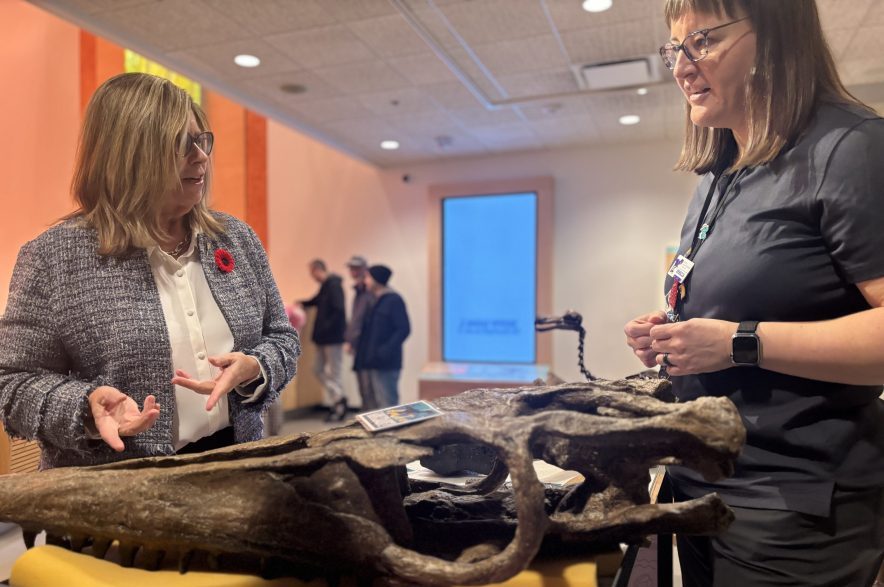
Parks, Culture and Sport Minister Alana Ross explores prehistoric specimens with a Royal Saskatchewan Museum’s Rebecca Hay during the launch of Dinovember in Regina on Nov. 2, 2026. (Jacob Bamhour/980 CJME)
One example is the mosasaur, a prehistoric marine reptile that lived alongside dinosaurs but wasn’t one itself.
“Lots of people think that the marine reptile, a mosasaur, is a dinosaur, and it has ‘saur’ in the name, but it is in fact not a dinosaur,” Hay said.
Visitors can test their knowledge at the museum’s discovery cart, where they’ll examine fossils, make their guesses and flip over cards to find out whether they were right.
“And it’s okay if you’re not, because the goal is to learn a little bit more,” Hay said.
Other activities include a dinosaur-themed scavenger hunt, where participants can earn a prize sticker, and a weekly challenge encouraging younger visitors to track down a featured dinosaur display.
The Wild Weekends activities run Nov. 7-8, 14-15, 21-22 and 28-29.
And if you think dinosaurs are just for kids, think again.
The museum is also introducing Jurassic Park: Audience Adventure, an interactive screening of the original 1993 movie on Nov. 20.
Sarah Schaefer, the museum’s visitor experience supervisor, compared the event to The Rocky Horror Picture Show, with audience participation, themed props, call-and-response moments, and a few surprises.
“We know that dinosaur lovers grow up, but they never really lose their passion, so this is kind of a night for our adult dinosaur lovers,” Schaefer said.
Before the movie, guests can explore the galleries after hours, meet a palaeontologist, examine fossils and amber, and make their own insect-in-amber keepsake.
Tickets for the evening cost $25.
Meanwhile, Parks, Culture and Sport Minister Alana Ross said Dinovember offers an opportunity to explore a side of Saskatchewan that many people may not know much about.
“I hope that they learn and ask a lot of questions and get a better understanding of dinosaurs and just what it was like here,” Ross said.
She said studying the province’s prehistoric past can also help people better understand Saskatchewan’s changing landscapes and natural resources.
The temporary Triceratops display will remain at the museum throughout Dinovember before the fossil returns to the museum’s collections.