

Sarah Mills: Alberta's referendum is Canada's wake-up call
Sarah Mills says Canada needs better collaboration between Ottawa and the provinces. She says what's good for Quebec sho...
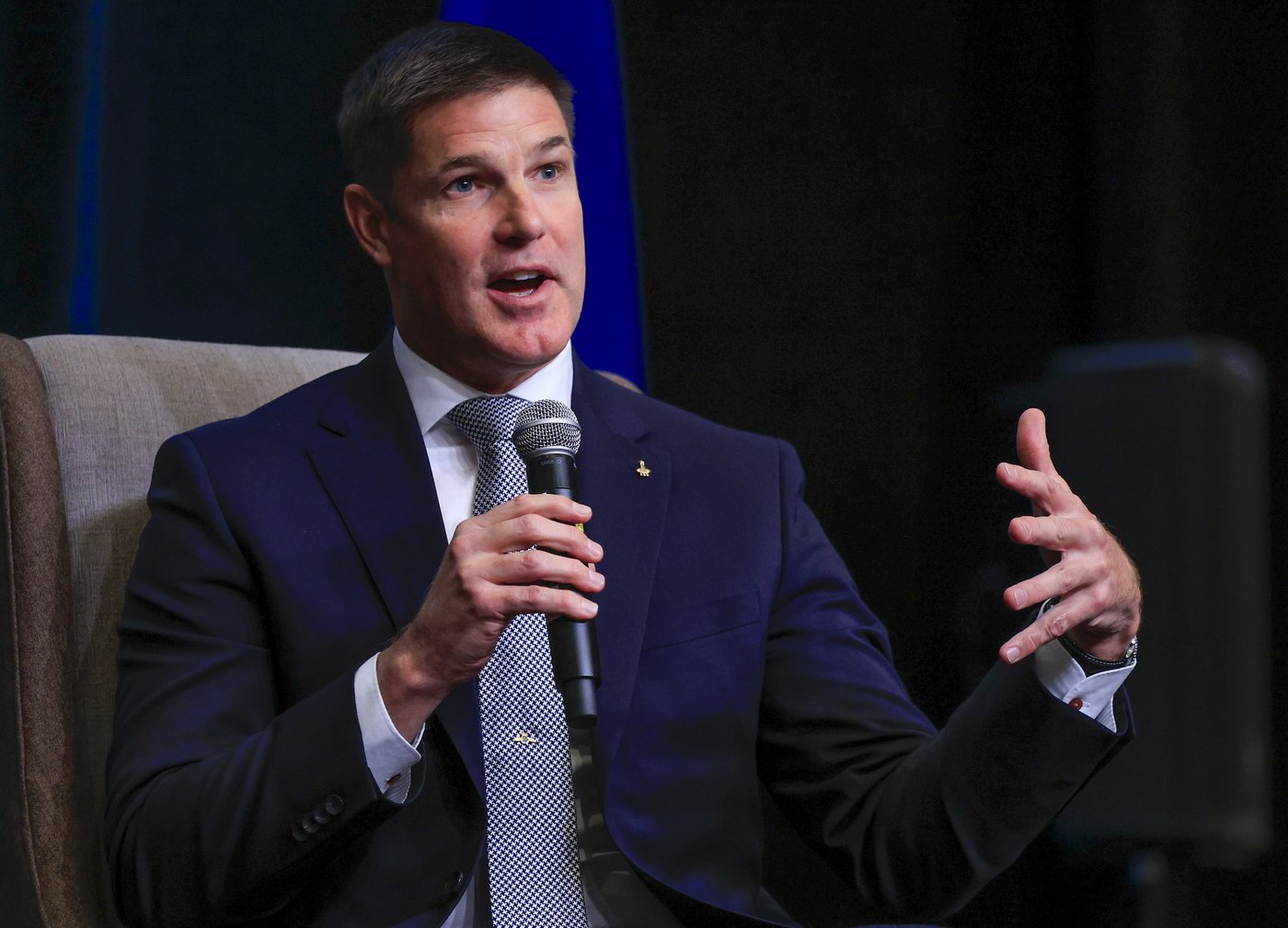
OTTAWA — Prime Minister Mark Carney has appointed Jeremy Hansen as a special adviser on space — just as the United States takes note of Canada’s efforts to shift its space partnerships toward Europe.
“I’m just super excited to serve Canada in that role,” Hansen said in a video he posted Tuesday on social media.
“There’s so much opportunity to leverage this position that we’re already in, to do more to provide for our sovereignty, our security, our quality of life on the planet, and at the same time make significant contributions on the global stage.”
The role involves advising Carney and Industry Minister Mélanie Joly, Hansen said.
In April, as part of the Artemis II mission, Hansen and three other astronauts travelled around the moon and further out into space than any humans before them.
Joly said Hansen proposed helping the government “develop a new space strategy” when he left the Canadian Space Agency.
“We had a conversation of how he could continue to have an impact, to contribute, to serve,” she said at an event Tuesday.
Joly said she’s getting feedback from other Canadian astronauts and people in the aerospace sector on the strategy “in order to accelerate innovation and reinforce our international partnerships.”
The offices of Carney and Joly did not respond when asked for details of Hansen’s role, such as its end date and compensation.
On Wednesday, Defence Minister David McGuinty announced a $20 million agreement on the use of a space launch complex in southern Newfoundland, which builds on a March agreement involving a complex in Nova Scotia.
“Reliable and independent launch access will enable Canada to place critical satellites into orbit even during global uncertainty, geopolitical tensions, or disruptions in foreign launch markets,” McGuinty’s department wrote in a news release.
“With military, emergency response, and government services increasingly dependent on space-based systems, sovereign launch (capacity) protects national interests and enables continuity of operations.”
Hansen’s appointment comes as Canada looks to expand co-operation with European countries in space — and as Washington warns it could seek partners other than Canada for its space missions.
Joly spoke Tuesday at the SpaceBound 2026 Conference. U.S. Ambassador Pete Hoekstra told that same conference that Canada has decided to “move away” from the American firm SpaceX.
“Canada has said that, ‘We’re going to take a look at the European Space Agency, we’re going do more with them,'” he said.
Hoekstra said it was helpful to know that Canada is not interested in partnering with the firm founded by billionaire Elon Musk, who has close ties to U.S. President Donald Trump.
“It’s kind of like, wow, Canada is really saying for all the investment, all the innovation, all the excellence that is being driven by Elon, we don’t want to be a part of it? OK. That’s fine,” he said.
Hoekstra said the United States will always have a “bias” toward the private sector.
“Competition breeds excellence,” he said.
“What we fight in the United States all the time is to make sure that we never come in and over-regulate it. We’ve had to fight that, in the digital world … We’ll probably have to fight this in the space realm.”
Hoekstra added that the F-35 jet is “the best fighter in the world.” He did not directly mention Ottawa’s decision to pause a planned purchase of F-35s after Trump launched his trade war and repeatedly threatened Canada’s sovereignty.
“We also recognize that Canada’s going through a re-evaluation of how they want to move forward on defence,” he said.
Hoekstra said Washington is waiting to see whether Canada wants to continue decades of airspace co-operation through Norad. He said Trump’s recent security deal with Greenland — which also followed his repeated threats to annex the island — is meant to shore up U.S. security in the North.
“We’re waiting to see exactly where Canada wants to go on this,” he said. “We’d love to do it with Canada. It would be very, very helpful. But at the same time, and I’ve said this for the past year and a half, we are not standing still.”
This report by The Canadian Press was first published Oct. 21, 2026.
Dylan Robertson, The Canadian Press