
Sarah Mills: Public entities need to be more transparent
Sarah Mills says a single coroner choosing not to release the toxicology report in the case of Saskatchewan Roughrider J...
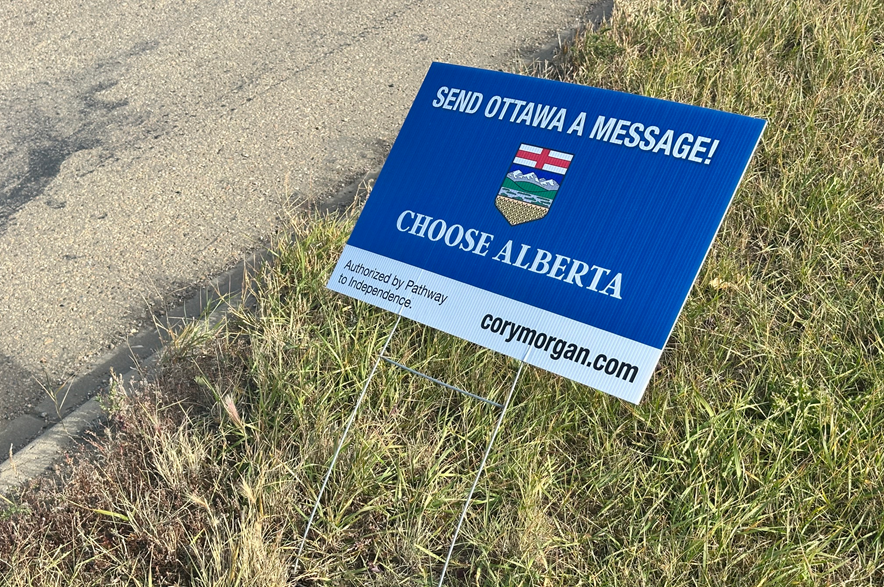
Voters in Alberta must cast their ballots tonight to have their say on whether they want the province to remain a part of Canada.
If they vote yes to separation, a second binding referendum will be held on leaving Canada.
Albertans will be presented with ten different questions about separation, immigration and constitutional changes.
Dwight Newman, a constitutional law professor at the University of Saskatchewan’s College of Law, joined The Evan Bray Show to speak about some of the questions on the ballot on Monday.
Read more:
This interview has been edited for length and clarity.
EVAN BRAY: If majority vote is to begin the legal process to hold a binding referendum on separation, what needs to happen?
DWIGHT NEWMAN: That would lead towards holding a referendum question on whether to separate. Alberta Premier Danielle Smith has spoken of her intent to organize that quickly.
Part of what led to having to have this referendum about a referendum was a court decision from the trial court level saying that there would need to be consultation with Indigenous peoples in Alberta before they held the vote, and that is under appeal.
I don’t know whether Alberta would try to get to an appeal result on that first, or would try to engage in that consultation first. But that would be one element that is part of what they’re calling the legal process.
They’d also be trying to develop questions or a question that fit with the requirements of the federal Clarity Act. If they’re really looking to hold a secession vote, they want to have it recognized by Ottawa.
BRAY: If the majority vote that they want to explore separation, that wouldn’t be able to happen right away because of the courts on the Indigenous consultation piece?
NEWMAN: It’s very possible. It might take some period of time. Some of those voting for Option two have suggested they’re voting for it not to hold an immediate secession vote but to try to put pressure on Ottawa around other issues in the meantime. It’s a little bit indeterminate just how long it would take.
BRAY: Can a provincial majority vote its way out of Canada?
NEWMAN: The Supreme Court of Canada ruled on this in a reference case in the context of Quebec back in the late ’90s, and said that a clear decision by a province in support of secession would lead to an obligation by the other partners in Confederation to negotiate in good faith with that province about that issue.
There would be many issues to be sorted out. So it doesn’t lead to an immediate secession under Canadian constitutional law, but it does start a process towards it that has been authorized by the Supreme Court of Canada.
Apart from that, if that broke down or the others didn’t negotiate in good faith, a province could try to take that to the international arena and just do a unilateral secession. But that’s very messy at that point, and it does depend on recognition by other states, and given that the provinces are interwoven right now, there would be a very messy situation arising from that.
The basic point is a province can vote to secede, and there are further things that take place after that.
BRAY: Is a de facto separation possible, where Alberta just starts saying no to certain issues?
NEWMAN: If it was just saying no to certain issues we could call it a de facto separation in some ways but they are in a difficult position to do that given the legal structure in Canada.
They might be able to temporarily, but they can’t just stop paying income taxes to the federal government because it will take legal steps to come and collect those from people, and there are legal mechanisms in place where it’s difficult to just de facto secede in a full way unless they were going to the international arena.
BRAY: From a constitutional standpoint, what is the relevance of these other nine questions on the ballot?
NEWMAN: The first five questions are really about how Alberta engages with immigration, and those are largely within Alberta’s jurisdiction to make decisions about already, subject to federal laws.
But the province can just act to some degree on those decisions about payment of certain benefits in the context of immigration.
Questions six through nine are calling for mandates to negotiate different kinds of constitutional changes about the appointment of judges, about the abolition of the Senate, about opting out of federal programs in areas of provincial jurisdiction, and about trying to give priority to provincial powers over federal powers in some more context and, in each case, those will require working with other provinces or using amending formulas that involve further work.
These questions would give a mandate to the Alberta government directly from the people to be working on those issues.
BRAY: Is there a need for modernization of the constitution, and could this be the bump that Ottawa needs to make that happen?
NEWMAN: There is always value in adjusting the constitution gradually over time to be responsive to fundamental changes in the country.
There have obviously been attempts at large-scale constitutional reform before that didn’t work out and it’s difficult because unless you have a big constitutional package, it doesn’t address some of the issues of Quebec, which had never agreed to the 1982 Constitution. Unless you have a big constitutional package, it doesn’t get agreement from Indigenous peoples.
BRAY: What are you most interested in watching as this plays out?
NEWMAN: I’m interested in seeing where the percentages are on each question.
I’m not sure the first nine are going to be differentiated too carefully between them. So where are the percentages on those first nine, and where is the percentage on Question 10?
I think that regardless of the outcome, the percentages matter. If the first nine get yes, how strong is that yes? And if Question 10 doesn’t see option two win, it’s very significant. Is it 40 per cent or is it 15 per cent in terms of the sense of what Albertans are feeling and what that implies for what the next steps.
Charles Smith, a professor of political studies at the University of Saskatchewan, believes any further Alberta separation votes will be squashed tonight.
He joined the Greg Morgan Morning Show on Monday to speak ahead of the vote.
This interview has been edited for length and clarity.
GREG MORGAN: Do you think messages from federal leaders were effective in swaying the vote?
CHARLES SMITH: I think the polls have been pretty static throughout this whole campaign.
I think Albertans, for the most part, are not supportive of a decision to hold a referendum in the future that would be binding.
The polls have been pretty consistently high within Alberta; about 60 to 70 per cent of Albertans don’t want to separate from Canada.
Behind the scenes, I think you’re seeing some really determined people inside of Alberta who are trying to push the province out, and that leads to a whole bunch of questions about what their motivations are and ultimately their relationship with other countries like the United States.
MORGAN: Whathappens after the referendum?
SMITH: They’re going to keep organizing. They’re going to keep fighting for their position. But I mean, we saw similar things with sovereignty pushes in Quebec.
The party structure and how parties work in Alberta, especially with the UCP party, is one of the reasons we’re in this spin. That party allows for 22 riding association presidents out of the majority of ridings to hold a leadership review, and it was why they were able to force out Kenney and bring in Smith.
MORGAN: What is on the line for Alberta Premier Danielle Smith today?
SMITH: She’s walked a fine line throughout this campaign. She’s in trouble with regard to her leadership within her party.
I think she’s alienated some of the separatists. I think she’s alienated some of the federalists, and I think regardless of what happens there’s going to be some infighting.
MORGAN: What do people need to know about all the extra questions included in the referendum?
SMITH: Smith was very critical of separation, but she encouraged Albertans to vote yes on the other questions.
The first four questions are on immigration. Smith has been very open about criticizing immigration for everything from the cost of living to the cost of housing. I would argue the evidence isn’t really there to support that claim.
There’s a question on voting ID laws with regard to proof of citizenship while voting. This, to me, seems like a solution in search of a problem. There’s almost no evidence of voting fraud in Alberta or anywhere in Canada.
On the constitutional questions, the province wants more control over judicial appointments and wants more control over the Senate. And even if voters support it, you know, there’s not much the province can do unilaterally.