
Murray Wood: When words fail, stuffed animals can say a lot
Murray Wood says people in Foam Lake and communities across Saskatchewan are putting stuffed animals outside to remember...
Regina city councillors may be looking for ways to speed up the replacement of lead service connections during budget deliberations.
Executive Committee agreed Wednesday to forward to council a report recommending hydro-vac investigations to confirm the number of lead connections still in use, with a target date of 2036 for total replacement.
That 10-year timeline isn’t fast enough for Patricia Elliott of the Get the Lead Out Community Action Group.
Read more:
“We’ve been asking to get the lead out within five years, for five years now,” Elliott told the meeting. “Contaminated water should not be tolerated for any length of time by decision-makers.”
Ward 3 Coun. David Froh agrees. His ward includes the Cathedral neighbourhood, which is known to have 659 city-owned lead connections, approximately 15 per cent of the total.
“I think what we have to look at to get to seven (years) or even quicker is, how do we look at our capital plan and reprioritize?” Froh told reporters. “There’s a limit to what residents can pay with utility bills and taxes, but the onus is on us as council to look at how we weigh this versus other priorities. I see it as the highest priority when we’re talking about human health.”
In its report recommending the 2036 target, administration said an accelerated five-year replacement schedule might not be achievable, even if additional funding were approved.
“Challenges include limited contractor availability, delays in obtaining equipment, more complex construction coordination and greater impacts on roads and traffic,” the report says. “It would also require up to five additional staff positions.”
One concern is that renters may not always know their home has a lead service connection.
Council and administration also hope a $5,000 cap on the cost of replacing lead connections on the property owner’s side will provide the needed incentive.
Committee members were told replacing a city-side connection without replacing the private-side connection at the same time increases the health risk because any lead remaining in the line can be stirred up.
Froh said council and administration will work together to find ways to prioritize lead replacements as part of the five-year capital plan.
“I think it’s a very fair criticism and expectation that the city move faster, and I’m confident that council sort of shares that urgency,” he said.
During the semi-annual report from Buffalo Pound Water Treatment Corp., councillors heard the treatment plant is on track to begin adding orthophosphate to the water by the end of 2027.
When added to water, the product gradually coats the insides of pipes and reduces corrosion.
But Elliott pointed to Health Canada guidance that says it does not completely eliminate the risk posed by lead pipe corrosion.
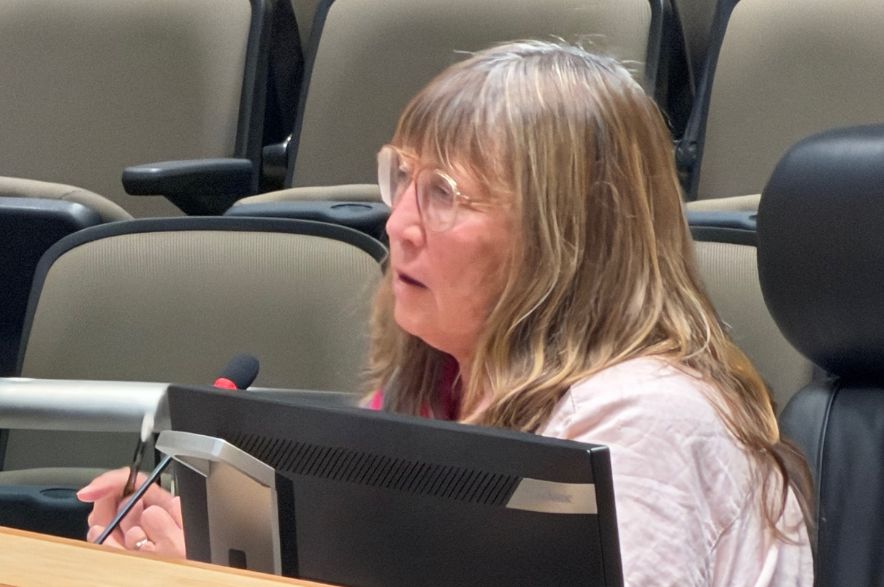
Patricia Elliott of the Get the Lead Out Community Action Group told committee members 10 years is too long to finish removing lead service connections. (Geoff Smith/980 CJME)
Froh believes it will help but adds it’s only part of the picture.
“We have a lot of folks that don’t even know they have lead service pipes,” he said. “Including a lot of renters. So we’ve got to connect with those renters and their landlords. We have to change how we communicate. We have a lot of newer members of our community. We have a lot of vulnerable people who may have lead service connections.
“I think it’s every tool in the toolbox, but no tool alone will do the job.”
Ryan Johnson, president and CEO of Buffalo Pound Water Treatment Corp., also updated councillors on another initiative that has been in the works: fluoridation of drinking water is expected to be in place by the end of 2027.
While Mayor Chad Bachynski was absent from the executive committee meeting, he held a virtual news conference from Ottawa. He is part of a Saskatchewan delegation working to convince the federal government of the need for a more flexible infrastructure cost-sharing program.
“One of the messages that I’ve spoken about during the trip, to a number of the folks that we’ve met with, is that the flexibility piece is really around acknowledging that municipalities are best positioned to identify the infrastructure investments that are required,” he said. “Infrastructure investments can mean everything from an aquatic centre to underground water pipes and infrastructure in Regina.”
He said he heard an openness from federal ministers, senators and others to listen and learn.
“We’re also asking not only for the flexibility for municipalities to invest where they need to, but also the volume of funding required to make sure that we can keep up with growth,” he said.
“Because even now, we’ve seen in Regina over the last year that we are actually growing even faster than we anticipated one year ago when we approved our growth plan.”
But given the utility budget forecast presented to council Tuesday, which anticipates a rate increase of 10 per cent, Bachynski isn’t holding his breath that Ottawa will respond in time.
“I think we have to be realistic and be prepared that, regardless, those infrastructure investments are required, and we have to navigate that and do our best to prioritize and mitigate the risks as we go forward.”
He said there’s a lesson he learned after a council decision to cut parks maintenance resulted in public outcry during the summer.
“My understanding was that we would see a minimal service-level change from that reduction,” Bachynski said. “It was trying something different, trying something new in the way we address our park spaces, as an example.
“And we’ve heard feedback. We’ve heard feedback from residents that we didn’t hit the mark. I think it’s not a bad thing to make some tough decisions with good intentions of trying to find a balance between service levels and affordability.”
While administration has been trying to present options that would keep the property tax increase below 5.81 per cent, Bachynski sees that figure as a starting point.
“This is my personal view on it: I think if there are small tweaks, both up and down, from that initial forecast, that would be a consideration that I would make as a result of feedback from residents,” he said.
“But overall, I don’t see, from my perspective, any massive swings that I’m looking to implement.”