

Murray Wood: Why this Roughrider season has not been like a roller coaster
Murray Wood says the Saskatchewan Roughriders' fans like him remain defiantly optimistic no matter what, even if they so...
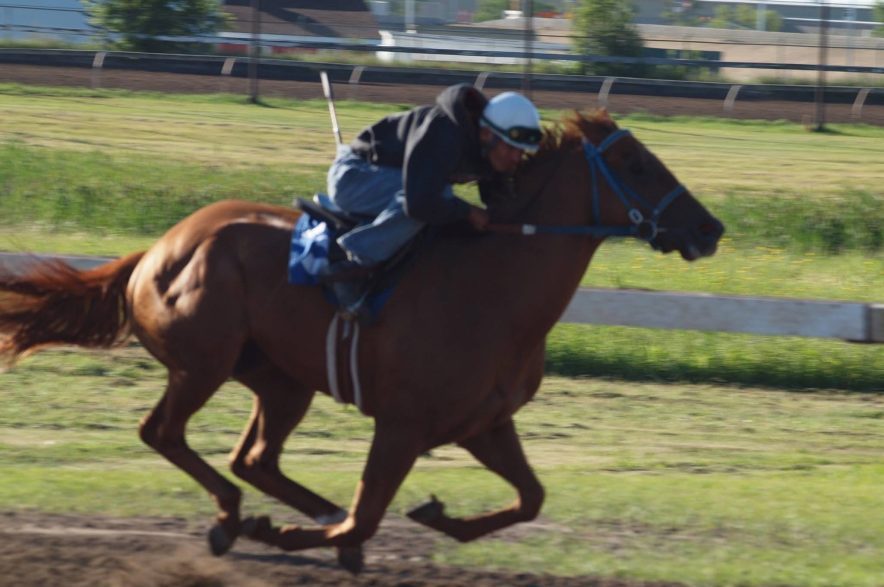
As the demolition of the Marquis Downs progresses, an accomplished Saskatchewan jockey is looking over his shoulder at the memories he has from days spent racing and training at the track.
Tim Moccasin, a professional jockey from the Saulteaux First Nation, said to him, Marquis Downs was home.
“I grew up at that track. I learned to be a man at that track,” Moccasin reminisced.
Read more:
The jockey credited his time at that horse-racing track as helping shape his character and work ethic.
“I had to apply myself in order to get the amounts to be that successful,” Moccasin said.
He remembered spending seven days a week at the Downs, “with no days off through the summer.” He was up by 6 a.m. every day to get out there and getting on his horse, working on mounts that he might use in his weekend races.
He said the wins at that track were the little extra benefits, but his biggest blessing was the people at the track he worked with every day.
“They’re like family,” Moccasin said. “There was trainers there that, you know, basically kind of guided you along the way … you know, telling me don’t do this, don’t do that.”
He remembers before his races, spending hours in the sauna trying to drop a few pounds because he was considered a tall rider.
“If you’re really determined and, you know, just for the love of doing what you do, you make it happen. You do whatever you can to make it happen,” Moccasin said.
The jockey first started riding horses at 12 and won the first bush race he entered. He was just 16 when he began racing professionally. A sign commemorating his career is up at his community’s racetrack.
A member of the North American Indigenous Athletics Hall of Fame, Moccasin still holds the North American record for the most consecutive wins at 14.
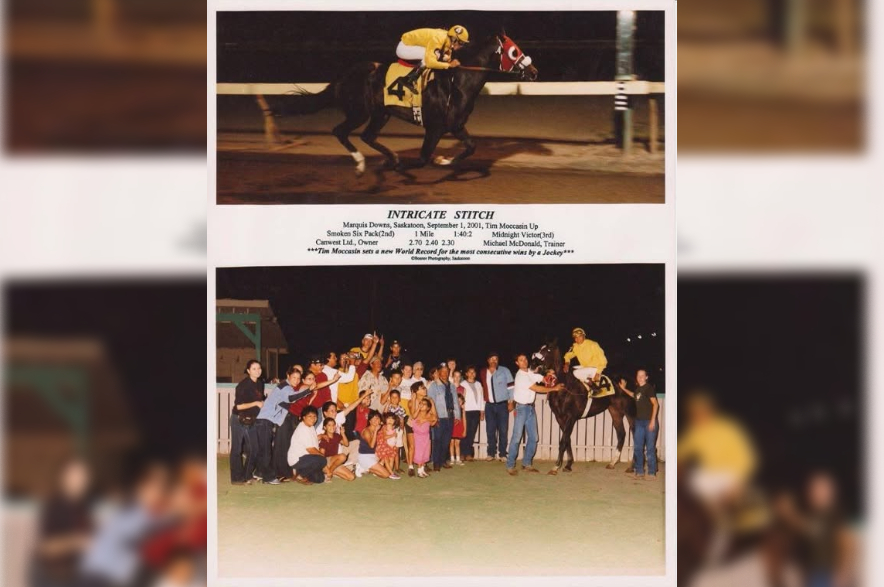
Moccasin credited his time at Marquis Downs as helping shape his character and work ethic.(Tim Moccasin/Submitted)
If you show Moccasin a photo of any of his races, he said he can remember the ride, his position and how he finished, watching the race from that day play out in his mind.
“That last race of my 14th win,” Moccasin recalled, is still one of his most precious memories.
“The grandstand was full, like it was packed. My family was there, you know. My cousin, Bob Cameron, was filming each race.”
He went into that weekend race day with 10 wins, and ended it with 14. He said still can hear the announcer at Marquis Downs as he “whipped that crowd into a frenzy.”
“‘Tim Moccasin, you are the man,’” he recalled the announcer crying out that day.
He said the demolition of the Downs “is what it is.”
“It’s sad,” he said. “So many jobs lost.”
Moccasin remains in contact with many of the people he worked with over the years at the track, saying they’ll always be family to him.
The demolition of the former horseracing track began in May and is expected to be completed by the end of November. At that point, the area will be levelled to be used, as needed, for ancillary parking.
Demolition continuing at #Marquis Downs in #Saskatoon today. Not much beyond the grandstand shell remains and machinery continued to dissect the structure @CKOMNews https://t.co/JH3swF6rZL
— Libby Gray (@libby_gray9) October 5, 2026
“This is an interim use while Prairieland undertakes a comprehensive master planning exercise for the entire project,” Prairieland’s marketing manager, Traycee Martens, said in an email.
That process is meant to guide the long-term use and future development of the site, according to Martens. With the goal of moving towards a new vision for the property, Prairieland Park has launched a master-plan survey online, where members of the Saskatoon community are invited to share their thoughts and perspectives on what the former Downs property should be used for.
Prairieland Park is “completely open to anything, married to nothing,” Martens said, sharing that the future use of the property where Marquis Downs was located has a lot of potential, depending on what vision comes together based on the community information gathered through the survey.
“We grow with the community and we always have,” she shared.
Martens said a full master plan is expected in 2027.
She noted the Ag Centre, ag barn, test barn, pole barn and one set of outdoor stalls will remain standing after demolition. A total cost is not yet available for the entire demolition of Marquis Downs, but Martens said Prairieland will know the full figure once demolition is completed. She confirmed Prairieland has assumed responsibility for the entire cost of demolition.
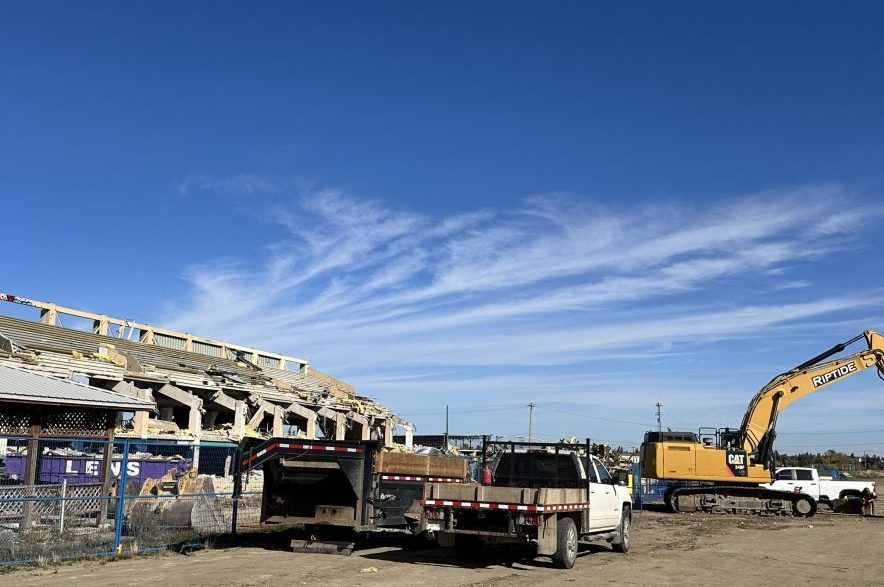
The grandstand at Prairieland Park was largely demolished as of Oct. 5, 2026. (Libby Gray/650 CKOM)
“Marquis Downs was an important part of Prairieland and Saskatoon for many years, so there is certainly some nostalgia in seeing it come down,” the statement read. “At the same time, we’re looking ahead to how the property can best serve the community in the future.”