Murray Wood: 'One of the worst' should be on hats and T-shirts in Canada
U.S. President Donald Trump called Canada "one of the worst" this week, saying that soon we will come to him t...
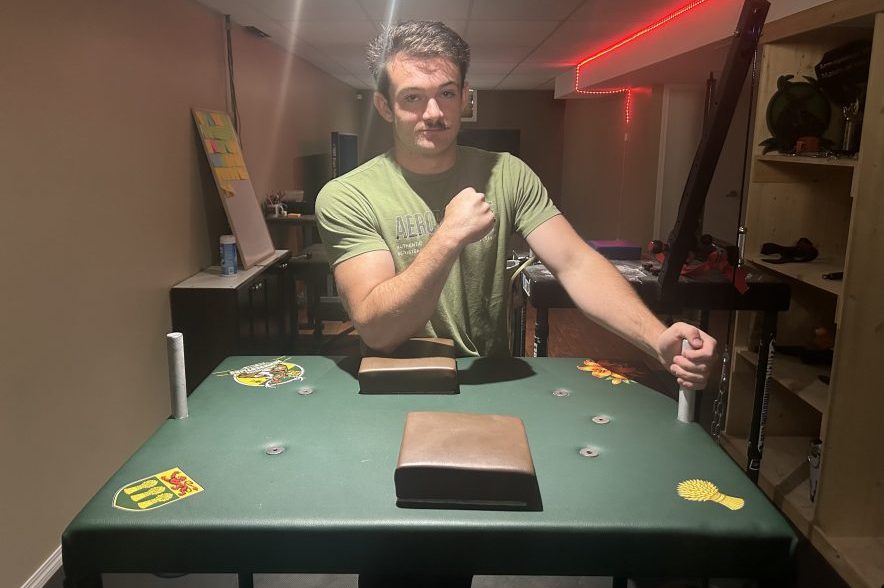
“If you’re not cheating, you’re not trying.”
That is not the sort of advice you expect to hear about a sport.
But competitive arm wrestling is unlike any sport most have us have seen before, and it’s definitely not what we picture when arm wrestling comes to mind.
Forget the kitchen table. Forget sitting bolt upright, planting your elbow and trying to overpower somebody with your biceps while your face turns approximately the colour of a tomato.
That’s recreational arm wrestling.
Competitive arm wrestling is something else entirely.
There are specialized tables. Weight classes. Referees. Grip strategy. Wrist strength. Finger strength. Hip positioning. Shoulder rotation. Footwork.
And, according to Nathan Muir, a little creative interpretation of the rules.
Muir discovered all of this the hard way.
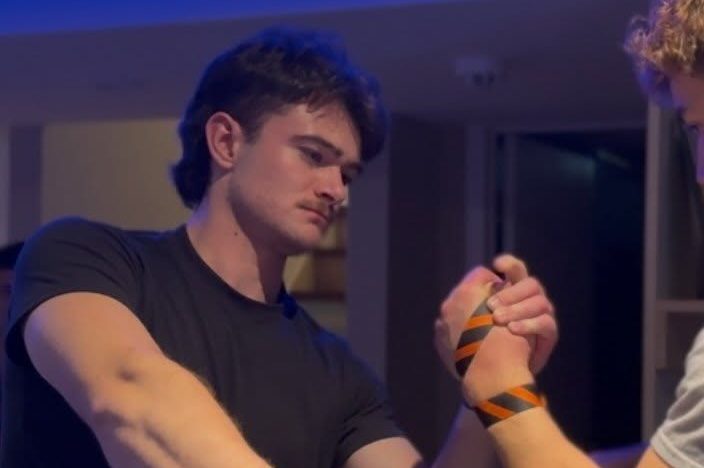
By day, Nathan Muir works at a local brewery. By night, he’s an arm wrestling machine. (Nathan Muir/Facebook)
His first arm-wrestling tournament was in Alberta in 2021.
“I got smoked,” he said, “and I’m pretty sure I might have gotten beat by a girl.”
That was the beginning.
Five years later, Muir is a four-time provincial champion. He even took bronze at the national championships in 2025.
Somewhere along the way, he discovered that the easiest way to understand competitive arm wrestling is to forget almost everything you think you know about it.
“Arm wrestling is absolutely not what you see in public,” Muir explained.
At a competition, the athletes stand around specialized arm-wrestling tables. There are elbow pads and hand pegs. Your elbow has to stay on the pad, but it can move around on it.
Before anybody actually tries to pin anybody, there is a setup.
And the setup is a battle of its own.
Competitors have to establish a legal grip. Their wrists need to be straight. Their shoulders have to be positioned properly. Their thumb knuckles need to be visible to the referee.
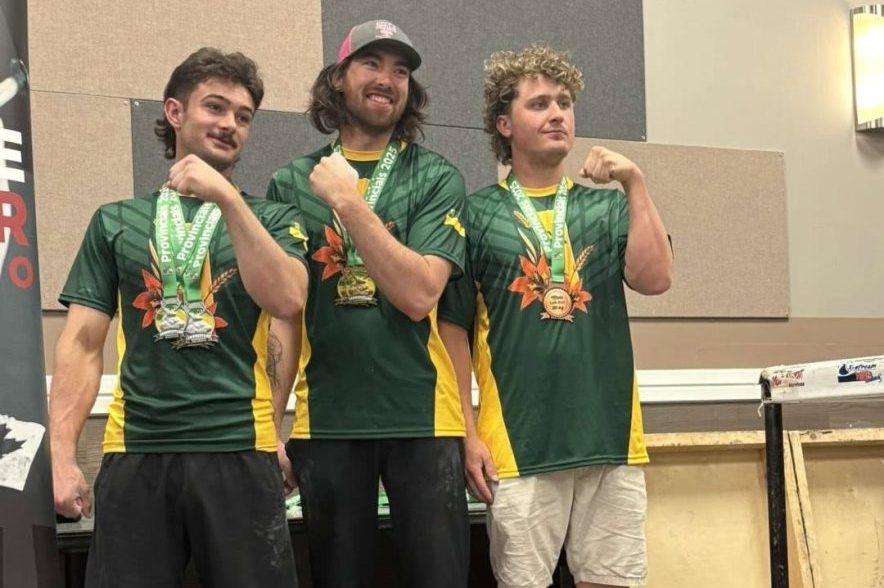
Nathan Muir said the arm wrestling community in Saskatchewan is a strong one, figuratively and literally. He says more and more people are picking up the sport with each passing year. (Nathan Muir/Facebook)
In theory, everybody starts fair.
But in practice? Muir says competitors are looking for every microscopic advantage they can get.
“You want to get a little bit more height, a little bit more depth,” he said. “If your hand is just a little bit stronger than your opponent, you can totally cheat.”
The trick is to find that advantage without the referee noticing. And you’d better be quick about it!
Because once both competitors are in position, the whole thing can be over almost instantly. Muir estimates that 95 per cent of matches last less than a second.
You can spend several minutes watching two competitors fuss over their grip, adjust their wrists, fight for position and wait for the referee to get them perfectly set.
Then the referee gives the signal, and somebody gets instantly obliterated.
“If you’re like, a very small percentage stronger than your opponent, you’re just gonna smoke them,” Muir said.
But when the competitors are closely matched? That’s when things get interesting.
A match can stretch out to a minute or more, with both athletes trying to gain the smallest possible advantage.
And while the actual contest may be lightning speed, the preparation behind it takes months, if not years.
Muir says his training program consists of a 40-day Excel spreadsheet.
“It took me a year and a half, pretty much, of trial and error,” he said of the training regime he personally developed. “It’s super particular into micro movements of the hand and wrist.”
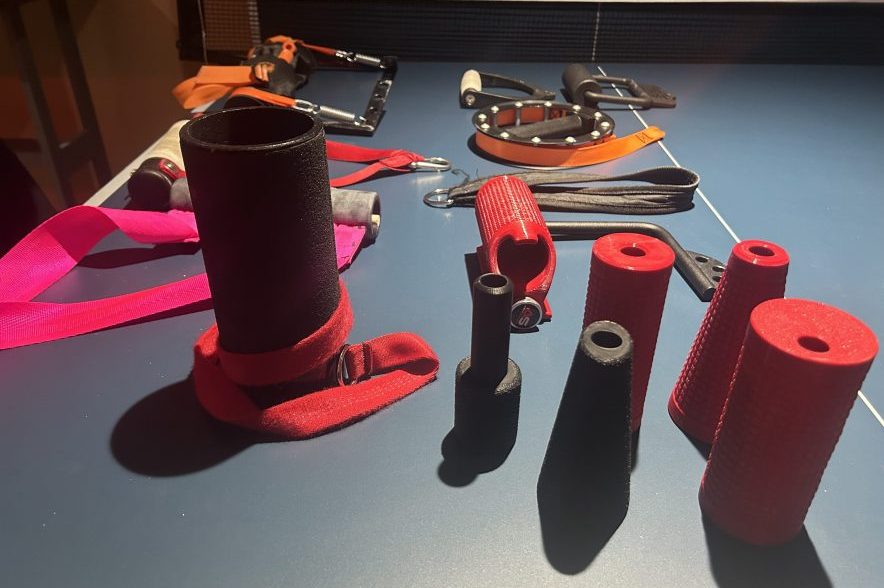
Instruments of torture? Nah, just some of the equipment Nathan Muir uses to target incredibly specific muscle groups as he trains for arm wrestling competitions. (Brittany Caffet/650 CKOM)
He works on pronation. Supination. Finger strength. Fingertip strength. Wrist flexors. Wrist extensors. Radial deviation. Ulnar deviation. Then there’s the back work. Biceps. Shoulder internal rotation. Shoulder external rotation. Naturally, you can’t forget about the core.
It’s exhausting just reading the list, never mind doing it.
But he says there is more to mastering the sport than just becoming physically strong.
“Technical wise, you have to learn your techniques,” Muir said. “Then you have to become strong in those techniques, and that’s how you get very good.”
There are three basic techniques: the top roll, the hook and the press.
A top roll is about getting over your opponent’s hand and opening up their wrist. A hook brings the fight inside, with both competitors pulling toward themselves. A press uses the shoulder and body to drive an opponent’s arm down.
And here’s another misconception: you don’t need to look like the Terminator.
Competitive arm wrestling has weight classes, generally divided into roughly 10-kilogram increments.
“So you don’t have to be big,” Muir said. “You can be 110 pounds, you can be 150, you can be 350.”
There are men’s and women’s divisions, along with masters categories for competitors who have a few more years under their belts.
The diversity on the competition floor is one of the things Muir likes about arm wrestling.
“It’s pretty inclusive as a sport, really.”
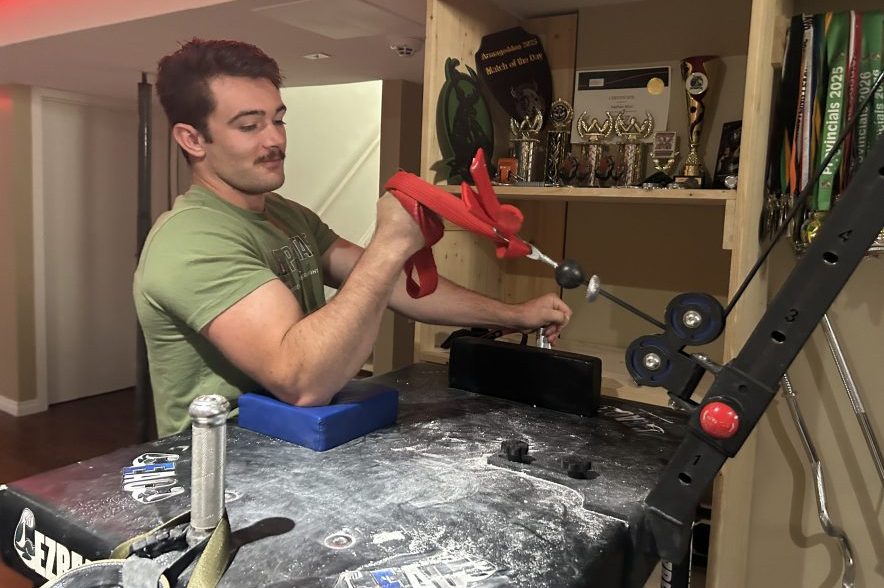
Muir’s basement is filled with training equipment he uses to train his upper body. He said he typically skips leg day. (Brittany Caffet/650 CKOM)
And the divisions don’t stop at weight.
Right-hand and left-hand competitions are separate.
“Whole ‘nother bracket,” Muir explained.
New matchups. New battle. Same table. Different arm. And that can matter quite a bit.
“Most people are right-handed,” he noted. “Most people are better with the right hand.”
But every so often, you get somebody who is unusually strong with their left.
“When you get a guy that’s left-handed and he’s also way better with his left hand,” Muir said, “that guy’s usually winning or top three in the left arm.”
Aside from the lefties, if you really want to know who to watch out for, look for the farm kids.
“Rural kids are like some of the best arm wrestlers,” he said.
Farm kids grow up doing things that happen to develop powerful hands, wrists and forearms. They lift bales. Carry pails. Torque on wrenches.
“And any blue collar workers come into the sport, they’re very, very good,” Muir said.
Basically, if you’ve spent years doing things that require your hands to grip, twist, pull and generally refuse to give up, you might already have some useful equipment.
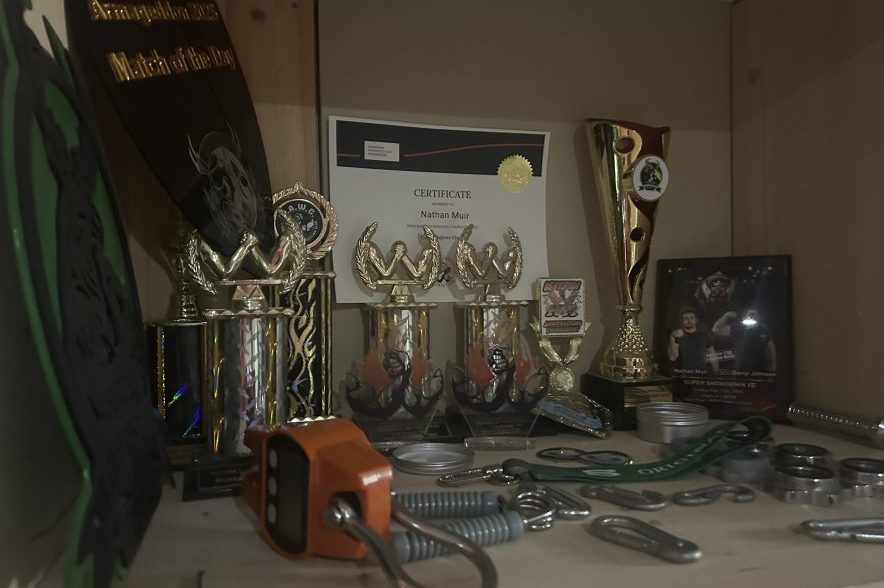
Nathan Muir may have gotten “smoked” in his first arm wrestling competition, but in the years since he’s accumulated a nice sized collection of trophies and medals in the sport. (Brittany Caffet/650 CKOM)
The problem is, all that gripping, twisting and pulling can take a toll.
Muir says elbow tendon problems are so common among arm wrestlers that there is even merchandise joking that “it only hurts for the first 10 years.”
“Pretty much if you don’t have tendonitis or a tendinopathy as an arm wrestler, you’re doing it wrong,” he laughed.
At this point, a reasonable person might wonder why anybody would willingly do this.
“The love of the game for the most part,” Muir said with a smile. “When they start arm wrestling, it’s like an addiction. And they just don’t ever stop.”
So the next time somebody challenges you to an arm wrestle, just remember: they might take it a little more seriously than you do.
And for a competitive arm wrestler, the line between fair play and cheating is about as thin as the time it takes to lose a match.
And if you’re not cheating?
Well, you’re probably not trying.
Think arm wrestling is just about having strong arms? Think again. Nathan Muir has spent years training his hands, wrists, shoulders and hips for a sport that lasts seconds. (Brittany Caffet/650 CKOM)