

Murray Wood: It's getting better all the time
Even if it seems - as the rejoinder in the Beatles' song observed - 'it couldn't get much worse,' Murray Wood suggests w...
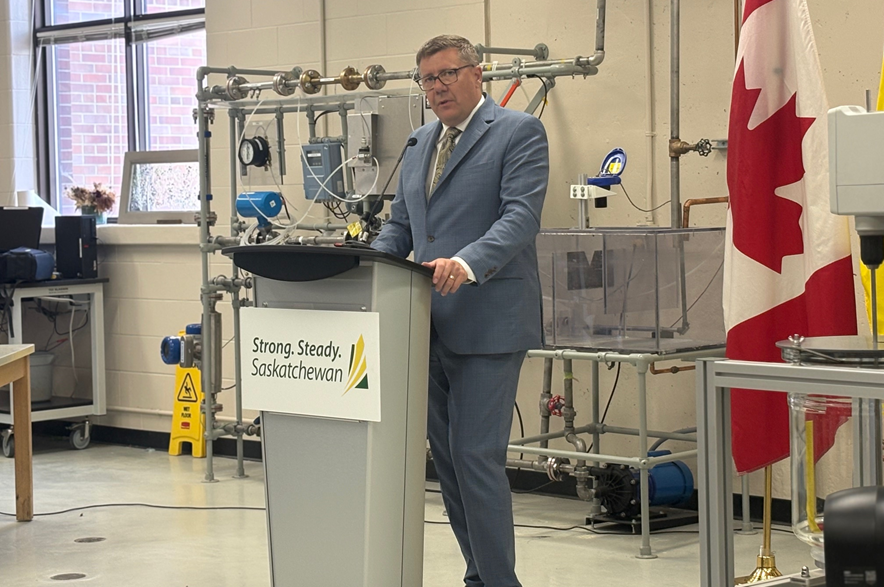
The provincial government has unveiled plans to establish two nuclear reactors in northwest Saskatchewan, with the first expected to come online by 2042.
The Government of Saskatchewan’s plan – titled Delivering Energy Security Through Nuclear Power – outlines a goal of generating at least 2,600 megawatts utilizing nuclear power by the year 2050 in order to ensure the province has the “reliable, affordable and secure” power needed to support its growing population and industries.
Read more:
“Reliable, affordable power is essential for Saskatchewan families to thrive and for businesses and communities to grow,” Premier Scott Moe said in a statement.
“With our world-class uranium resources, skilled workforce and growing nuclear expertise, Saskatchewan has everything we need to be a global leader in nuclear energy. This ambitious plan turns that potential into action – strengthening our energy security, attracting investment, and building a strong nuclear future right here at home.”
The provincial government said SaskPower has been working to evaluate technology options around large reactors, and will now start planning for the potential development of the two reactors in northwest Saskatchewan.
“Building on previous experience over the past several years on site assessment work around Estevan, SaskPower will evaluate potential locations while having meaningful engagement with local communities and Indigenous peoples,” the provincial government said.
The province is also continuing its work in the Estevan area, with a site selected for further study and the potential deployment of a small modular reactor, which would deliver “at least 600” megawatts of power.
“Nuclear power will be a cornerstone of a reliable, affordable and secure electricity system in Saskatchewan,” Jeremy Harrison, minister of Crown Investments Corporation, said in a statement.
“This plan gives SaskPower a clear path to meet growing demand and support the investment and industries that keep our province strong.”
The provincial government said it is taking “an all-of-the-above” approach to nuclear power, which will complement other forms of power generation in the province like coal, wind, solar, hydro and natural gas.
The plan outlines Saskatchewan’s intentions to build electrical capacity in order to support long-term growth, incorporate large reactors into electrical supply planning, continue development in the Estevan area and build on existing nuclear capacity.
“Nuclear power from small modular and conventional reactors will provide reliable, emissions-free baseload generation for decades to come,” Rupen Pandaya, SaskPower’s president and CEO, said in a statement.
“Under this plan SaskPower will continue its work to advance nuclear development, support economic growth and ultimately ensure we continue to deliver the reliable electricity that Saskatchewan people and businesses depend on every day.”
Tim Gitzel, CEO of uranium mining giant Cameco, said his company is “incredibly pleased” to see the province recognizing the important role nuclear power can play in its future growth.
“We understand the economic, environmental and energy security benefits that safe, reliable and carbon-free nuclear power can provide for our people, communities, and industries,” Gitzel said in a statement.
“As a proud Saskatchewan company with nearly 40 years of operations here, we look forward to competing for the province’s business as it embarks on this transformative plan to build a reliable energy grid, utilizing nuclear energy to power Saskatchewan’s future.”
The province noted that it will continue to engage with Indigenous rights holders, municipalities and other stakeholders.
“As we explore the nuclear future in Saskatchewan, we welcome the opportunity and shared responsibility to ensure First Nations are meaningfully involved in shaping the path forward,” Sheldon Wuttunee, CEO of the Saskatchewan First Nations Natural Resource Centre of Excellence, said in a statement.
“Through our strong partnerships with the Government of Saskatchewan and SaskPower, the Centre is helping First Nations assess workforce, supply-chain and equity opportunities. We also look forward to Canada investing in the regional capacity needed to support informed First Nations participation and create lasting benefits for our communities.”
Bill Huber, president of the Saskatchewan Association of Rural Municipalities, said his organization welcomes the commitment to advance nuclear energy in the province.
“The goal of at least 2,600 megawatts of nuclear generation by 2050, alongside planning for large reactors in northwest Saskatchewan and continued (small, modular reactor) work near Estevan, reflects the scale of electricity generation needed to support a growing province,” Huber said in a statement. “Rural municipalities will be important partners as this work moves ahead, and SARM looks forward to ensuring local infrastructure, community capacity and rural municipal perspectives are considered throughout the planning process.”
Huber’s comments were echoed by Randy Goulden, CEO of the Saskatchewan Urban Municipalities Association.
“As the order of government responsible for more than 60 per cent of public infrastructure, we need our power supply to be resilient and affordable, and we recognize that that will include a mix of baseload power, such as nuclear, as well as periodic power like wind and solar,” Goulden said in a statement.
“We look forward to continuing to work closely with the Government of Saskatchewan to ensure that urban and northern municipalities are part of the discussion, planning, and implementation of this next chapter in Saskatchewan’s power generation and delivery system.”