

Murray Wood: Does anger at Carney on trade extend across the political spectrum?
Murray Wood says Stephen Harper and Scott Moe support Prime Minister Mark Carney's position on trade. Does the criticism...
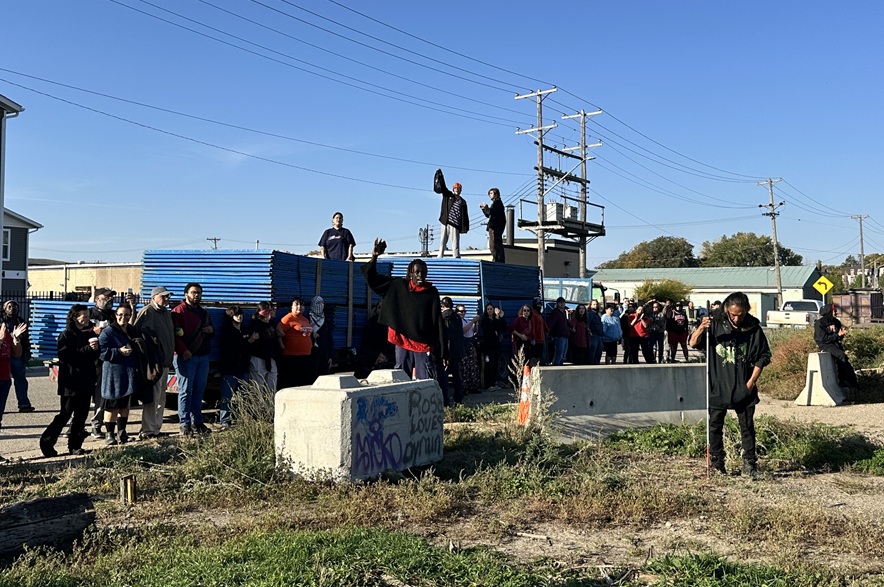
It’s a place called home by a couple of hundred people for the last two weeks and, for now, the encampment on Avenue K in Saskatoon will remain in place.
On Thursday morning, fire inspectors and police officers attended the encampment as the tents appeared to be coming down and fences were being put up.
Read more:
Protesters linked arms around a truck carrying the fencing, calling for the work to stop.
But after Saskatoon lawyer Crystal Fafard filed an injunction to stop the cleanup, the City of Saskatoon confirmed that the encampment will remain in place pending the outcome of that hearing. The injunction will be heard in court on Monday.
The scene now at the 20th Street & Ave K. Police arrived and people began to move around 9:15 a.m., mobilizing to form a human chain around the truck with fencing, set to be put up around the field where the encampment is @CKOMNews @CJMENews @miaholoway pic.twitter.com/1QUej3NK2i
— Libby Gray (@libby_gray9) September 24, 2026
“We could have cleaned it up, but we want to respect the legal process and allow them to have that say,” said Yvonne Raymer, Saskatoon’s deputy fire chief.
“I do have concerns that in the next four days something could occur, but I also want to give them that opportunity to be heard.”
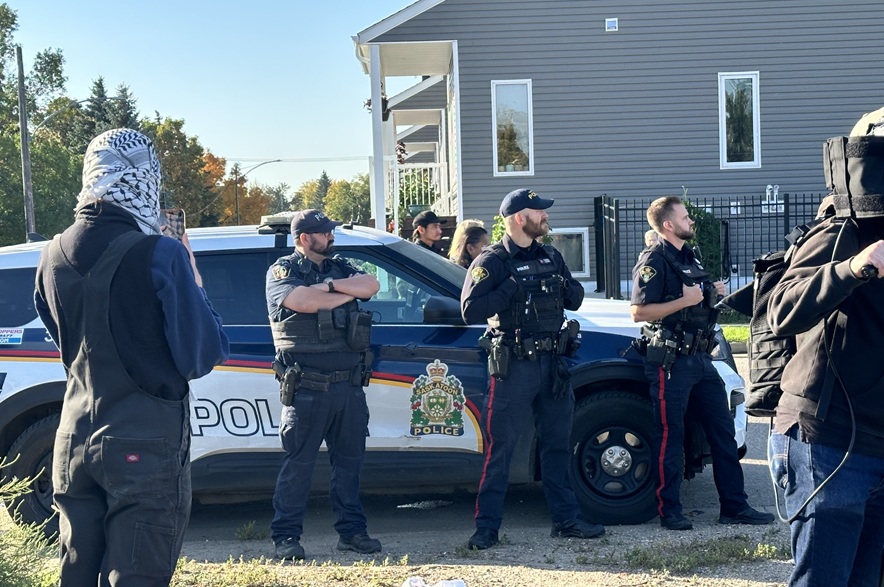
Deputy fire chief Yvonne Raymer said fire inspectors have been confronted when trying to offer services to those at the encampment. (Libby Gray/650 CKOM)
Raymer said the fire department will abide by the court’s ruling, but noted that people at the site were being confrontational when approached by fire inspectors and other outreach workers who attended the site on Wednesday morning.
“They were confronted by many people who were acting quite aggressively, using profanity and capturing video, and that wasn’t the intent of the site visit from (the Saskatoon Fire Department’s) point of view,” she said.
“The income assistance workers and our staff noted that community advocates outnumbered the individuals who are actually staying in the encampments. And I just want to clarify, for most of the confrontation that occurred it wasn’t coming from the unhoused individuals. It’s actually from the organizations and advocates.”
Raymer said it’s been difficult trying to connect the occupants of the camp with services.
“Yesterday was a contentious day, for sure. They had two site visits and any attempts, they were swarmed,” Raymer said.
“There was a lot of profanity, and the police officer on scene made the call that in order to keep the income assistance workers safe, to keep our inspectors safe, it was time to vacate. So that’s why we’ve brought more personnel for today.”
Several tents take up space in the empty lots, with roughly 200 people living there at times.
In a statement, the city said, “We know this is frustrating for many in our community, notably the St. Mary’s school families and staff who have been asking for officials to take action for the past year.”
St. Mary’s Wellness and Education Centre is located on Avenue N South, west of the encampment.
More to come.
While the Avenue K encampment in Saskatoon faces removal, one remains in Regina.
The tent city in Core Community Park in the Heritage neighbourhood is one police said they won’t tear down.
Regina Police Chief Lorilee Davies said police and the city hope to get people into housing or addictions treatment.
Ward 3 Councillor David Froh joined the Greg Morgan Morning Show to discuss homelessness.
“We can’t tear down those encampments unless we have a place for those people to go,” he said. “There’s nowhere for them to go.”
Froh said there isn’t enough supportive housing, which is a provincial responsibility.
“It’s quite maddening that we know what works, and for some reason we’re not willing to do it,” he said.
Froh said he understands businesses’ frustration that traffic through their establishments has decreased since the encampment was set up.
“I feel for those businesses,” he said. “I feel for the people sleeping in the tents. No one wants an encampment.”
Unless there’s more permanent supportive housing and transitional housing, Froh said the situation will only get worse.
–with files from 650 CKOM’s Lara Fominoff, Mia Holowaychuk and Libby Gray and 980 CJME’s Gillian Massie