Murray Wood: Trump's potash claim is more 'art' than deal
The U.S. president says a deal is in the works to buy cheap potash from Belarus, but Murray Wood says Donald Trump proba...
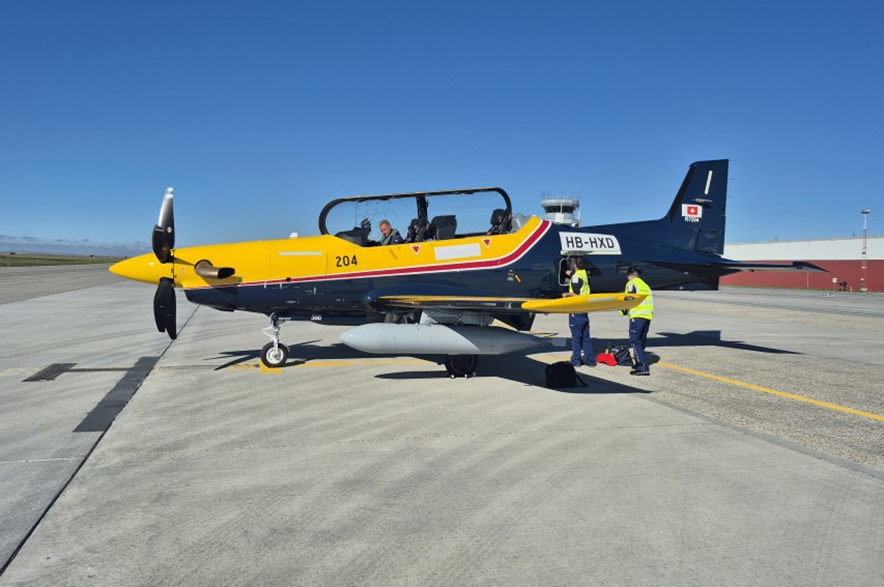
The first two CT-157 Siskin II aircraft destined for 15 Wing Moose Jaw have officially arrived in Canada, marking a major milestone in the Royal Canadian Air Force’s modernization of pilot training.
The aircraft, known commercially as the Pilatus PC-21, recently arrived from Switzerland and are now undergoing final acceptance procedures before entering service. Once those inspections are complete, instructors at 15 Wing will begin familiarizing themselves with the new aircraft ahead of future student training.
Read more:
Maj. Zach Charbonneau, a flying instructor at 15 Wing Moose Jaw, was among a group of Canadian military personnel who recently travelled to Switzerland to train on the new platform.
“There was eight of us, four from the RCAF and four from CAE,” said Charbonneau. “We did our initial cadre training, learn how to fly the aircraft, learn the abilities that the aircraft has and all the technical know-how we need to essentially develop the training plans here in Moose Jaw.”
The Siskin II is replacing the CT-156 Harvard II as part of the future aircrew training program, and will eventually be used for both advanced flying training and jet training preparation.
According to Charbonneau, the new aircraft represents a significant leap forward in capability.
“It’s definitely a step up in performance,” he said. “It’s a true military aircraft. It flies like a jet.”
While speed and performance are among the most obvious differences, Charbonneau said the aircraft also changes the way pilots are trained.
“Instead of flying by the seat of your pants, your big goal now is to perceive, comprehend and project the required information to do the flying,” he explained. “It’s a step forward in how we do train.”
The aircraft are expected to better prepare students for the increasingly complex systems they’ll encounter as they move into operational military aircraft.
Although the aircraft have arrived in Canada, they are not yet officially part of the Royal Canadian Air Force fleet.
Before that can happen, a multi-agency team must complete acceptance inspections that verify the aircraft meet Canadian operational requirements and airworthiness standards.
“It’s quite a big team here in house to do the acceptance,” said Charbonneau.
Once the inspections are complete and ownership formally transfers, the aircraft’s Swiss registration markings will be removed, revealing their Canadian registration.
“If you went out and saw the aircraft, there was a big white sticker on it,” he said. “As soon as the acceptance is done, they’ll have a nice little ceremony, pull the sticker off and then it is officially Canada.”
While many aviation enthusiasts are eager to see the Siskin II in the skies over Moose Jaw, Charbonneau said there are several steps before students begin training on the platform.
If acceptance proceeds as planned, instructors hope to begin flying the aircraft in early October. The initial focus will be ensuring instructor pilots become fully proficient before expanding training to additional instructors and eventually students.
“We need to be proficient first before we start teaching somebody else to fly,” said Charbonneau.
From there, the instructor cadre will grow before the first student pilots transition to the new platform.
“Flight training is very one-to-one,” he added. “You need a pretty strong instructor cadre, numbers-wise, before we start teaching students.”
One of the most noticeable differences between the Siskin II and its predecessor will be its speed.
Asked how quickly the aircraft could travel from Regina to Moose Jaw, Charbonneau estimated the trip would take less than 10 minutes, roughly half the time required in a Harvard II.
With the first aircraft now on Canadian soil and more expected to follow, Charbonneau said excitement is growing among instructors eager to begin flying the new platform.
“We’re very excited with the new airplane and to have it here now,” he said. “It’s a new era and moving the training forward.”