

Evan Bray: Data centre project offers real opportunity for Saskatchewan
Evan Bray says he understands skepticism about Bell's giant AI data centre project, but some are so afraid of the idea t...
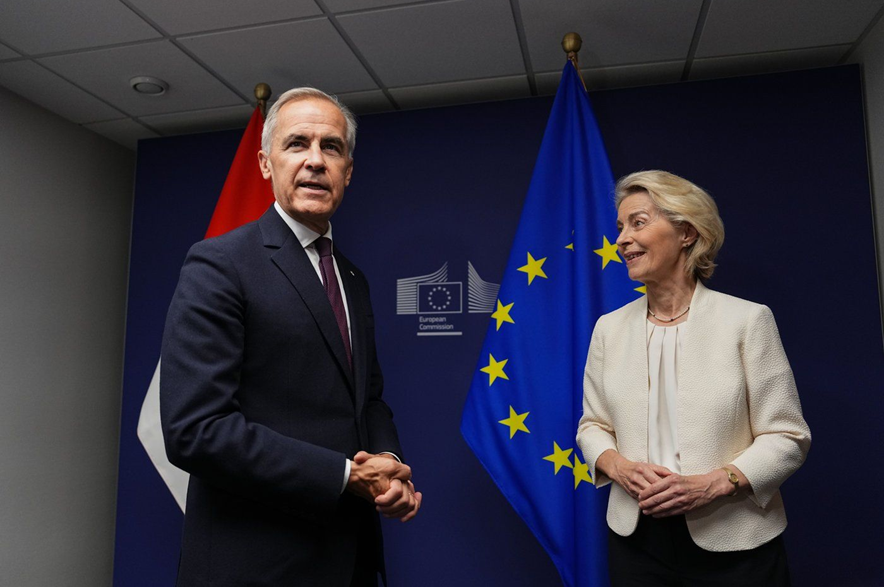
European Commission President Ursula von der Leyen said Wednesday she wants Canada to become the first “associate member” of the European Union, inspiring both curiosity and confusion on two continents.
“The status of associate member does not exist, so no one knows what it would mean,” said Achim Hurrelmann, co-director of the Centre for European Studies at Carleton University.
Read more:
“It’s a label that really does invite misunderstandings.”
Here’s what we know — and don’t know — about what von der Leyen is proposing.
In a major speech Wednesday, von der Leyen laid out key pillars for stronger co-operation with Canada. Brussels already has a free trade deal, a strategic partnership agreement, a scientific research pact and a defence industrial arrangement with Canada.
“I would like to work with you on opening the door for Canada to be the first associate member of the EU,” von der Leyen told the European Parliament as a visiting Prime Minister Mark Carney listened from the audience.
Hurrelmann said the speech outlines von der Leyen’s agenda but her words did not amount to an invitation to join the EU.
In a post on the platform X, EU Ambassador to Canada Geneviève Tuts quoted von der Leyen and added in French that “every word counts.”
On Thursday, Carney will address the 720 politicians representing the continent’s 27 member states in Strasbourg, France.
He has said that Canada seeks “a unique alliance” with the EU, based on shared values and priorities, coupled with “very complementary strengths.”
The EU is made up of multiple institutions, directed by three leaders. Von der Leyen oversees the European Council, making her the bloc’s policy heavyweight.
European Council President Antonio Costa is in charge of negotiating political issues with member states, while European Parliament President Roberta Metsola’s role is similar to that of a Speaker in the Westminster system.
Von der Leyen’s annual State of the European Union speech is generally similar to the U.S. president’s annual State of the Union speech, with some added policy heft, Hurrelmann said.
The U.S. president visits Congress to give his annual speech but his powers are limited by House, Senate and state-level jurisdiction.
Hurrelmann said von der Leyen’s speech outlines policies for the next 12 months that require work with elected members of the European Parliament and consultations with countries through the European Council.
“It’s her attempt to really put the relationship with Canada on the top of the agenda and to give a strong label to it,” he said.
There has been little public pushback against the idea of closer ties with the EU since von der Leyen’s speech.
Political groups at the European Parliament — including one that is skeptical of Brussels and of integration with other countries — either spoke positively about Canada or ignored the partnership idea entirely.
Unnamed sources cited in American and British media have said that some EU countries were surprised by — and skeptical of — von der Leyen’s proposal.
The Wall Street Journal reported last week that some Europeans worry Carney wants to use the prospect of stronger EU ties as leverage in trade talks with Washington and has no plans to pivot toward Europe.
Hurrelmann noted that von der Leyen is attempting to centralize more power in her office, with mixed success.
“She has clearly been the more visible of the presidents of the EU, compared to (Costa),” Hurrelmann said.
Member states have pushed back on the centralization of power in Brussels in recent years. France has sought more arms production on the continent outside of EU partnerships with North America, while Germany has resisted further integration of its banking sector.
Hurrelmann said Brussels is careful to avoid being perceived as prioritizing one country over another as it seeks a rapprochement with the post-Brexit United Kingdom and a deeper partnership with Ukraine. It also has a long list of countries that have waited years for EU membership.
Canadian and European officials have suggested that more details about the associate membership proposal — and maybe even some type of agreement — could emerge in late October, when Carney welcomes Costa and von der Leyen to Montreal.
Carney, Wilkinson and other Canadian officials have avoided using the term “associate member,” though Hurrelmann said it’s possible Canada already has embraced that phrasing.
“I would consider it unlikely that she would have included the terminology in her speech if the Canadians had opposed it,” he said. “They maybe like the symbolic weight that it gives to the relationship.”
Industry Minister Mélanie Joly told reporters Wednesday in Toronto that talks with Brussels are aimed at giving Canada more options in an age of protectionism.
Those options could include Canada being exempted from European restrictions on steel and aluminum imposed in response to U.S. tariffs, or partnering with Europe on digital safety and sovereignty in the face of pressure from American tech giants.
European officials have repeatedly noted that Canada has access to key resources, minerals and energy in an age of climate chaos, Chinese trade pressure and oil shortages caused by the U.S. war on Iran.
Hurrelmann said the confusion over the “associate membership” concept is creating room for a partisan split over how Canadians see Europe, after years of polling that indicated widespread enthusiasm and alignment with the EU.
Conservative MPs have suggested associate membership in the EU might compromise Canadian sovereignty. They have warned of chaos from open borders, heaps of tax revenue going to Brussels and newcomers taking Canadian jobs — though it’s not clear that any of those changes would come from associate membership.
Jonathan Wilkinson, Canada’s new ambassador to the EU, said any new labour mobility programs would be limited and would require consultations with the provinces.
Hurrelmann argued Canada should work with the EU on making sure existing agreements are being used to their full potential.
Ten of 27 EU countries still haven’t ratified a trade deal with Canada that has been in place provisionally for nine years. Canadian businesses have not taken up market access provided to them in Europe to the same extent that European industries have in Canada.
This report by The Canadian Press was first published Sept. 16, 2026