

Murray Wood: Is it fake, or just stolen?
People looking for news on Facebook need to watch out for fake content. And even if it's true, it may have been stolen. ...
Jill and Rick Van Duyvendyk answer all your gardening questions in Garden Talk on 650 CKOM and 980 CJME every Sunday morning at 9 a.m. Here are some questions and answers from the May 24 show featuring special guest Genevieve Russell, a sustainability specialist with the City of Saskatoon:
Read more:
These questions and answers have been edited and condensed for clarity.
Q: How can I be water-wise in the garden?
A: There’s many ways you can save water in your yard — use rain barrels to capture rainwater, which is good for the plants and helps reduce water use; apply compost and mulch; and have drought-tolerant plants.
Rainwater is way better than the water that comes out of your tap for the plants. It has lots of nutrients in it, and it doesn’t have chlorine.
The City of Saskatoon offers a rain barrel rebate. Anybody — residents, schools, nonprofit organizations — can qualify for a $40 rebate on a rain barrel every year and there is also an income qualified rebate of $100 to for anyone with a leisure access or transit access pass.
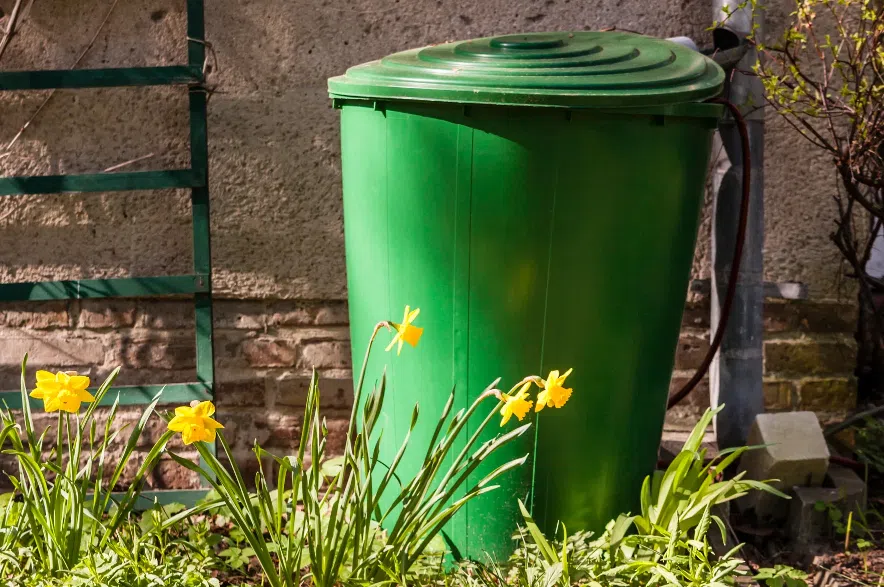
Black is the best colour for a rain barrel, it doesn’t let the sunlight in, so you won’t get algae growth. Make sure you use the water, so don’t let it sit all summer. Also, it’s important to have a cover on your rain barrel to prevent animals and pets and things from accidentally falling in.
Connect the rain barrel to a downspout. There’s lots of rain barrels on the market and they’ll have a lid and often a tap on the bottom you can hook up to a hose and feed your garden from there or just fill up watering cans. You can also build a larger tank to capture more of that water.
During the average year in Saskatoon, a 1,000 square foot roof on a house will capture enough rain to fill a 55 gallon rain barrel 110 to 125 times during the garden season.
Q: What’s the best way to use mulch?
A: Wood mulch or something organic is great because it will retain moisture and keep the soil cooler and it’s also lightweight, so it won’t compact the roots of your plant. It will also break down over time and release nutrients.
If you’ve got hard soil, after a year or two dig through the wooden mulch and you will find the soil is not hard at all. In Saskatoon the compost depots on Highway 7 at 11th Street offers dig your own mulch and compost. It’s free to residents.
Q: Can I use shredded cardboard for mulch?
A: Yes. Put the cardboard down and a thin layer of mulch over top for aesthetics and also to help it break down.
Q: If I could change one thing in my yard to be more water-wise, what would it be?
A: Always start with the soil, working compost into it and making sure that’s a nice deep layer that will hold a lot of moisture and release it over time for your plants.
Q: What about lawn watering?
A: Water early in the morning or in the evening when the sun is at its peak because when the sun is high, evaporation is also at its peak. More of the water will stay in the garden if you water during the cooler parts of the day.
Water once a week but deeply — longer watering and less often means the water will will get deep into the soil and encourage root growth for your plants and that helps them be more resilient.
Q: How do I apply fruit and berry fertilizer?
A: There’s two different types. There’s a granular that’s a slow release and a liquid. The liquid stuff needs to be mixed with water according to the instructions, and then poured around the drip line of the tree, not right at the trunk. Don’t spray it when the tree has blossoms and don’t apply it in a heat wave. Wait for a cooler day as well. If the ground is really dry, water it first.
Q: How can I deal with thistles?
A: You’ve got to dig them out because they have a rhizome root. Just keep working at it, and you’ll keep them down.
You an try using Roundup Advanced or TopGun, they’re both a horticultural herbicide that will burn the top off. The thistles will come back again but if you keep doing that it will eventually just die out because it just can’t survive without having the sunlight. When you dig them up, try to get all the roots out. What you don’t want to do is rototilling in that area.
Q: How do I deal with woodpecker or sap sucker holes in a tree?
A: Let any wet holes dry up right now and wait until the leaves or needles come out in full. Then put a pruning paste on it to seal up the holes so the insects don’t go in.
Q: How do I top dress a lawn with new seed?
A: Do any aeration needed first, rake it to get all the old grass out and then you can overseed. If you’re short of topsoil, you can always add more topsoil. In some new yards, they only put maybe two inches of topsoil but a lawn needs at least four inches of topsoil to really be strong and survive the winter.
Get a good Canada No. 1 mix of grass seed. It will have two different Kentucky blues, some fescues and a rye. That way then you got different grasses will come up at different times of the year. Fertilize and water at the same time with Groundskeeper fertilizer (the green bag.)
Q: Does potash help if I work it into my soil before planting my garden?
A: Absolutely. Remember that potash in Saskatchewan is a kilometre down in the ground. Potash is huge for the health of a plant.
Q: How long do plants and veggies take to get hardened off?
A: If you’ve had them outside for three to five days in and out here and there, especially for your veggies, it’s good to get them in the ground.
If you’re from a northern part of the province and you have snow on the ground, make sure that ground is thawed and your nighttime temperatures are sitting at least 5 C.
Q: Can you propagate a lilac bush?
A: You can. Probably the best way to do it is to take some hardwood cuttings about six inches long. Hardwood, not the fresh green growth. It’s the old wood from last year.
The trimmings should have about three or four buds on. When you put it into the ground, cut it off about half a centimetre to a centimetre below a nodule where the leaf would have come out and apply rooting hormone number three and stick it into a jiffy pod or something like that to get them to root and then slowly move them out into the yard. Keep misting the leaves.
Q: Are eggshells good for plants?
A: Absolutely, they’ll help to add calcium to the soil. Break them up as much as you can. The best way is to put them into the compost first and then put them into the garden.
Q: My tulips are only a few inches high. What is the problm?
A: Tulip bulbs need to be about four to six inches below the ground, so make sure that they weren’t planted too deep or too shallow. Too shallow and they’ll have winter damage and too deep stunts them.
Make sure you’re using a good bulb fertilizer then you can wait till they finish blooming and dig them up in the fall and replant them.
If you’re using them for cut tulips, you’ve got to buy new bulbs the following year because you need to keep the flower and leaves, and let them die back down into the bulb every year.
Q: How can I make blue spruce trees more blue?
A: Use some aluminum sulfate. Spread it around the soil around the tree, or mix it with water and pour it around the drip line.
Read more: