

Murray Wood: Trump's potash claim is more 'art' than deal
The U.S. president says a deal is in the works to buy cheap potash from Belarus, but Murray Wood says Donald Trump proba...
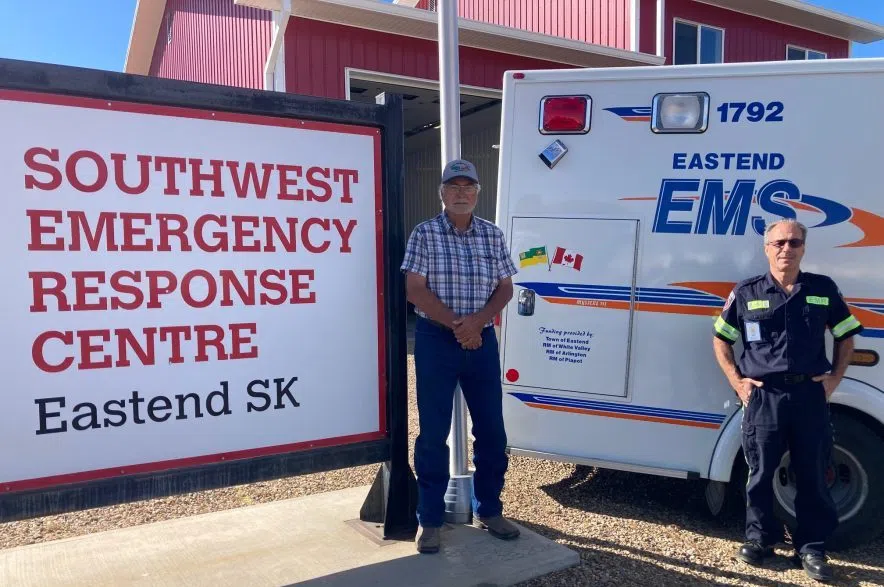
A handful of local Saskatchewan towns and communities have limited their friendly rivalries to the ice in order to work together on bringing together local ambulance services for the area.
Concerned about long wait times for ambulances, a number of smaller communities in the southwest corner of the province are rallying together to ensure people living in those areas can have access to a dependable medical response when an emergency arises.
Read more:
Reeve for the RM of Arlington No. 79, Don Lundberg, said local leadership realized they had an issue with recruiting ambulance attendants for its two services in Eastend and Shaunavon. For the past year, the Eastend ambulance service has been shut down.
“Something had to be done and we have to get at it and get it done,” Lundberg said.
He explained that their community was only being funded for two part-time positions.
“People do not move to work for .3 positions,” Lundberg said. “So we went to work on that.”
Shaunavon was only running one of two ambulances because that community was short of primary care paramedics to operate them, despite having an acute medical centre and a hospital in that town. That town’s ambulances were purchased by the SHA, while the Eastend ambulance was funded by Eastend, the RM of Arlington and the RM of White Valley.
“(The ambulances) were just sitting there for a year, not being used because we had no one to run the ambulance.”
Lundberg said Eastend was “stealing services” from different towns like Maple Creek and Frontier to cover their area.
“Which was not right,” he said, but also noted the fear of an emergency situation happening without proper responders.
“You might not do anything per week and then there could be two motor vehicle accidents in two days,” Lundberg said. “You don’t know.”
A typical ambulance response usually took about an hour to get to the RM of Arlington or Eastend, sometimes shortened to about 30 minutes if the responders were coming from Shaunavon.
A committee was formed, combining representatives from the towns of Eastend and Shaunavon and the RMS of Arlington, Bone Creek and Grassy Creek. That representation approached the Government of Saskatchewan’s Lori Carr, minister of mental health and addictions, seniors and rural and remote health and minister of health, Jeremy Cockrill.
“They didn’t realize our situation,” Lundberg said.
Carr visited Shaunavon in May 2025, according to the RM of Arlington No. 79’s website, to hear “firsthand from Saskatchewan Health Authority (SHA) staff about current service gaps and challenges in local emergency care.
“They’ve been very helpful,” Lundberg said, explaining that the province has increased funding to Shaunavon and Eastend for two more primary care paramedics, each, as well as two more emergency medical responders (EMRs).
The community committee is now working to staff those positions, to ensure medical care is reliably accessible to all five of the Saskatchewan communities. A financial incentive of $20,000 cash is being offered to new primary or advanced care paramedics committing to work in Shaunavon and/or Eastend for three years – paid out 30 per cent in the first year, 20 per cent the second and 50 per cent in the final year.
A page on the RM of Arlington No. 79’s website detailed this program is “a direct response to staffing challenges across the region and reflects strong inter-municipal collaboration and community investment in frontline healthcare.”
“We’re both well-equipped with good ambulances and good facilities,” Lundberg explained. “It’s just (that) recruitment is a problem.”
Further incentives are being offered by the communities seeking to fill these positions, including five $2,000 bursaries for high school students accepted into an approved EMS program and an EMR training incentive amounting to $1,000 and full SHA support, covering training and enrolment costs and a $2,000 bursary to applicants taking an approved EMR training program through the SHA.
The town of Eastend and RM of White Valley No. 40 are also offering a room and board in the form of a rent-free three-bedroom home in Eastend with utilities included and any tax costs covered.
At present, Lundberg said two EMRs have been hired in Eastend, but the town is still looking to fill its two paramedic positions.
“Basically, we still only have two weeks of service a month,” Lundberg explained, “and then the ambulance sits.”
He said the rural communities in the area have a large senior population, who have greater health care needs.
“Lots of these people are 90 to 100 years old,” Lundberg said. “If they’ve had a fall or something, they’re going out in an ambulance in the cold weather to a strange facility, a strange town, and they’re often confused.
“We just have to provide the service,” Lundberg said, noting the large geographical area of about 1,500 sq. miles – about 3,385 sq. kilometres.
Lundberg said all people hired to run the ambulances in these communities are employed by the health authority while most of the incentives for prospective employees are being covered by the local communities.
Employees have to be new to the Cypress Health Region to qualify to take advantage of these incentives, Lundberg added.
The communities are sending representatives to Saskatchewan job fairs and working with the SHA to try and fill the needed paramedic positions.
“It’s a great place to raise a family. Cost of living is absolutely reasonable,’ Lundberg shared. “Your kids, they’re going to smaller schools where there’s less peer influence … Our hockey is unbelievable down here. We have curling, baseball, there’s everything, all the recreation, right in the Cypress Hills.”
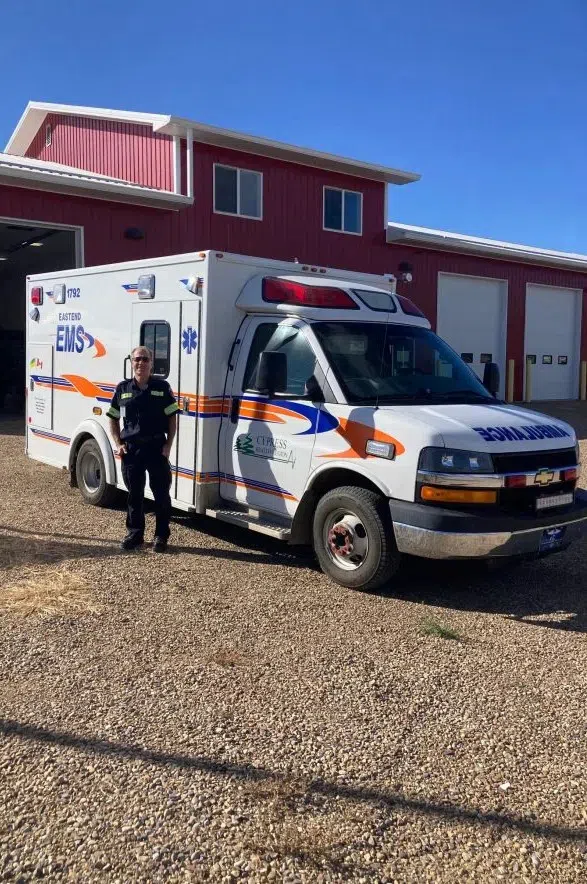
Lloyd Weis, an EMR in Eastend, stands beside the Eastend ambulance that also services three RMs and the town of Shaunavon. RM of Arlington No. 79 Reeve, Don Lundberg, says their communities are searching for more EMRs to staff their ambulances. (Donald Lundberg/Submitted).
Lundberg said the southwest communities have worked together for at least three decades and operate with joint fire departments and recreation.
“We do everything together. We always have,” he said. “We knew we had to to survive.
“It’s been very successful. There’s still small town rivalry, but we work together for the big things.”
Eastend has been an area that community leaders in Saskatchewan are paying attention to.
Jean-Marc Nadeau, executive director of the Saskatchewan Urban Municipality Association, said he was aware of regional co-operation between the town and other communities, which has been an important collaboration for the sustainability of Eastend, even continuing past the retirement of local leaders in the community.
“That’s a testament to the longevity of that collaboration in the region,” Nadeau said.
Nadeau and Laurel Feltin, Saskatchewan Association of Rural Municipalities executive director, joined The Evan Bray Show on Feb. 9, and mentioned a collaborative effort the two have partnered on to produce community case studies.
The first has been sent for publication consideration to the University of Regina, Nadeau shared.
Both Nadeau and Feltin are PhD graduates and familiar with the academia of case studies. The decision to pursue this academic endeavour came when the two were discussing how to better promote the good work that municipalities are doing in Saskatchewan and beyond.
Nadeau said challenges facing municipalities like shrinking tax bases and rising annual operating costs are continually impacting communities in the province and future planning.
He said Feltin and himself are putting together a list of communities both working well together and some where that has not happened, offering opportunities to explore both the successes and failures communities in Saskatchewan could learn from.
Nadeau said he’d like to eventually piece these case studies together into a book as a testament to the value of regional collaboration over potential amalgamation, both of which Nadeau investigated in his PhD dissertation.
“Councillors don’t make a ton of money,” Nadeau said. “They’re not going to retire rich, but they put (in) an awful lot of hours and they’re very proud of their communities and we need to find ways to support them in making their communities successful for the future.
“They’re serving the citizens of their communities and providing services to the citizens within the urban municipality, the villages and towns and cities, but also to the region,” Nadeau said.
When municipalities don’t survive, people have to travel to other communities or bigger urban centres for services. He hopes these case studies can offer examples and options to municipal leaders who are, perhaps, seeing challenges in their communities to encourage them to build relationships with their neighbours.