Evan Bray: Fall is the my pick of the seasons
It isn't quite fall yet - the season officially changes next week - but Evan Bray says fall is his favourite season, wit...
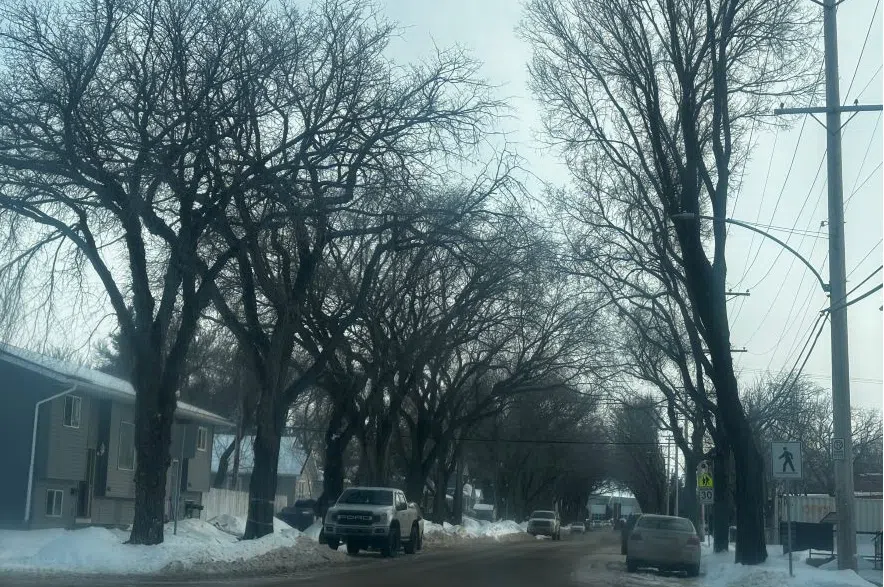
Dutch elm disease is now unavoidable in Saskatoon, according to parks officials, so city council has approved $1.7 million to help the department deal with and dispose of what’s expected to be a higher number of dead and dying trees this year.
The money would come from the urban forestry and pest management capital reserve, which has enough in it to accommodate the ask outside of budget deliberations.
Read more:
During council’s last meeting on Feb. 25th, Konrad Andre, city park’s department operations manager, said there were 41 cases of Dutch Elm Disease in Saskatoon in 2025, up from just four cases in 2023, and 11 cases in 2024.
“The spread is now city-wide, and DED is considered likely to be endemic, meaning complete prevention is no longer feasible,” he said.
According to a map he provided, most of the cases of Dutch elm disease were on the city’s west side, but spread as far east as Sutherland, College Park, and Silverspring neighbourhoods.
Even with dedicated resources, Andre said the numbers of dead trees are expected to dramatically increase in the coming years.
“Without active intervention, DED numbers and canopy loss could accelerate significantly. Early modelling from comparable cities suggests that unmanaged communities may lose 18 per cent of elms per year.
“With strong management, losses can be slowed to two per cent annually. Four our city, a two per cent annual loss would equal approximately 550 elms per year,” he explained.
Around $1.5 million of the extra money is expected to go towards a comprehensive program over the next year, including hiring more seasonal staff for tree surveillance, removal, stump grinding and planting contracts.
“An additional $250,000 for urban forestry vehicles, and equipment,” he added, noting that long term costs to manage the disease will likely grow.
Andre said management has slowed “loss rates” in other Prairie cities, citing Winnipeg where 7,000 elm trees out of 194,000 were lost due to disease in 2024.
This year, administration is expected to complete a “canopy assessment” to gather baseline data, helping guide and inform future loss initiatives.
However, Ashley Thompson, Regina’s manager of parks and technical services says their department believes the disease is preventable, rather than unavoidable.
Both cities will continue taking a “preventative” approach, including informing residents about pruning practices, when bans are in place, keeping an eye out for trees that appear to be in distress or dying, and quickly testing them before disposing of the elm wood in a safe manner.
Andre says all elm wood disposal fees for residential and commercial customers will be waived at the Saskatoon landfill as part of the comprehensive Dutch elm disease response.
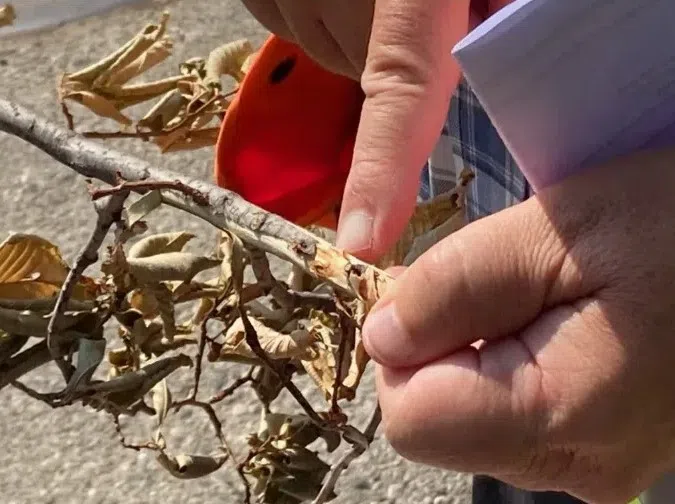
Evidence of Dutch elm disease on a removed branch. (980 CJME file photo)
A province-wide ban on pruning elm trees is in place every year from April 1 to Aug. 31 to make sure that elm bark beetles that transmit Dutch elm disease aren’t attracted to newly pruned trees.
There are provincial regulations against storing, transporting and using elm wood for any purpose, including using the wood for chips, wood slabs and firewood.
Elm wood should be disposed of at a landfill and not taken to a compost depot or put in a green bin. It should be disposed of immediately, even if it is during the provincial ban.
Trees may start to show evidence of Dutch elm disease as early as June. Typically, the leaves will start to wilt and turn yellow, then curl and turn brown.
Anyone who suspects an unhealthy elm tree or is unsure what type of firewood they have should take a photo and complete the online form or call the city’s Urban Forestry department.
—with files from CKOM News
Read more: