Evan Bray: Fall is the my pick of the seasons
It isn't quite fall yet - the season officially changes next week - but Evan Bray says fall is his favourite season, wit...
A newly published report from the Canadian Centre for Policy Alternatives (CCPA) found the rate of child poverty is worse in Saskatchewan than any other Canadian province.
According to the CCPA report, which was released on Wednesday, more than 78,000 children under the age of 18 in Saskatchewan were living in poverty in 2023. It makes for a child poverty rate of 27.1 per cent, an increase of 1 per cent from 2022.
Read more:
The CCPA defines itself as an independent, non-partisan research institute. Peggy Nash, former NDP Member of Parliament, is the executive director.
Manitoba ranked a close second with a rate of 26.9 per cent. In comparison, the national child poverty rate in 2023 was 18.3 per cent.
Saskatchewan’s child poverty rate grows when looking at young children. The report found almost one-third – or 30.39 per cent – of children under the age of six were living below the poverty line in 2023.
Looking at overall poverty rates for that year, Saskatchewan’s was 19.7 per cent –the second highest rate amongst the provinces, getting narrowly outranked by Manitoba.
Depending on where you are in the province, child poverty rates vary.
Northern Saskatchewan’s child poverty rate is the highest at 62 per cent. For comparison, the second highest is in Prince Albert and that’s only 35.4 per cent.
What’s even more concerning for Peter Gilmer, an advocate with the Regina Anti-Poverty Ministry, is the depth of poverty more families are finding themselves in.
“The fact that low-income people are not just living in poverty, but are living in deep, grinding poverty is something that we see all the time,” he said.
As with child poverty rates, Saskatchewan’s poverty gaps are the largest of any province. According to a graph by the CCPA, based on poor families in Saskatchewan, a single parent with one child’s median family income after tax is $19,470 – leaving them almost $18,000 below the poverty line.
Additionally, a poor couple with one child falls more than $16,000 below the poverty line. For both single and partnered parents, that gap between their income and the poverty line increases with two children.
“The depth of poverty is a key factor that people are dealing with,” according to Gilmer.
This data, however, is relative. The figures in the report were pulled from the Census Family Low Income Measure, After Tax.
It defines poverty, “as below the median income of all filers.” If a person or family’s income is below the median for their family size, they’re “considered to be living in poverty,” according to the CCPA report.
When asked whether there were any concerns with this methodology, the provincial government did not provide an answer. It also didn’t answer whether these numbers accurately reflect what’s happening in Saskatchewan.
For Gilmer, “there’s no surprises in the report.”
The report included a list of ideas for improving affordability, like increasing minimum wage, creating a Saskatchewan child benefit, and indexing social assistance benefits to inflation so people don’t lose more of their purchasing power each year.
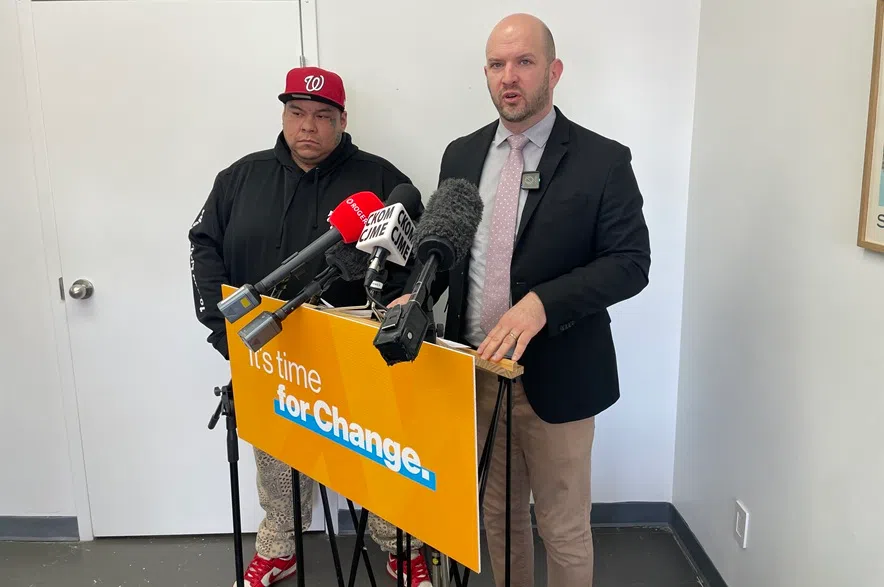
During a press conference on Wed, Feb. 25, Saskatchewan NDP MLA, Matt Love, also said the provincial government needs to remove the PST on children’s clothes and groceries, reverse course on insurance and power bill rate hikes, and bring in rent controls.
This last demand would help parents like Chris Moyah, who said he only had $650 to cover rent in Saskatoon when he was living on social assistance.
On the point of rent control, the provincial government wrote in a lengthy email statement that the average monthly rent in Saskatchewan this past January was $1,371.
That’s, “well below the national average of $2,053 and well below the average rent of $2,347 in NDP B.C., which has rent control, and $1,641 in NDP Manitoba, which also has rent control,” the statement wrote.
In the CCPA report, it found that Regina and Saskatoon had “some of the highest rent increases in the country over last year,” even if prices are still lower than other provinces.
The government also pointed out that PST isn’t applied to essential grocery items, adding how removing this tax on other foods – like candy and pop – would take away revenue from healthcare, education and social services.
While the email included a list of ways the government is working to improve affordability, one noted was the Saskatchewan Low-Income Tax Credit.
“It is a fully refundable, non-taxable benefit paid quarterly to help Saskatchewan residents with low and modest incomes,” and will increase by five per cent each year for the next four years, in addition to indexation, according to the government.
“The taxation changes our government has introduced … provide over $250 million in tax savings this year,” the statement continued.
For Gilmer, this CCPA report ultimately paints “a stark picture about where we’re at.”
The reality is that people in 2026 are much worse off now than, “they were a decade ago,” he said.