Evan Bray: Diversifying trade doesn't mean abandoning U.S. relationship
Evan Bray says there's nothing wrong with Canada looking for new trade partnerships, but the idea of joining the Europea...
The Saskatchewan man who was receiving treatment for a brain tumour and died in a struggle with security at Royal University Hospital earlier this month had already experienced concerns during his time as a health-care patient in the province.
Trevor Dubois had filed a complaint with the First Nations health ombudsperson for Saskatchewan in the fall before his death about the treatment he was receiving while being involved in the health-care system.
Read more:
“That’s appalling. That’s concerning,” said Diane Lafond, First Nations health ombudsperson in Saskatchewan, who shared her office has opened about 550 files to investigate since it began in July 2023.
Though she wouldn’t share further details, citing patient privacy, Lafond did say Trevor’s complaint was “very serious.”
Lafond repeatedly referenced other recent and severe cases that she said represent the mistreatment of First Nations people in the province, including that of Brydon Lafavour, who was reportedly evicted from a hospital in Prince Albert and left outside in a snowbank in December.
According to Lafond, about 20 of the complaints her office is dealing with have to do with protective services. She also noted about 20 serious incidences her office has had reported, with five being “excessive,” all involving Indigenous men.
“Today we stand with the families that are sitting here, that are present to elevate their voices for change,” Lafond said.

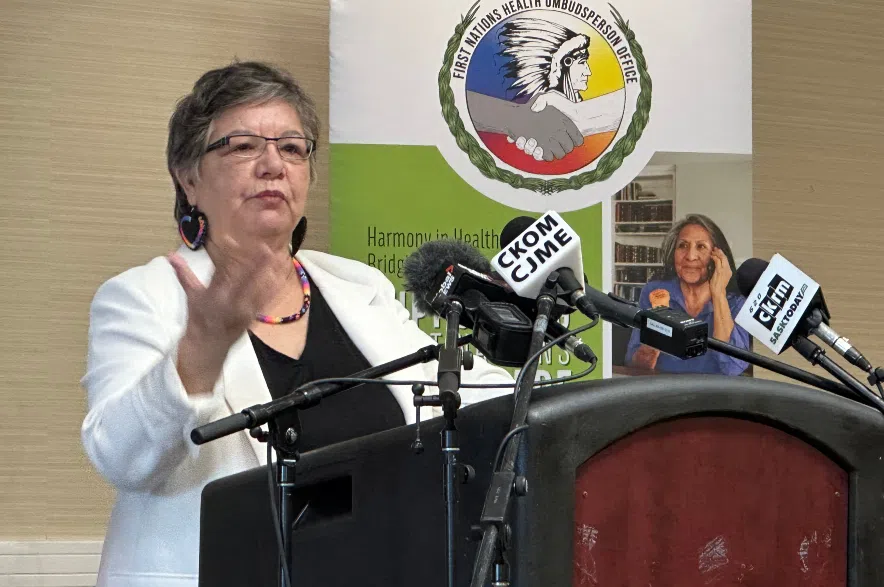
Federation of Sovereign Indigenous Nations first vice chief David Pratt and First Nations Health Ombudsperson Office board chair Heather Bear have a conversation while First Nations Health Ombudsperson Diane Lafond (left) speaks at the Saskatoon Inn on Jan. 26, 2026. (Libby Gray/650 CKOM
Lafond, alongside Federation of Sovereign Indigenous Nations (FSIN) first vice chief, David Pratt, and Heather Bear, First Nations Health Ombudsperson Office board chair, called on the Government of Saskatchewan and the Saskatchewan Health Authority (SHA) for a thorough inquiry, independent of the SHA and Saskatoon Police Service.
While the health authority and the province had announced an independent inquiry into hospital safety and security in Saskatchewan last week, Lafond explained the call on Monday is for an inquiry that is completely independent.
Lafond said the inquiry needs to include First Nations consultation and engagement, with her office and victims and their families who have suffered as a result of what they say is mistreatment in Saskatchewan’s health-care system.
“We want inclusion in the selection of who’s going to be on this inquiry … we want inclusion from our families, to be able to share and tell their stories about what happened to their families,” she said.
“We want to be a part of the process. We want to be a part of the change.”
Lafond said that despite various invitations, the Government of Saskatchewan’s Ministry of Health has not met with her office.
“We have the facts, we have the evidence, and we’re speaking from that today,” Lafond said. “Families come to us and they’re experiencing severe harm in a system that’s supposed to be safe and helpful.”
Lafond highlighted concerns about the announcement last week that metal detectors have been installed in several major Saskatchewan city hospitals.
“We have people that are in extreme mental health crisis. We have people that are having heart attacks and they have to go through a metal detector,” Lafond said. “They could easily collapse right there.
“We don’t want to take our families into the hospital and (have) them leaving in a body bag,” Lafond said. “That should not happen within our health-care system. It shouldn’t, and it’s got to stop now.”
Lafond said Dubois told her office that he wanted to see change in the province with how Indigenous people are treated while interacting with the health-care system.
“I’m disheartened,” Bear chimed in.
She highlighted various frameworks where recommendations for substantial change to the treatment for Indigenous people in Canada have been made, including the Truth and Reconciliation Commission reports and the final report into the National Inquiry into Missing and Murdered Indigenous Women and Girls.
“We’re in the hospitals more than anybody,” Lafond said. “Our health is not where it should be.”
Bear said Indigenous families and communities in the province are grieving.
“It’s very, very sad when our people go to the hospitals and they come out beaten up, they come out in wheelchairs, they come out lifeless,” Bear said.
Pratt added: “Hospitals are meant to be places where people can go to when they’re not doing well, whether they’re mentally sick or whether they’re physically sick, they’re to be safe places.”

Federation of Sovereign Indigenous Nations first vice chief David Pratt speaks to reporters and others, including family members of Trevor Dubois, at the Saskatoon Inn on Jan. 26, 2026. (Libby Gray/650 CKOM)
While Pratt said the concerns being voiced are not meant to attack the health-care system and that many health-care workers are doing an exceptional job, he said it is clear that there is a disservice being done to First Nations people seeking care in the province by some.
This is partly why Pratt and Lafond stressed the importance of an independent inquiry.
“It cannot be health officials investigating health officials … it has to be an independent process (and) not only that, it includes First Nations and the families, so that there’s no tainting of that inquiry, so that it’s not just glossing everything over.”
Pratt wants to see clear outcomes and objectives to ensure an end to situations like that of Trevor Dubois.
In addition to the independent inquiry and its inclusion of First Nations voices, Pratt called for an immediate meeting between the SHA, Ministry of Health and the First Nations Health Ombudsperson’s office.
Pratt also wants to see concrete policy changes that will see tangible change to how First Nations people are treated in the Saskatchewan health-care system and measurable changes, like body cameras to be worn by protective services officers in Saskatchewan hospitals and security camera footage to be kept for longer than 30 days, in case of a need to review that footage.
Lafond noted that “whistleblowers’ — health-care workers who allege to have witnessed concerning behaviour — have also reported complaints to the First Nations Health Ombudsperson’s office, particularly concerning inappropriate treatment of Indigenous people in health-care settings in the province.
She likened the report her office is hoping to see produced to B.C.’s In Plain Sight: Addressing Indigenous-specific Racism and Discrimination in B.C. Health Care.
Read more: