Murray Wood: It's a Monday Melange
From the B.C. NDP being DOA to the Riders, Trump and Murray Wood campaigning for a spot at the trough.
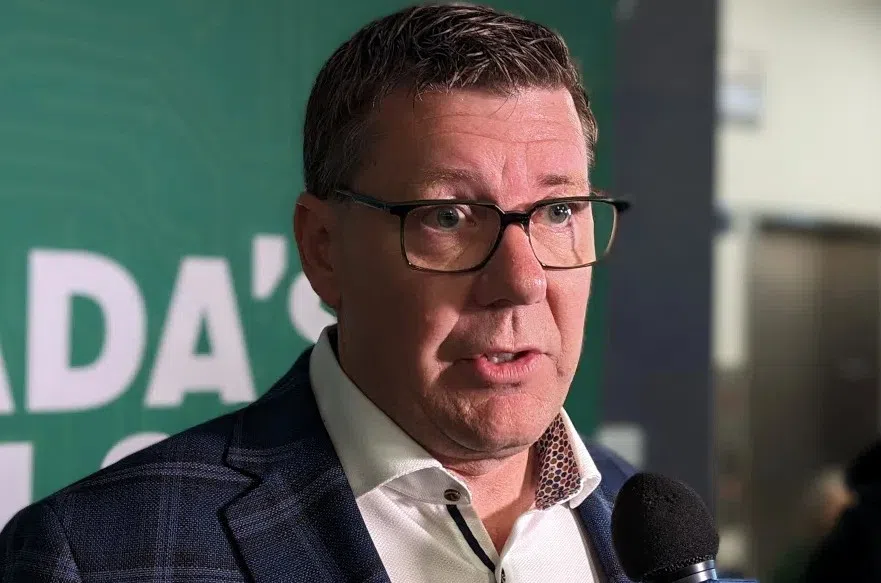
Saskatchewan continues to watch the latest trade tensions between Canada and the United States very closely.
Over the weekend, U.S. President Donald Trump threatened to impose 100 per cent tariffs on all Canadian goods if Canada goes ahead with a trade deal with China.
Mark Carney posted a video to social media urging Canadians to buy Canadian and many premiers across the country weighed in — mostly supporting Carney’s message.
Saskatchewan Premier Scott Moe has already called the tariff threat a further degradation of the free and fair trade system Canada has depended on for decades.
He joined the Evan Bray Show to talk about what these threats mean for the province and what Canada should be doing next.
Read more:
The following questions and answers have been edited for length and clarity.
Evan Bray: On the weekend, you called this tariff threat a degradation of the free and fair trade system. Why?
Scott Moe: I think we have had a great free trade system dating back to NAFTA, despite what the president may have commented on before, but for the economic strength of North America, Canada included. That has evolved and morphed into the current-day USMCA, or CUSMA.
I think it is going to evolve or morph once more, as we do a review of that. We should never take that for granted; that’s our largest trading partner. However, as we look around the world, we need to continue to push for access to other markets as well, so that we are not reliant entirely on any one nation around the world and really work together as Canadians, from an economic perspective, to ensure we are determining our own destiny when it comes to the products that we produce and where we’re selling them around the world.
There’s no threat of backtracking on this China deal, correct?
Moe: There can’t be. If we’re truly serious about diversifying our trade and not being entirely reliant on any one nation, including the United States of America, that doesn’t mean we shouldn’t aspire to trade with the United States of America. They will continue to be our largest trading partner for the benefit of both of us, I might add. We need to always be working towards, in this case, restoring market access, but I would say also where we can expand some of our market access in other countries around the world, and there are some opportunities out there today for us to really be taking a serious look at.
I think back to when we were first dealing with the threat of tariffs. There was a lot of speculation, like what would this level of tariff mean for Canadian businesses? When we look at what the president said this weekend, do your thoughts go there? Or are you acknowledging it, but moving past it, given the fact that there’s been a lot of false threats that have happened over the last few months?
Moe: If you just go back, and I’ll just name a few off the top of my head; our military spending was an issue. There were tariffs that came in. The ads that were run were an issue and tariffs were consequences to that. The potential discussion around backing away from the F-35 purchases, which precipitated some discussion around tariffs, as well as the Davos speech, or the restoration of some of our trade with countries like China. They’ve all precipitated a reaction from the president. I noticed this week that he initially was fine with us, restoring some trade with China, and then all of a sudden, wasn’t.
You need to take what the president says very seriously. But this seems to be the new normal, that there are tariff-related policies that will be put out on social media and then, I won’t say walked back, but worked through. I think that’s the lesson for us, whether it be with a country like China most recently, and some of the successes in restoring trade there, but also with the U.S. We need to be at the table and we need to be negotiating and representing Canada’s interests at that table. And Dominic LeBlanc is the guy down there and I think he should, in many ways, take up residence in Washington, D.C.
Federal ag minister, Heath MacDonald, indicated that he wasn’t privy to the conversation, but felt like there was some heads up given to the United States that this trade deal with China was forthcoming, which is potentially why that initial reaction from Trump was so passive. Do you think that Trump’s reaction is probably less about the trade deal and more about his frustration with Carney’s comments?
Moe: I lean towards that maybe being the case. But at the end of the day, it doesn’t matter. We need to take care of ourselves in our global trade relations, and we need to take care of ourselves as Canadians and our trade relationship with the United States of America. So we need to be in countries like China, but we also need to be at the table in the U.S. as well.
There’s a lot of noise, and I used to say, every week, things changed; now it’s three or four times a week things change, and that seems to be the new normal. The trade negotiations, as we historically have been able to have them, where it’s multi-country, multi-sector, and we negotiate and everybody signs, those days are over for the foreseeable future. Trade negotiations and deals now are specific sectors, usually between two countries, just essentially a memorandum or a commitment to move forward in a non- or low-tariff environment, and this speaks to the importance of being in the markets. As government leaders, we need to be side by side with producer associations and representatives in those markets where we want to do business around the world.
Prime Minister Carney had said this, and I think one of our senators from Saskatchewan had said it about a year or two ago; if you’re not at the table, you’re likely going to be on the menu. I think that’s an incredibly good analogy for what the future looks like for Canada, and specifically for our concerns in Saskatchewan.
Are you confident that we’re going to get a CUSMA deal?
Moe: I don’t know if it’ll be a CUSMA deal. CUSMA was negotiated among three countries, multi-sector, with many, many months, if not years, of negotiation going into what was the revamp of NAFTA at the time. So, I don’t know if we will. It may be more of a sector-by-sector approach with the American government, much like it was the agreement that we just had with the Chinese government, which was a number of specific sectors, which we both have an interest in and a commitment to move forward in that space. So I would ideally love to have CUSMA extended. I think it’s a tremendously strong agreement for North American economic security, thus North American General Security, whether it be energy, food, or keeping our country sovereign. However, in today’s day and environment, you need willing partners around the table, and I don’t know if the U.S. is going to be.
Can you give us some insight about the talk that you would have been privy to and at the table for amongst the Canadian premiers back in the spring of 2025, versus what the chatter is today? Is there a more consolidated approach today?
Moe: There are definitely differences. We’re going out to Ottawa tomorrow for meetings on Wednesday and Thursday. I might be part of those differences as well among the premiers. Our economies are driven by different industries. Manitoba’s Premier Wab Kinew has a very different view on Crown Royal Whiskey than (Ontario Premier) Doug Ford does right now. However, when it comes to determining our own destiny, being in the market and negotiating an acceptable trade deal with the United States and with Mexico, I think we’re fairly aligned. But we’ll have to move very quickly in the interest of placing and positioning the Canadian economy, the entirety of it, in what is a very different negotiating environment than what we’ve been used to over the last number of decades.
You’ve been heavily involved over the last year, for sure, since there’s been some uncertain waters with regard to geopolitical trade. What is your message this morning to Saskatchewan?
Moe: We need a steady hand in what we do, in producing the products that we do. Have some faith that we are going to find our way to the other end of this very uncertain time and know very well that your provincial government is working with whoever we can, traditional and non-traditional allies, I might say, both politically and in the economic sphere, as well as globally, to ensure that we have as much our market access as we possibly can.
That is notwithstanding, there are some choppy waters in the short term, and I’ve said that in my year-end interviews. But a steady, firm hand is going to be what leads us to the best place possible in the future. Have faith in what we do. The world most certainly needs what Saskatchewan has, including the United States of America, and we are positioned very well as a province and as a nation to be a significant part in these negotiations.