

Murray Wood: All hail the placekicker! Except when he misses
Alex Hale was supposed to make us forget about Brett Lauther, but how can we? Murray Wood says Hale has struggled, while...
Environment Canada is encouraging people to be prepared for a multiple-day stretch of extreme cold weather.
Meteorologist Danielle Desjardin said these are the coldest temperatures we’ve seen so far this year.
Read more:
“We’ve dipped into anomalous cold,” she said. “So Arctic air for the next several days.”
Desjardin said if people are travelling to remember to pack an emergency pack with candles, blankets and matches.
She said windchills will drop down to -50 C in some areas and people will need to bundle up.
“If you’re going outside, dress warmly in layers and then try to keep any skin covered up and not exposed directly to the cold,” Desjardin said.
She encouraged pet owners to be wary of taking the animals out for long walks.
“If it’s cold for us, it’s cold for the animals as well,” Desjardin said. “So try to keep them indoors too.”
Cold warnings from Environment Canada covered all of Saskatchewan on Friday morning, with the weather service warning that wind chills could drop as low as -45 C.
“Wind chill values may improve slightly during daytime hours, but are expected to drop back below -40 each night for the next several nights,” Environment Canada said in a statement.
“Cover up. Frostbite can develop within minutes on exposed skin, especially with wind chill.”
With temperatures forecast to continue to plummet across the province, CAA Saskatchewan is warning that even routine winter driving could become dangerous if a vehicle fails or people become stranded in the extreme cold.
“When temperatures get this low, preparation is not an option anymore,” said Angel Blair, a spokesperson for CAA Saskatchewan. “Before you leave, drivers need to make sure both they and their vehicles are ready for what they might face on the road.”
Blair said extreme cold temperatures add strain on nearly every part of the vehicle. She said checking tire pressure and brakes is especially important, as both could be affected by plunging temperatures.
“Cold weather changes how your vehicle performs,” she said. “If something is already borderline, extreme temperatures can push it over the edge.”
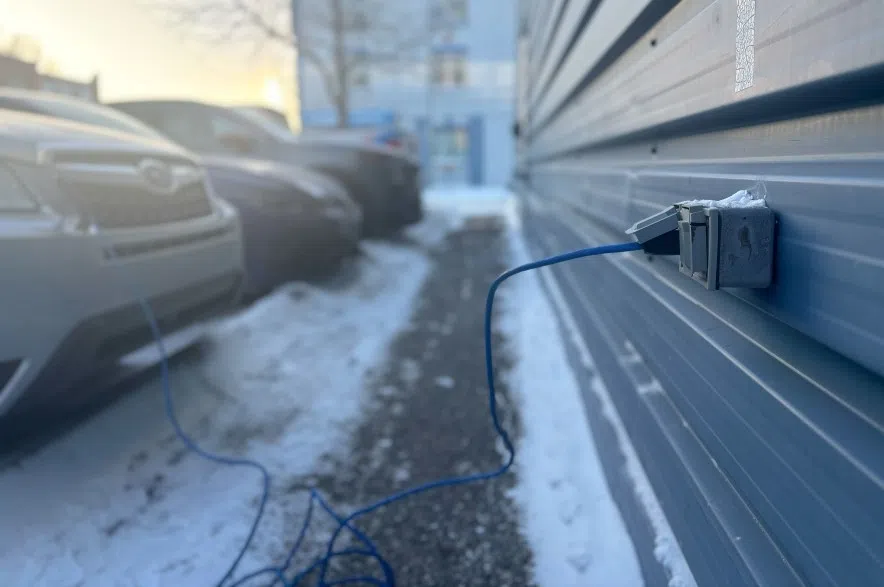
CAA also emphasizes the importance of plugging vehicles in once temperatures drop to -15 C or colder.
“That’s one of the simplest things drivers can do to avoid problems,” Blair said. “Warming the vehicle up can make a huge difference when it’s this cold.”
Fuel levels were another focus. Blair said drivers should always fill up in extreme cold, even for short trips.
“Keeping your tank half full adds weight and helps reduce moisture buildup,” she said. “It also gives you more options if traffic slows or conditions deteriorate.”
For drivers travelling outside city limits or heading out on longer trips, Blair said carrying a roadside safety kit could be the difference between an inconvenience and a serious situation.
“In this kind of weather, layering is critical,” she said. “Proper winter clothing: mitts, toques, insulated boots, should be in the vehicle.”
She said emergency supplies should also include practical tools that help drivers stay safe while waiting for assistance.
“Things like a phone charger, non-perishable food, water, a shovel, ice scraper, snow brush and booster cables are all important,” Blair said. “They’re small items, but they matter when help isn’t immediate.”
If a vehicle breaks down, Blair said drivers should resist the urge to leave their vehicles to look for help.
“Staying inside the vehicle is often the safest option,” she said. “It provides shelter from the wind and cold while you wait for assistance.”
CAA’s roadside assistance remains available around the clock, Blair said, but the extreme cold has led to a spike in calls.
“We’ve seen 45 boosts in Saskatoon, with 40 in Regina since midnight, with a typical wait time of 90 minutes,” she said.
“People should be prepared for longer wait times.”
Lots of people still have to work outside on days with frigid temperatures, including firefighters.
“It’s a challenge in the extreme cold,” said Regina’s deputy fire chief Gord Hewitt.
He said firefighters have to do things a little bit differently in extremely cold temperatures.
“In temperatures like this, if you don’t keep the water flowing through the hose, the hose line will freeze up very quickly and basically render the hose useless,” Hewitt explained.
Hewitt said that means firefighters have to make sure the water continues to flow through the hoses on top of all the other requirements.
He said the fire department also brings in its operational support unit so they can rotate crews, as their firefighting gear isn’t always warm enough.
“They do provide some warmth, but obviously, when extreme cold mixes with spraying water, they’ll be cold,” Hewitt said.
“That is why it’s always important for us to make sure that we are rotating them through and trying to keep them as dry as possible.”
Despite the challenges in the extreme cold, Hewitt said firefighters in Regina do a great job regardless of the temperature.
The latest updates on the weather alerts can be found on Environment Canada’s website.
–with files from 980 CJME’s Abby Zieverink, Gillian Massie and Jacob Bamhour