Murray Wood: It's getting better all the time
Even if it seems - as the rejoinder in the Beatles' song observed - 'it couldn't get much worse,' Murray Wood suggests w...
The lights go down and the room responds instantly. Voices collide into a single roar that presses in from all sides.
You roll your shoulders, steady your breathing and focus on what’s ahead of you. Across the way, your opponent waits. You’ve seen them before. You’ve studied how they move, how aggressive they get, where they tend to over commit. You know what you’re walking into.
There’s a weight limit. A strict one. You made it, barely.
This isn’t your first match, but it never gets easier. Three minutes is all you’re guaranteed.
The signal comes. The crowd explodes.
Impact is immediate. Violent. Every hit draws a reaction from the crowd.
You adjust. You press. You look for the weak point that will lead to a knockout.
Tomorrow, you won’t be icing swollen knuckles or explaining a black eye.
You’ll be straightening bent armour. Swapping motors. Replacing shredded wheels. You’ll be figuring out what failed, what held and how to make it stronger before the next match.
Because the fighters in this room aren’t people.
They’re robots.

Spinners, sharp blades, hammers… almost no weapons are off limits in this wild sport. (Brittany Caffet/650 CKOM)
More than twenty years ago, Kurtis Wanner was an engineering student with a problem.
“Back in 2003, I wanted to get into fighting robots,” he explained. “That didn’t exist here.”
So Wanner and a group of other students did what engineers do best. They built it themselves.
They formed their own group. They built robots. They fought them.
But soon, they ran into another problem. They couldn’t get parts for these machines.
“We started by just going to the hobby shops in town and finding what they had,” Wanner said. That meant model airplane wheels, RC car parts, anything that could be repurposed. Even the basics didn’t exist. “There was no good way to keep a wheel on a motor shaft.”

The top bot is one of the very first made by Wanner. His combat robots have come a long way since 2003! (Brittany Caffet/650 CKOM)
That conundrum became the foundation for FingerTech Robotics. The Saskatoon-based business founded by Wanner designs its own components, prototypes them locally and manufactures parts in metal, rubber and plastic.
Wanner said they carry “probably the largest selection of combat robot parts in the world,” including full kits for beginners.
“Even if you go to the big TV show, BattleBots,” he said, “a lot of those people will have started their journey with one of our kits.”
Wanner knows that path firsthand. He competes on BattleBots as part of the Witch Doctor team.
From a small Saskatoon workshop, FingerTech Robotics has quietly helped shape an international sport.
[/vc_column_text][/vc_column][/vc_row]
At its core, combat robotics is simple. You build a robot. You put it in an arena. You try to disable another robot. You have three minutes.
That might mean flipping your opponent upside down so they can’t drive, tearing off wheels, puncturing armour or ripping into electronics. If neither robot dies before the clock runs out, judges score the fight based on aggression, damage, strategy and control. But Wanner is honest about what everyone really wants.
“It’s a lot more fun when it ends with a knockout,” he laughed. “Everyone loves a dead robot.”

The body of this robot was made from the FingerTech Robotics Viper kit, one of the shop’s most popular items. (Brittany Caffet/650 CKOM)
The robots come in weight classes, most commonly one pound, three pounds and an even trickier 150-gram class. The machines may be minuscule compared to the massive 250-pound machines seen on television, but the smaller classes are no less intense. Spinning weapons can reach thousands of revolutions per minute. Blades rip, tear and throw sparks against the arena walls.
The designs are endlessly creative. Vertical spinners that deliver uppercuts. Undercutters that go straight for the wheels. Crushers with titanium teeth capable of exerting hundreds of pounds of force. Flame throwers. Some robots use magnets near their wheels to grip the steel floor, effectively making themselves heavier than their opponents. Others rely on gyroscopic forces, dancing unpredictably on a spinning blade when knocked off balance.

The Wanners have two sons who are both already diving into the world of combat robotics. The pair put their ideas down on paper, then ask their dad to help make them a reality. (Brittany Caffet/650 CKOM)
There are rules, but they’re built around one guiding principle: giving the crowd a show. No explosives. No liquids. No invisible damage. “The point of this sport is to be entertaining,” Wanner explained. You should see exactly why a robot stopped moving.
And once it does, the clock starts ticking.
Each combat robotics event is a tournament. You might have as little as 20 minutes to repair your machine before your next match. Motors get swapped. Screws get replaced. Knowing how to fix your robot under pressure is as important as knowing how to drive it.

The arena where the robot battles takes place has a steel floor and is surrounded by plexiglass, ensuring all of the flying robot parts stay contained. (Brittany Caffet/650 CKOM)
For a sport built around smashing machines into scrap, combat robotics is unexpectedly kind.
“Once you get in there, you are doing your best to win,” Wanner said. “But as soon as the match is done, you are best friends with the person that you just destroyed.”
Competitors loan each other parts. They offer advice. They help rebuild the very robot they just knocked out. These moments happen at Kilobots events, small tournaments held in Saskatoon and Calgary where hobbyists bring their robots to battle head-to-head.
Prizes aren’t just for winners. Awards go to best sportsmanship, most creative design and even the robot that gets destroyed the most but keeps coming back for more.
The competitors themselves reflect the community’s wide reach. Wanner has seen participants in their 70s and as young as five. One memorable team paired a young boy with his grandfather. “The grandson would just go for it and destroy his robot, win or lose, and then just hand it to his grandfather when he was done, and say, ‘I need this ready soon,'” he recalled with a chuckle.

Participants start with a basic robot body during the Build and Battle workshops. They then customize their bot with 3D-printed weapons and attachments. (Brittany Caffet/650 CKOM)
The sense of welcome that combat robotics offers is something Valérie Wanner, Wanner’s wife and business partner, works hard to protect.
She’s also an engineer. They met in a robotics class. Robots, she says, are no longer just part of their work. “It’s our life. Robots is all we do.”
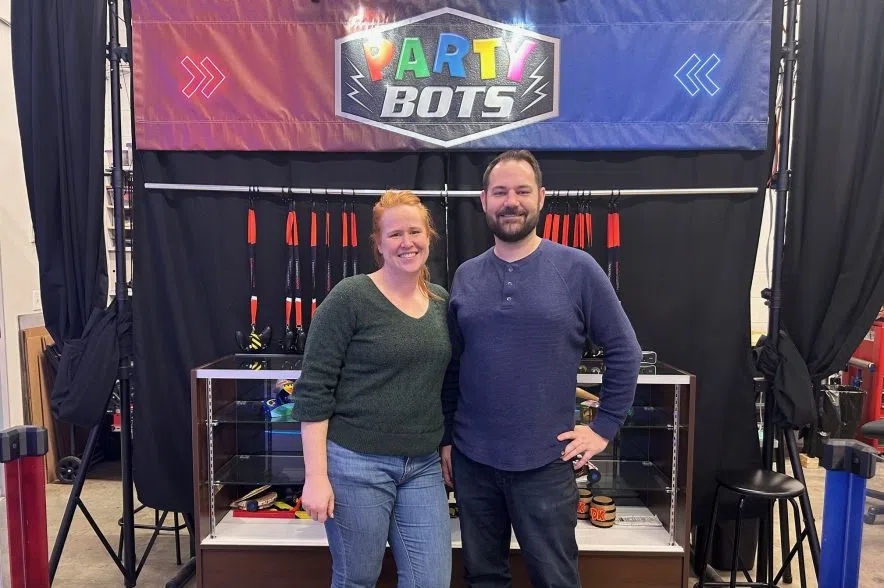
Over the years, their business has grown beyond FingerTech Robotics, which supplies parts and kits to builders worldwide. Now, it also includes Party Bots, where they focus on making the excitement of combat robotics accessible to beginners and kids.

All of the robot combat fun with none of the danger. The robots used for kids’ parties are 3D printed. No sharp blades or flame throwers in sight! (Brittany Caffet/650 CKOM)
Valérie spends her days guiding people through building their first robot, helping them tweak a lifter or hammer or letting them take the controls in a safe, competitive match. “People want in,” she said. “They just don’t always know where to start.”
In their build-and-battle workshops, small groups work through the basics: how motors work, how power flows, how all the pieces come together. Valérie calls it “stealth learning.” The kids don’t always notice they’re learning engineering principles. They’re too busy building.
Once the base robot is done, creativity takes over. Armour placement matters. Weapon choice matters. Kids discover, through trial and error, that a design that looks cool might not drive well. Some workshops introduce tasks like pushing opponents or collecting objects, forcing participants to rethink their designs and adapt.
“The goal,” Valérie explained, “is to make them makers.”

The Party Bots are controlled remotely through handheld controllers. The battles are held in a tournament style, eliminating robots one by one until the winner is declared. (Brittany Caffet/650 CKOM)
Few would expect it, but Saskatoon has quietly become the country’s robot hot spot.
“People don’t think that little Saskatoon has anything to offer,” Wanner says. “But FingerTech has been in Saskatoon for so long that this is kind of the hub now in Canada for combat robotics.”
That’s why they host events. Not for profit. Not for hype. Just to hear the crowd react when a big hit lands.
“That’s why we do it,” Wanner said with a smile. “To entertain people.”
This weekend, the Kilobots arena inside FingerTech will come alive.
Motors whir and blades hum. Builders scramble with tools between matches. The crowd leans in as the first sparks fly.
For three minutes, it’s chaos. Destruction, repair, repeat.
And somehow, it never, ever fails to thrill.
This weekend, the Kilobots arena at FingerTech Robotics will come alive for Kilobots 63, one of the biggest combat robotics gatherings in Canada.
Date: Saturday & Sunday, January 24–25, 2026. Fights start at 12 p.m. Saturday, 11 a.m. Sunday.
Location: FingerTech Robotics HQ, 3111 Millar Ave #20, Saskatoon, SK
Cost: Free admission for all ages.

Kurtis and Valérie Wanner of FingerTech Robotics and Party Bots are guiding kids and hobbyists into the thrilling world of combat robotics, where sparks fly and machines clash in epic battles. (Brittany Caffet/650 CKOM)