Evan Bray: Harvest time brings back memories of home
Evan Bray recently spent some time on his family's farm, helping with harvest. He says it's a special time of year that ...
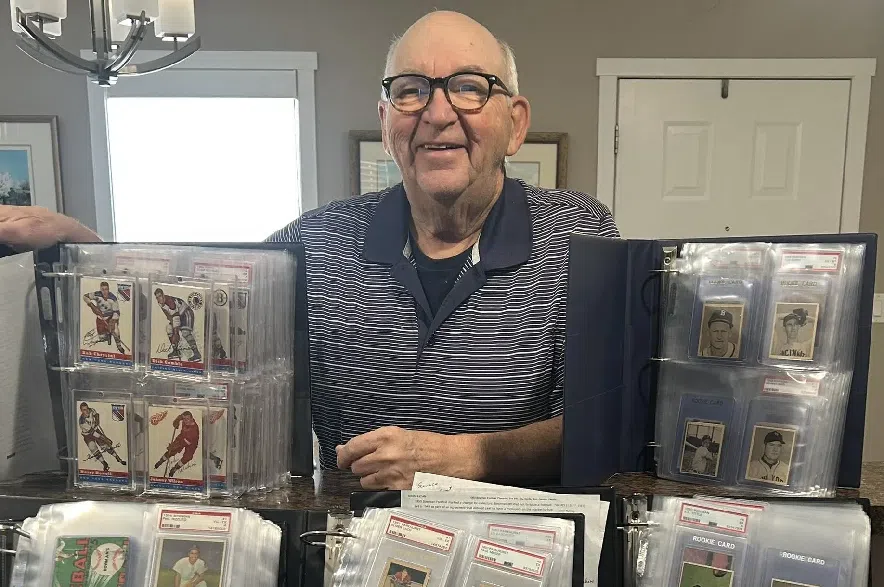
Barry Firby was just a boy in the 1950s when he fell in love for the first time.
“I fell in love with the Montreal Canadiens, because they were winning,” he recalled with a laugh. “That really got me started being a sports fan. I’ve been totally addicted to all sports since then.”
What began as admiration would become accumulation, then an obsession, then, quietly, a life’s work. Now, Firby is preparing to let go of his most treasured possessions. In 2026, large portions of his extraordinary sports card collection will be auctioned off in multiple lots through Classic Auctions, the world’s largest auction house for hockey cards and memorabilia.
It’s one of the most significant dispersals of a private collection the company has handled, and for Firby it represents a rare and uneasy moment of finality.
The story of this lifelong card collector, surprisingly, doesn’t even begin with a card. It was a promotion from the St. Lawrence Starch Company.
“We would buy their Beehive Syrup, and on the top there would be a white little collar that was a redemption collar,” Firby recalled. “You could send it in a letter off to to St. Lawrence Starch Company in Ontario, and you could ask them for a picture of whichever hockey player you wanted.”
The young sports enthusiast said he couldn’t get those letters mailed off fast enough.
“Of course I got Gordie Howe and then, you know, my hero, Jean Béliveau,” he noted, smiling at the memory. “They were my first two. I collected those for a number of years, so that was what got me really kind of hooked”
The ritual of collecting deepened with cereal boxes.
“The first cards were actually cut outs on the back of Post cereal,” he said.
Six at a time, carefully trimmed, laid flat and preserved. Baseball. CFL football. No sport was off limits. And even as a child, Firby collected with intent.
“I’m obsessed with organization. Simple as that,” he explained. “I was very careful with them from the get go. I don’t have a card in my entire collection that had a crease in it.”
When the owner of Classic Auctions visited Firby’s home to see the collection for himself, the reaction was immediate. Firby recalled the owner saying he had “never seen any sets that are as consistent.”
For much of Firby’s life, card collecting was a slow, patient pursuit carried out by mail, word of mouth and trust.
In the 1960s and ’70s, information came from prediction magazines and publications, their back pages packed with small ads from U.S.-based dealers.
“We didn’t have any dealers in Canada at that point,” Firby recalled.
If you wanted something rare, you wrote letters, waited weeks and hoped the card that arrived matched the description. Then came the collector newspapers.
“Someone had the brains in the industry to create a newspaper… called the Collector’s Digest,” Firby said.
It was page after page of ads. Buying, selling and trading. For Firby, it cracked the world open. Then one listing, placed by a dealer in Los Angeles changed his collection forever.
“I saw a fellow… had two complete sets for sale,” he said. “That struck me as ‘Wow.'”
By chance, a family vacation took him to California where he met the seller face to face.
“He had them in a binder. There they all were. They were very good shape,” Firby said.
Firby bought both: the 1948 Bowman baseball set and the 1950 Bowman NFL set, which are now among the most significant pieces heading to the auction block.
The Internet, when it arrived decades later, once again transformed everything for collectors. Suddenly, cards that once took years to track down were visible with a few clicks. For Firby, it wasn’t about buying more, but about refining.
“I spent probably the last 20 or 30 years… upgrading some of these cards that were 70 and 75 years old,” he said.
The hunt shifted from ownership to excellence; from having a card to having the right one.
In an industry now driven by instant access and global bidding, Firby used the digital age not to rush, but to perfect what he had already spent a lifetime building.
Deciding to part with the collection wasn’t about losing interest. He said it was about understanding when a lifetime’s work is complete.
“The pride and satisfaction that I’ve had over the years, and the absolute enjoyment of the hobby has put me in a place where I’ve come to grips with it,” Firby said. “I’m proud of what I was able to do. And, you know, nothing lasts forever.”
The cards are ready to move on, carrying decades of restraint and care with them, but that doesn’t mean the collector inside Firby is gone for good. He’s realistic, but honest with himself.
“Once a collector, always,” Firby admitted with a laugh.
“I’m not foolish enough to think that I can just go cold turkey.”
He expects he’ll still chase a handful of special cards, maybe “some PSA nines or PSA 10s of some of my favorite players,” just enough to keep the thrill of the hunt alive.
When asked what advice he’d give young collectors, Firby doesn’t talk about value or profit. He talks about care.
“Take one of each and put it in proper sleeves,” he said. “Keep the ones that you really cherish and protect them.”
As Firby’s collection begins crossing the auction block in 2026, bidders will see pristine cards, complete sets and historic names. What they won’t see is the boy licking envelopes in exchange for black-and-white photos, the patience of weeks waiting for mail or decades spent quietly upgrading a collection, card by card. But it’s all there, embedded in the condition, the consistency and the care.
Barry Firby’s first love came early. It never really let go. And even as the collection moves on, the collector remains.
Kenaston’s Barry Firby has meticulously collected sports cards for more than 70 years, building complete sets with unmatched care. His collection is set to be auctioned off by Classic Auctions over the coming year. (Classic Auctions/Facebook)