
Murray Wood: Is it fake, or just stolen?
People looking for news on Facebook need to watch out for fake content. And even if it's true, it may have been stolen. ...
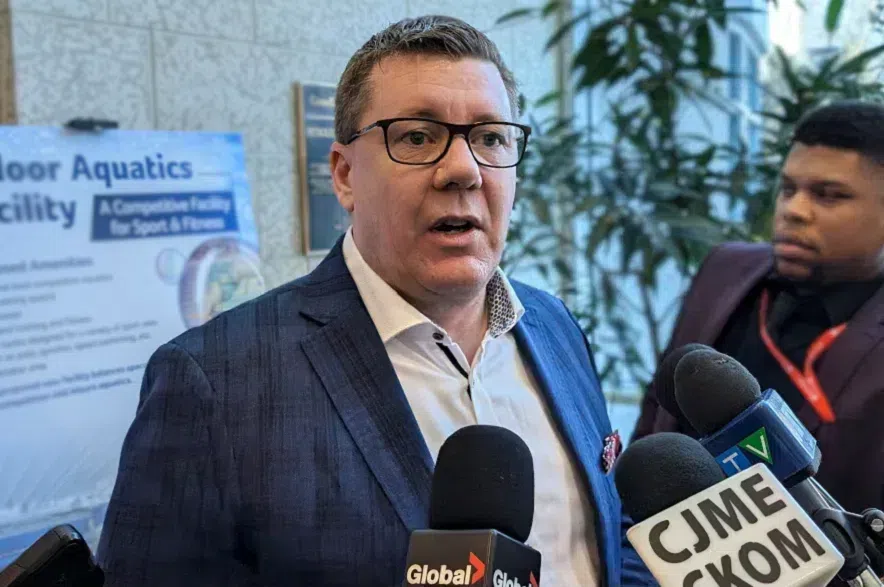
Saskatchewan’s premier says the U.S. strike in Venezuela over the weekend highlights the need for Canada to diversify its trading partners.
Premier Scott Moe joined the Evan Bray Show on Wednesday to share his thoughts on the uncertainty surrounding almost all of Canada’s international relations. Moe said he welcomes an upcoming trip to China by Prime Minister Mark Carney, and emphasized the importance of getting Canadian oil and other resource products to markets around the world.
Read more:
The following transcript has been edited for length and clarity.
EVAN BRAY: I welcome Premier Scott Moe for his first visit of 2026 this morning by phone from his office. Premier Moe, thank you so much for taking the call.
SCOTT MOE: Happy new year to you, Evan. And a very merry Ukrainian Christmas to a good portion of the province of Saskatchewan as well.
Have you had a Ukrainian Christmas meal before, premier?
MOE: I have. It’s bigger than a regular Christmas.
It’s quite the experience, for sure, so I know there’ll be a lot of people enjoying those today. OK, let’s talk about Venezuela to start. Maybe just give me your thoughts, if you don’t mind. What does this mean for Saskatchewan in terms of all of this talk around the redevelopment of their oil?
MOE: It’s important just to understand a little bit that a barrel of oil is not, essentially, a barrel of oil. There’s heavier crude, lighter crude, different types of oil. The thing with Venezuela is they actually produce a very close product to what we produce, not only in Saskatchewan but in Alberta as well. And so, to some degree, it’s interchangeable with western Canadian oil, and that’s, I think, the basis of where our concerns come from. Should some of that oil shift from where it’s going now, which is largely China, to the U.S. – it’s about a million barrels a day. It’s fluctuated up to a high of three million barrels a few decades ago, but through a lack of investment by their state-owned company that that’s down to about a million barrels a day. There’s a lot to happen in order for Venezuelan oil to come and replace Canadian oil, or Saskatchewan oil, which largely goes to the U.S. Ninety-five per cent of our oil goes to the U.S., because we don’t have that market or that ability to send it to the west coast and send it to the rest of the world. And so I think the concern that we would have from our province – and Alberta likely mirrors this concern – is should that Venezuelan oil see some investment and divert its not only existing production, but additional production, into the U.S., displacing Canadian oil, which I don’t think it can easily do, we would have to then be able to provide our product to other countries around the world, which I think we should be doing anyway. Thus the importance of the MOU that was signed by Prime Minister Carney and (Alberta) Premier Danielle Smith, and I think the more immediate conversation that we need to get very serious about is can we expand some of the capacity in existing pipelines that we have, like TMX, to the west coast? It’s a light product. A lot of investment needs to happen in order for it to A) get to the U.S. and B) increase any of their production numbers. And so I don’t think it’s an immediate threat, but it’s one that we should certainly be paying attention to and doing the right thing by providing the world access to the products that we’re producing in Western Canada today. And I think we have ample opportunity to expand our production in the years ahead if we make the right decisions today. So that’s, in a nutshell, what’s happening here.
Does this help the message that is delivered to Ottawa on the importance of oil for our country? I’ve heard our federal politicians speak about “Well, Venezuela isn’t necessarily attractive in terms of investment right now, because there’s not a lot of stability.” You and I have talked about the policy and regulation in Canada that also disincentivizes investment in our oil industry. Will this change things?
MOE: I think it definitely changes things when the president of the United States does what they have done in the last week, expressively because they have an interest in accessing the Venezuelan oil. So certainly, things have changed, and things are changing in a big way. I liken it to a race, and I think we’ve been in this race for quite some time, but we are now in a race where the American companies are going to make investments in the Venezuelan oil industry. We need to ensure that we’re making parallel investments in providing our oil industry access to the world, or providing, I guess, in reverse, the world access to our Canadian oil industry. That’s through expanding TMX and the capacity we have there. That’s through doing the work. And there’s some work that needs to be done on the engagement side. And I think you saw the minister of energy in Alberta commit today to doing some of that work on the on a new pipeline to the west coast as well. And you know what? I heard (B.C.) Premier (David) Eby talk about increasing our refinery capacity as well.
And what do you think of that type of investment?
MOE: I think that’s a good idea. However, it’s been premiers, largely, I would say, NDP, premiers like Premier Eby that have really been hesitant, resistant, not advocating in any way for a regulatory environment where that investment could actually come in to British Columbia or Western Canada to build a new refinery so that we can be producing a refined product. But I welcome his change of heart in that space. And there’s an opportunity there as well, but we have to get very serious. And you mentioned this at the outset, about the regulatory environment that we’re operating it within here today to ensure that we have the stability of our existing supply, having access to the world, not just to the United States. I said earlier, Saskatchewan is 95 per cent reliant on the United States by default. And second we have to have a regulatory environment that’s attracting that investment to increase our production and maybe even increase some of the refining capacity and providing that to the world. All good ideas.
Premier, before we move on to another topic here, I have just one more question on oil. I’m wondering about the fluctuation in the markets when it comes to oil prices and what that will mean for our budget. I think our budget number pegged oil prices at $71 a barrel. It’s down in the 50s right now. Can you give us thoughts on that?
MOE: Yeah, we’re off and everyone’s off. Alberta is off. Newfoundland’s off. Canada’s off on their budget as well, with respect to where the oil prices are versus what it was projected by industry forecasts and investor forecasts at budget time. So we will be down. I don’t have the number on me at the moment, but we will be down on what our oil revenues are. However, I believe our productions continues to increase ever so slightly, and I think there’s opportunities for us to increase it quite dramatically, should we have that more solid investment environment and a commitment that we’re going to be able to access the world with Saskatchewan and Canadian barrels of oil. But it is going to be a challenge in the near term for not only the federal government, but Saskatchewan, Alberta and to some degree Manitoba as well.
We’re about three months away from the next budget. Is it fair to say there may be a more conservative estimate?
MOE: Well, how we arrive at the estimates on potash, uranium, oil, or any of the goods and the royalties that we have on behalf of the Saskatchewan people is the industry estimates that come out over the course of the next year, but they come out as we near budget time, and so that’s what we use. That’s what we use every year, and I will likely use them again, but I would expect that those estimates will be down from last year, certainly. But we’re living in a pretty erratic time when it comes to natural resource pricing around the world. Market access, tariffs, all of those things that are impacting many Saskatchewan and Canadian products around the world. I said in our year-end interview, uncertainty was certainly the word of 2025, for the economy, anyways, and I think that seems to be continuing in the first few days of 2026.
Prime Minister Mark Carney has given you credit, Premier Moe, for the work that you have done, the groundwork, the relationships you built, with China. We find out this morning that he is planning a visit to China next week, and agriculture, tariffs is on the agenda. This is probably not news to you. Can you talk about the discussions you’ve had with the prime minister on this?
MOE: Yes, and this is a a good thing, to be, I guess, fostering or increasing the relationship that we have with not only China, but our credibility more generally in the international space or sphere. It’s that credibility has been neglected over the course of the last decade by the previous guy, and Prime Minister Carney does appear to be placing a fairly high focus on increasing Canada’s credibility in the international space, and that includes engagement with China. The second thing I’d say is, if we are truly serious about diversifying our economy to many countries around the world, this is one of the largest, and so any diversification efforts of selling existing products, like maybe oil, like canola, we want to increase our sales of canola into places like China – and other products. China has to be part of that conversation. Now there are certain security concerns, and parts of that conversation that are sensitive, but they do need to be part of that conversation and they need to be part of our trade relationship and market access conversation moving forward. So I am happy to hear that Prime Minister Carney is going. We’ve been talking about the potential for this for a number of weeks now, myself and other premiers, with the Prime Minister’s Office, and this is exactly what he should be doing. I would, however, say that when it comes to dealing with China, it can be a little slow and tedious, at times more slow than I’d like to see it. It’s more like a process as opposed to an event. Sometimes these tariffs come on as an event, but the process of removing them takes some time and it takes multiple visits like this. Kody Blois (Carney’s parliamentary secretary) has been on the ground in China numerous times, and that’s a positive as well.
I know there was a meeting that you had with the prime minister and the other premiers just before Christmas. Can you give us a sense of other agenda items that were discussed there?
MOE: There was a lot discussed at that meeting, including discussion around our international relations and what we’re doing not only in the China, but what the federal government is doing to continue to engage with the with the Americans. And so we appreciate the update from the prime minister. There’s feedback that we’re able to provide, as premiers, on specifically what is impacting our particular province, and that varies across the nation. There’s definitely differences on the level of impact and what industries are impacted, but this China visit was starting to be broached at that point in time, and I’ve had the opportunity to have some discussions with Prime Minister’s Office in the last number of days as well as he starts to solidify a few days in China. And as we’ve seen, he’s been in many other countries as well. And that’s all part of not fixing, but certainly strengthening our trade relations that we have with so many countries around the world that just weren’t prioritized the last decade. And so this is a welcome change of focus and priority.
We’ve only got about a minute left, but does this recent situation with Venezuela – and some of the rhetoric we’re hearing about Greenland – does this cause the job that the federal government has to renegotiate CUSMA to be more challenging. Do you have more worries about things going forward?
MOE: We get back to that word, uncertainty. It’s a hell of a challenging conversation, not only with the U.S. but some of the indirect impacts that we’re seeing in China and other countries around the world. And so it is very, very choppy waters. And uncertainty is in every conversation that we have, regardless of who the country is right now. However, I think Canada is increasingly being recognized as having some – I’d quote the president – as having some cards to play when it comes to securing food supply, securing energy supply, critical minerals, all those sorts of things. And in particular, Saskatchewan is at the very center of that. As well, we saw a significant uranium nuclear deal signed with a Saskatchewan company and the United States of America. I think you’re going to see more of that type of action with countries around the world working with some of the companies that are operating in Saskatchewan, whether it be mining companies, agri-food companies, whether it be energy companies. So lots of cause for concern and lots going on. There’s a lot of phone calls that are being made between the provinces and between the provinces and the Prime Minister’s Office, and I think the provinces and the national governments of other countries around the world. And we’ve just got to stay the course (and) keep our relations strong and find our way to the to the best landing spot that we can with as many countries as we can.