
Evan Bray: Looking back on 9/11 a quarter century later
On the 25th anniversary of the 9/11 terrorist attacks in the United States, Evan Bray is remembering his own experience ...
Everyone’s past 12 months have been different, but for the province as a whole, it’s been an eventful year.
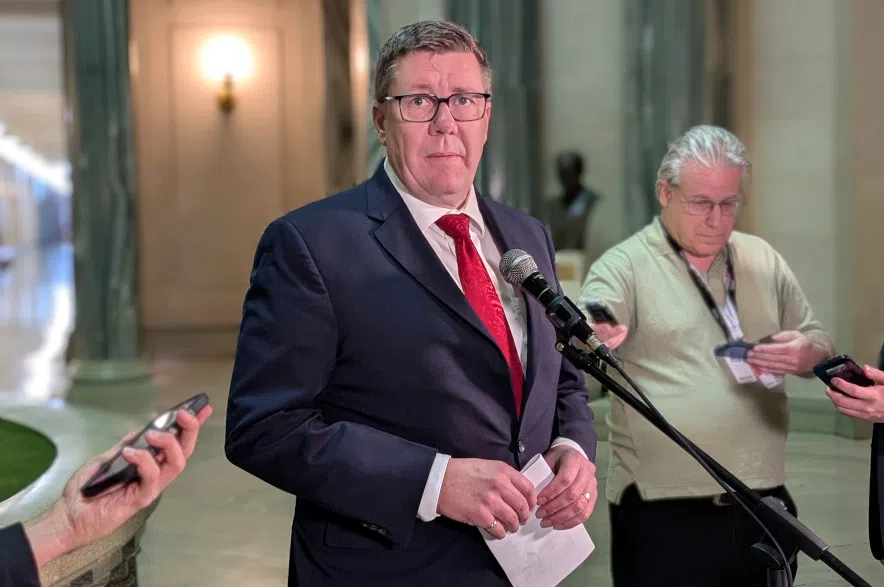
Premier Scott Moe sat down with 980 CJME senior reporter Lisa Schick to talk about the year that was.
This interview has been edited for length and clarity.
Lisa Schick: What would you say is your government’s biggest accomplishment this year?
Scott Moe: What I think is the most significant accomplishment this year is where we’re getting health care to with respect to the increasing the number of physicians and nurses in the system, which is not an easy undertaking given the market that we have across the nation right now. This is something we talk about at our Council of the Federation table each and every time, is just it’s a difficult human resource market in the health-care sphere.
So, we are increasing numbers there, and that is going to, I think, prove to be critical in where we’re going moving forward. We need to look at healthcare in a much more open-ended way than maybe we have in the years gone by, and be much more innovative and patient focused on the decisions that the government is making, but the delivery the Saskatchewan Health Authority is making, as well.
So, I am feeling quite good about just the base compliment and the direction of where we’re going in the health-care system, albeit, you know, still many challenges, because I think it’s going to provide us with some opportunities to make some pretty innovative, pretty forward-looking, patient-focused decisions in the year ahead.
It’s interesting you mention that, because I was going to ask you about healthcare availability as it’s still a big issue. So, even with those advances you say you’re making, what does it feel like to be running a province, a health-care system, but still have people not being able to get the care they need?
Moe: Yeah, there’s challenges, I know, as I say often, those challenges are across Canada, with access to a physician, access to timely surgery, the diagnostics and all of that. In order for us to make any advancement in that space, I think there’s two things that we need to be talking about as Canadians, not just in Saskatchewan.
And first is, how do we attract more people into the health-care industry? And so we need to become much closer in our conversation about all of the positive attributes and all of the opportunities that we have to to work in the health-care sector here in the province.
And then the second piece is, ultimately how we deliver health care, and I don’t mean going to private from public health care or anything like that. I mean, how do we actually deliver in a patient-focused way, the health-care services across the province? And there’s many, many, opportunities, not just for government, for but for the SHA (Saskatchewan Health Authority), the Ministry of Health, and everyone, to really talk to people about, how we are delivering this service today and how are we going to do better in delivering that service tomorrow.
They say a sign of strength as a leader is being able to admit your mistakes, so what’s one mistake you or your government made this year?
Moe: I have many, usually I make at least one or two before breakfast each and every morning. I’m human.
But if I had a redo, if you would, this past year – and I’ve said this publicly, and I’ve said it in private meetings to the individuals in particular in Denare Beach – I should have been on the ground in Denare Beach much sooner than I was.
There were operational decisions that were coming down about how we support the community, and rebuilding, and how we support the community and ensuring making every effort so this type of tragedy doesn’t happen again. And I would extend that to any northern community. However, I had overlooked the support that an in-person visit would provide to members that had tragically had lost their homes in that fire. And I apologize publicly, I should have done better as a leader, from a personal perspective, and I didn’t.
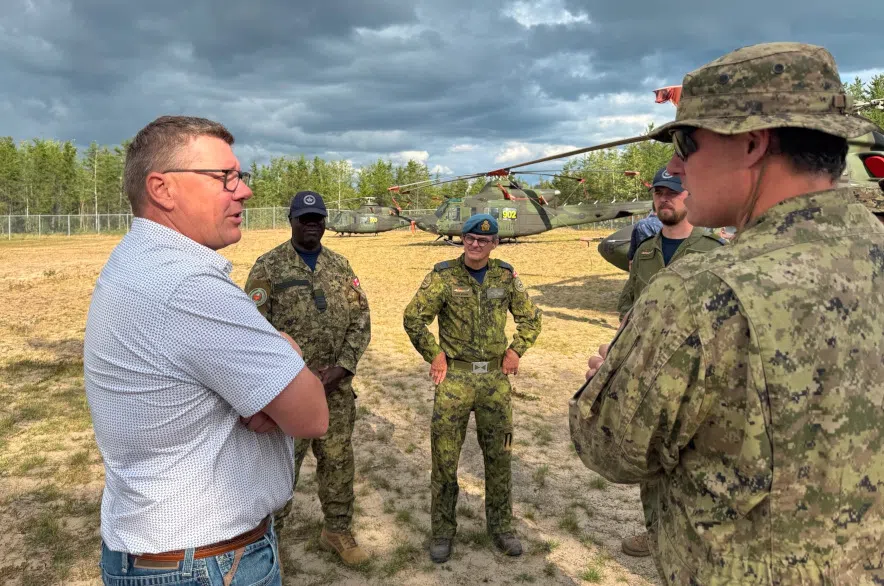
Premier Scott Moe speaks with wildfire responders in the north in August 2025 (Scott Moe social media)
Speaking of the wildfire response, was there anything you feel the government could have done better. Because, there does seem to be a feeling from people in these communities that it wasn’t handled very well.
Moe: Operationally, as you know, there’s a review that’s being conducted by the same organization that did a review, I believe, in Lytton, Jasper, Fort McMurray, places that have experienced tragic loss of homes as well.
I would just say this, with respect to the operations: one, if there there’s ways to deliver either a better wildfire response or a more seamless evacuation, I would hope those would be highlighted in in that review and could be adopted not only by Saskatchewan, but other areas of the nation as well. I would say I’m very thankful – and this is the primary focus of the wildfire response – is that no one lost their life.
Second to that, I would say that Minister McLeod, in his time in charge of the file, had brought forward a number of additional supports that came to fruition throughout the response – whether they be doubling their per diem rate for evacuees, whether it be providing $15 million to support the Red Cross and their work, or whether it be in the post-fire season, working closely with the communities of Denare Beach and East Trout Lake on providing funding for short term accommodations, cleaning up the community, getting it build ready.
And I think the next steps are for us to work with, maybe firstly, the community of Denare Beach to ensure that they have the confidence to rebuild their homes there by committing to fully fire-smarting to the degree that we can in that community, so that it is as fire-proof as we can possibly be.
What about the trade situation, it’s been going since basically January this year with one country or another?
Moe: It is (exhausting) and it seems to get more challenging as the weeks go by, not less.
You know, just recently we see more changes, largely from the U.S. that might have an indirect impact on things like potash sales and things from Saskatchewan. And so we’ve seen these direct impacts, some positive, some negative, and then indirect impacts as well, with decisions that are being made by our major trading partners, and also, decisions that are being made by pretty significant areas of global conflict that we haven’t seen for a number of years as well, where really, what is essentially wartime policy, is connected to whether or not you’re going to have access of certain products in certain areas of the world.
And it is just a complicated, uncertain environment that we certainly are forced to partake in and navigate in, and for us as the Province of Saskatchewan, that is, I often say, the highest exporting per capita space in North America and an area that is exporting to over 160 countries around the world. All of these very complex international relationships likely impact as us as much, or more than any other province in Canada. And that’s why we have our international presence in those trade offices, that’s why we have a minister that is engaging and a whole department that is engaging in those international markets on a consistent and ongoing basis.
You’ve just introduced the Compassionate Intervention Act, that’s a big swing. How did you and your government get to the point of deciding this was appropriate?
Moe: Listening to families talking about a loved one that they feel they could have helped. And we heard some of them on introduction day, but they feel they could have helped if an act like this had been in place where, they might have a child or a brother or a friend that wants to make a difference but just can’t quite get there. And that’s why one of the referring parties proposed in the legislation is a family member, it is a police officer, it’s a physician. And those are the entities that are going to be able to really enact this act in any case where it may be required.
This would be for a very small number of individuals, but where it originated is just in simply conversations with families, with loved ones that, all too often, have had a loss, whether it be a loss of a loved one’s life due to addictions, or whether it’s just simply a loss of that individual to addictions, and they aren’t able to bring them back to a recovery lifestyle, and this act is going to at least give them the chance.
And just at the end of the year here, the Riders won the Grey Cup, were you disappointed you couldn’t be at the legislative building for the parade?
Moe: So, I was thrilled to be able to go to the game, and then we found our way to Washington for some meetings. And so I had left the Deputy Premier, Jim Reiter and former Hall of Fame Roughrider Gene Makowski, in charge of the parade and the football team as they arrived at the legislature.
Then I started to see some of the videos that were going live with all of the shenanigans that were happening. And it’s great to see the parties in Regina and not another CFL city. And it’s great to see that the Saskatchewan legislature actually survived the one day that Jim Reiter and Gene Makowski were in charge.