

Murray Wood: When words fail, stuffed animals can say a lot
Murray Wood says people in Foam Lake and communities across Saskatchewan are putting stuffed animals outside to remember...
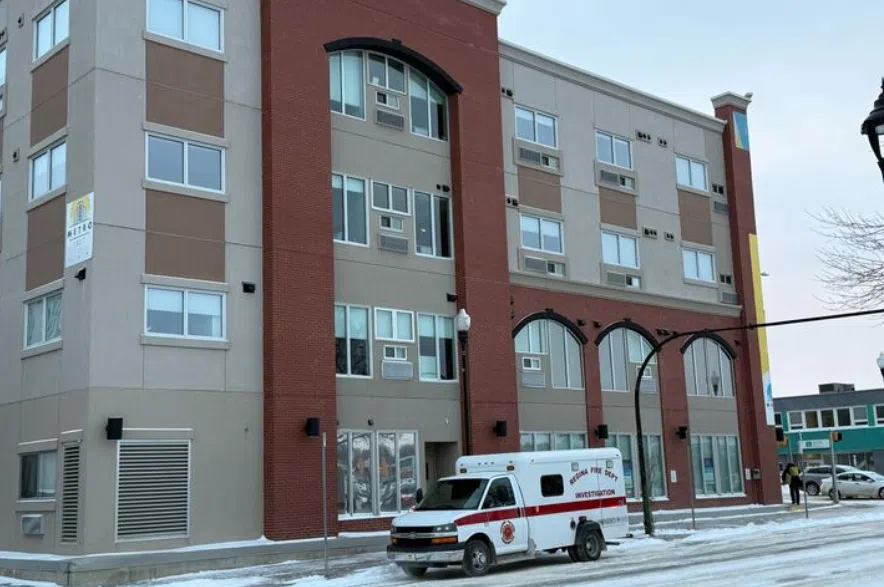
The quick actions of emergency personnel at the scene of the carbon monoxide (CO) incident on the 1800 block of Albert Street in Regina where one person died on Friday night saved lives, Regina Fire Chief Layne Jackson said on Monday.
“It’s the great work of emergency crews out there (that) limited this incident from becoming worse,” he said.
Read more:
“The quick response and that diligence of those crews out there to quickly identify that there was a dangerous environment and start to move folks out. They really did save a lot of lives that evening,” Jackson said at a news conference.
Fire crews and Regina EMS took another person to hospital in critical condition, and they are recovering in hospital, he said.
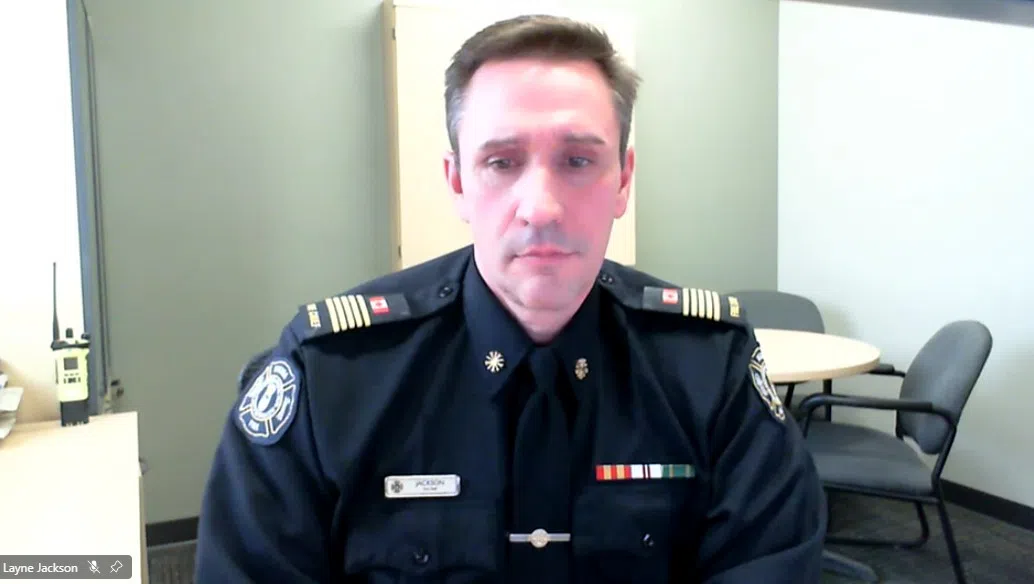
Regina Fire Chief Layne Jackson. (Teams meeting screenshot)
Jackson was unable to provide the age of the person who died, or the injured person, but he was able to confirm the building had working CO alarms.
The source of the CO was found on Friday night.
“What we’ve been able to confirm … is that there was some mechanical work being done in the building on some of the service equipment.
“That piece of service equipment was identified as the source of the carbon monoxide release and firefighters, along with gas inspectors, were able to isolate it and shut it down,” he said.
He doesn’t believe the incident was deliberate.
“The investigation is still ongoing … we have investigators on the scene. They need to have some time to complete their work.”
In a post on X, Regina Fire said firefighters were on scene alongside paramedics, SaskEnergy and Regina Police Service. At that time, authorities said residents would not be allowed to return until the source is confirmed and the building — Metro 1827 apartments — was deemed safe.
Crews are on scene of a carbon monoxide incident on the 1800 Blk of Albert St. Two residents transported to hospital by EMS. Multiple occupants displaced until source of carbon monoxide is identified and mitigated. RPS, Sask Energy and Fire investigator on scene. #yqr pic.twitter.com/FjwRH7jGgP
— Regina Fire (@Regina_Fire) December 20, 2025
During the response, police said crews detected dangerous levels of carbon monoxide and upgraded the incident to include the Hazardous Materials Team.
“As this incident involved a fatality, a multi-agency investigation is underway, including Regina Fire & Protective Services, Regina Police Service, Technical Safety Authority of Saskatchewan and the Saskatchewan Coroners Service,” the City of Regina said in a news release Monday.
Anderson Builders Group website says 69 residential units were built there in 2018.
As of 1:30 p.m. on Saturday, all impacted residents were cleared to return to their homes.
“Regina Fire & Protective Services urges all residents to ensure they have a working carbon monoxide detector in their home,” the city said.
“Saskatchewan regulations require carbon monoxide detector in all homes with fuel-burning appliances or attached garages. Detectors must be installed outside each sleeping area and on every level that contains a fuel-burning appliance.
“Test your carbon monoxide detector regularly, replace batteries as needed, and never ignore an alarm. Carbon monoxide is a colorless, odorless gas that can be deadly. A functioning detector is the best way to protect yourself and your family.”
Regina Fire Marshal Randy Ryba told CJME News last year that carbon monoxide is a silent killer.
“It’s about the same buoyancy as air, so it moves through the house. It’s odourless, colourless, and our call volumes go up dramatically in the heating season,” he said.
Provincial regulations require CO alarms in every residential structure in the province, with one CO alarm on every level of a home, and a CO alarm within 16 feet of all bedroom doors.
Even though you can’t smell or see the gas, there are some very noticeable signs you have been exposed to it.
Acute exposure can lead to long-term neurological effects such as cognitive and behavioural changes.
Chronic exposure to low concentrations of CO can lead to lethargy, headaches, nausea, and flu-like symptoms and, in a worst case scenario, severe exposure can ultimately lead to unconsciousness, coma, and death.
It’s recommended that people change out their carbon monoxide alarms every eight to 10 years.
– with files from 980 CJME’s Jacob Bamhour and Nicole Garn
Read more: