

Murray Wood The end of the great Canadian game as we know it
The last Roughrider home game was the last CFL game in Saskatchewan played on a CFL-sized field. Murray Wood thinks it's...
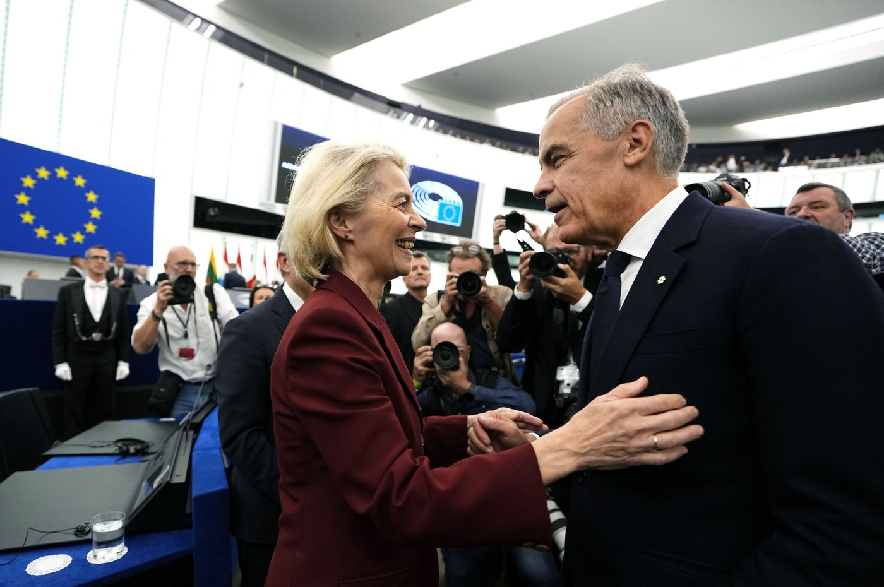
OTTAWA — The next step in the relationship between Canada and the European Union is set to be unveiled by Prime Minister Mark Carney and EU President Ursula von der Leyen at a summit in Montreal on Thursday and Friday.
This summit comes just over a month after Carney delivered a speech to the European Parliament calling for closer ties with the 27-nation bloc.
Read more:
Here are five things to look out for at the Montreal summit:
1. What’s in a name?
Ursula von der Leyen made waves last month when, in her own address to the European Parliament, she opened the door to Canada becoming “the first associate member of the EU.” Canadian officials were quick to downplay the likelihood of that name.
Canada’s EU Ambassador Jonathan Wilkinson pointed out that Carney described the arrangement as an “alliance of the future” when speaking with reporters after von der Leyen’s speech.
Since there’s no such thing as “associate membership” in the EU, the exact nature of the planned agreement with the EU has been a topic of much speculation.
Conservative Leader Pierre Poilievre has insisted Canada will never be an EU state and has said he doesn’t support EU taxes, laws or “reckless European-style immigration.”
Carney has said that any agreement will be brought to Parliament to be debated and voted on.
2. Mobility and labour
Freedom of movement is a central element of EU membership — European citizens are able to live in any member nation visa-free for up to three months. Those looking to work or study in a different country still face administrative obstacles that vary from country to country.
Wilkinson told The Canadian Press the two sides are not talking about free labour mobility between Canada and Europe. Rather, he said, Canada and the EU are looking at specific sectors which could benefit from shared labour pools.
There also has been talk of Canada joining Erasmus+, the EU’s study and training program that facilitates exchanges between member nations.
3: Digital and IRL trade
International Trade Minister Maninder Sidhu was in Ireland last week to push forward negotiations on a digital trade agreement with the EU that would make it easier for Canadian and European businesses to buy and sell across borders.
Sidhu said in a statement the goal is to create “less friction” on e-signatures, e-contracts, paperless trade and cross-border data flows.
The Canada-European Union Comprehensive Economic and Trade Agreement, or CETA, is celebrating its 10th anniversary on Friday.
Nine EU members — France, Italy, Belgium, Ireland, Poland, Bulgaria, Cyprus, Greece and Hungary — have not yet ratified that trade deal.
Wilkinson said he’s met with all 27 of his EU counterparts and senses “momentum” in efforts to get more nations on board with CETA.
4: Energy and environment
The EU sees Canada as a valuable partner for developing clean, low-carbon energy. Canada has vast mineral resources that can be put toward hydrogen, nuclear and wind power projects.
Wilkinson said the two sides are talking about ways they can invest in boosting critical mineral refining and supply on both sides of the ocean to cut into China’s market dominance.
Natural Resource Minister Tim Hodgson signed a critical mineral partnership with Europe earlier this year focused on opening up more avenues to get European money invested in Canadian projects.
The European Investment Bank applied earlier this month for an exemption from foreign banking rules that would allow it to back Canadian projects.
5: Deeper defence ties
Critical minerals are also vital to modern weapons manufacturing. Canada recently chose a German-Norwegian partnership over a South Korean competitor as its new submarine supplier, and this summit could see even closer ties emerge with Europe on defence.
Finance Minister Francois Philippe-Champagne recently announced a Nov. 30 summit in Luxembourg where Canada will gather its partners to sign an agreement to establish the new Defence, Security and Resilience Bank.
That bank will have headquarters in both Canada and Luxembourg.
This report by The Canadian Press was first published Oct. 27, 2026.
David Baxter, The Canadian Press