
Murray Wood: Why this Roughrider season has not been like a roller coaster
Murray Wood says the Saskatchewan Roughriders' fans like him remain defiantly optimistic no matter what, even if they so...
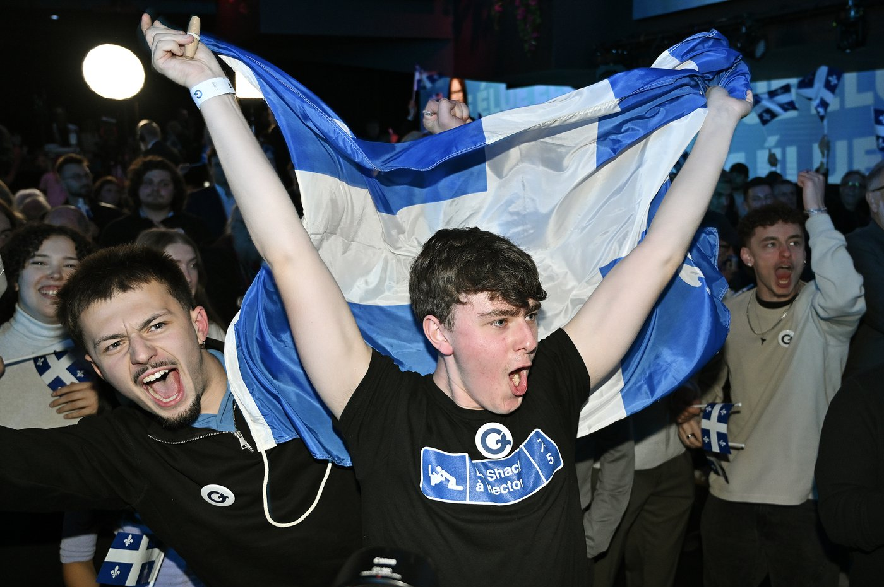
Quebec’s provincial election results don’t often matter to people in Saskatchewan, but this one could.
Monday night’s election brought the Parti Québécois (PQ) into power, forming a minority government.
On Oct. 6, chief parliamentary correspondent, host of both Power Play and Question Period for CTV, and host of the Vassey Kapelos Show on 650 CKOM and 980 CJME, Vassy Kapelos joined The Evan Bray Show to discuss the results.
Read more:
She said the significance of this election is that it brings separatism in Quebec front and centre once again.
According to Kapelos, it’s a “fascinating scenario” because no party received more than 28 per cent of the vote.
“But because the federalist vote was so atomized, was so bifurcated between parties that outperformed actually their own expectations, you’ve got the separatist PQ party that was able to form government,” she told Bray.
Specifically, the way the Parti Québécois translated its share of the vote into seats drastically changed the government’s composition, Kapelos said, resulting in a separatist government.
Kapelos noted Quebec will try to leverage this separation question to get even more for the province.
“And I think much of the rest of Canada feels they are already given preferential treatment in a number of areas. I know Quebec would feel differently, but I think that’s going to be so interesting to see the way in which that plays out,” she said.
Since it’s only a minority, though, the conversation is different. She said there would be a greater chance of a referendum with a majority government, but in this situation, a separatist vote will be harder to advance.
Additionally, “support for a referendum or separatism in Quebec has never been lower,” Kapelos said.
“It’s only sitting at around 28 per cent, right? The 70-plus per cent of Quebec don’t want to talk about separatism. They’re certainly not interested in that right now, given everything that’s going on with Donald Trump,” she added.
The party’s leader, Paul St-Pierre Plamondon, doesn’t plan to hold a referendum right away. Kapelos explained that the idea is to hold off while U.S. President Donald Trump is in power.
It’s a strategy, she said, that resonated with voters because it eased concerns that a referendum would aggravate Canada’s trade war with the U.S.
The consequence for Saskatchewan, and the rest of Canada, is that it will have to wait two and a half years, wondering when a separatist vote will happen, according to Kapelos.