

Murray Wood: 'One of the worst' should be on hats and T-shirts in Canada
U.S. President Donald Trump called Canada "one of the worst" this week, saying that soon we will come to him t...
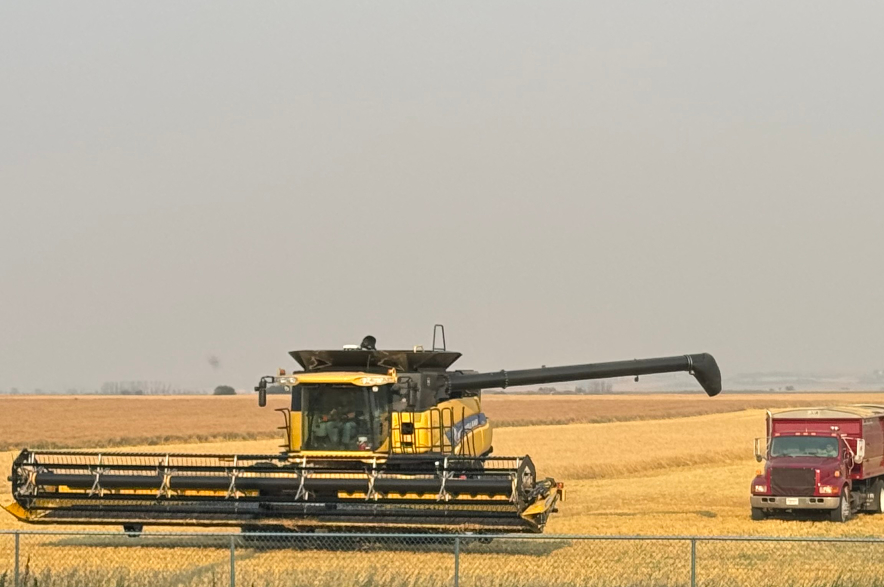
Warm, dry weather over the past week allowed Saskatchewan farmers to make serious progress on this year’s harvest, but a slow, wet start to the season means it’s still lagging behind the historical averages.
According to the latest crop report from the Saskatchewan Ministry of Agriculture, which covered the week ending on Monday, an estimated 63 per cent of crops are in the bin as the weather created “excellent combining conditions.” That’s an increase of 22 per cent over last week’s report, but the delayed start to the season in many areas means that progress still lags well behind the five-year average of 91 per cent and the 10-year average of 82 per cent.
Read more:
“Harvest progress is relatively consistent across all regions of the province. The southwest region leads with 84 per cent complete, followed by the west-central and southeast regions at 69 and 57 per cent complete, respectively,” the ministry said in its report.
“The northwest region has reached 53 per cent completion, the east-central region has 52 per cent, while the northeast is 49 per cent harvested.”
The harvest of winter cereal crops is essentially complete, the ministry said, and producers made good progress on pulse and spring cereals over the week ending on Monday.
The highest rainfall over the week covered by the report hit the Mount Pleasant area, where 15 millimetres of rain fell. The dry conditions allowed harvest operations to proceed without interruption, but did result in a slight decrease in topsoil moisture reserves, the ministry noted.
In cropland, topsoil moisture was rated as 13 per cent surplus, 81 per cent adequate and six per cent short. In hayland, topsoil moisture was reported as eight per cent surplus, 84 per cent adequate, seven per cent short and one per cent very short. Five per cent of pastures had surplus moisture, 81 per cent had adequate moisture, 12 per cent were short and two per cent were very short.
“Livestock water availability remains favourable across Saskatchewan, with 93 per cent of producers reporting no current or expected shortages. Six per cent reported moderate shortages and one per cent anticipated future shortages,” the ministry said.
“Concerns regarding water quality were limited, with eight per cent of respondents citing issues, primarily due to algae in some water sources. Producers also reported that adequate rainfall has supported water supplies by keeping dugouts full.”
The majority of the crop damage reported over the week ending on Monday was due to high winds, the ministry said, which were strong enough to blow away swaths in some regions.
The ministry noted that the dry conditions allowing farmers to make good progress on their harvest operations also bring an increased risk of machinery fires.
“Producers are reminded to take appropriate fire prevention measures, including carrying fire suppression equipment, regularly cleaning combines and other machinery, and exercising caution when working around powerlines,” the ministry said.
Brian Andrew, who farms in the Craven area northwest of Regina, said his harvest is behind schedule, but it’s a situation he’s seen before.
“We’ve been through this before. We’ve had later harvests before, and it’s not something completely unique, so we can deal with it,” Andrew said during an appearance on The Greg Morgan Morning Show on Thursday.
“We’re about 70 per cent done. Normally we’d be very close to complete, if not completed. I would say we’re roughly two weeks behind normal.”
Andrew said he’s had good luck with rain, getting enough but not too much. But he noted that you don’t have to go far from his farm to find other producers struggling with wet fields and bogged-down equipment.
He said the price of diesel fuel has been a bigger concern than excess moisture.
“From a year ago, I’d say the diesel price has doubled for us, and it’s gone up 25 per cent even this harvest, from August to now,” Andrew explained.
“On a good day, our combine would use probably 400 litres of diesel, maybe 500. It’s a significant cost, and there’s nothing we can do about it.”
Andrew said he’s still a ways away from completing his harvest for the year, but noted that it’s always a great feeling to finish with a field for the season.
“There’s a huge amount of satisfaction when you look back at a field that’s been harvested, and it looks nice and clean, and the yields were what you expected or hopefully even better,” he said.
–with files from The Greg Morgan Morning Show on 980 CJME