

Murray Wood: It's getting better all the time
Even if it seems - as the rejoinder in the Beatles' song observed - 'it couldn't get much worse,' Murray Wood suggests w...
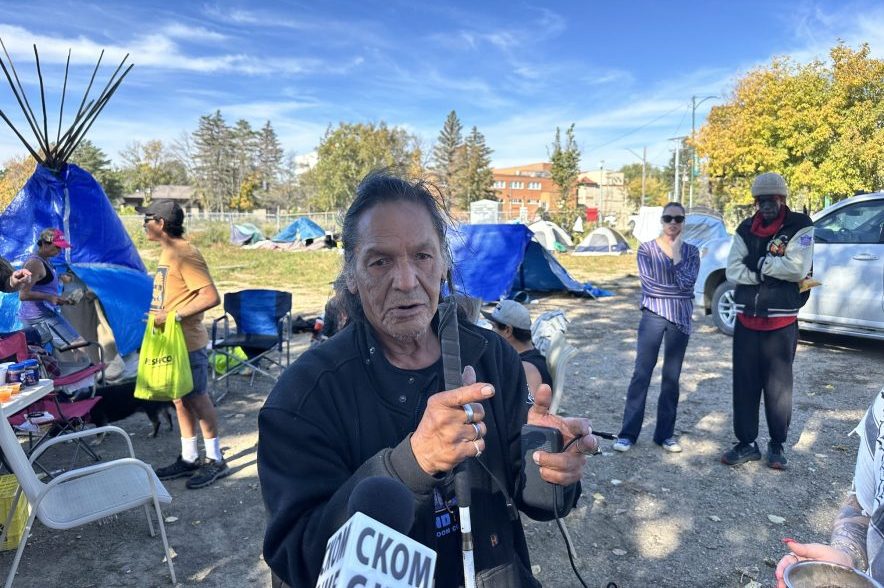
A Saskatoon police staff sergeant responsible for the encampment and shelter file says officers’ main role during last week’s planned cleanup was to keep the peace and prevent violence.
Speaking on the Evan Bray Show on Tuesday, Staff Sgt. Mike Horvath said police often walk a tightrope in “high-charged situations.”
Read more:
“Our primary directive is to keep the peace and prevent violence and things like that,” Horvath said. “As we look to volatile situations like that, it’s important to understand from my desk, working for the chief, that we need to look at other things to support the destination for residents who are experiencing homelessness.
“Those situations for sure can be volatile, and it’s important for us to assess, and the last thing we want is to escalate the situation higher. We just want to make sure that the peace is kept at that moment. But we’re always evaluating what next steps are.”
On Thursday, the city halted plans to clean up the site at 20th Street and Avenue K, partly due to an application for a court injunction.
Advocates asked a judge during Monday’s hearing to prevent the city from clearing out the location until shelter is found for all of the occupants. A ruling was expected Tuesday.
Horvath said it was difficult to guess what might happen next while that case was pending.
“We have to respect that process, and we’ll make that decision once the court process is finished here,” he said.
Horvath explained health and safety would be the prime motivator that would lead to an attempt to clear out and block off an encampment site.
He cited concerns like rodents, drug paraphernalia, biohazards, and garbage.
The lawyer who brought forward the injunction application is seeking a way to allow the city to clean up such hazards without dismantling the encampment.
Regina watching Saskatoon court case
Regina mayor Chad Bachynski said the city is watching what other jurisdictions are doing about homeless encampments, including the Saskatoon case.
But he reiterated Regina’s approach is “people-centred,” and he hopes to find shelter for the occupants of an encampment in Core Community Park.
“We have more than 60 people that we know by name that are ready to leave the encampment,” Bachynski said. “They’ve said they are absolutely ready to leave. That is the goal.
“Encampments are not safe places for people to live. Obviously, as the weather turns, it’s going to create a more challenging situation. So I’m hopeful that the province is going to step up in short order here, and we’re going to be talking this week again about potential spaces, what that looks like.”
Bachynski added he shares concerns about crime and safety in the neighbourhood.
“Unfortunately, when people are in that vulnerable situation, it does potentially draw other folks that take advantage of those folks and can create more crime and other things in the area,” he said. “We need to kind of rally together.”
Chief Lorilee Davies of the Regina Police Service said officers have been making their presence known.
“Increasing our visibility, our presence in that area is something that we’ve been intentional about,” she said. “Obviously, there’s been a number of files that we’re investigating into to hold people accountable.”
Both Davies and Horvath say police are just part of a team approach to resolving the situation.
“I think police are not forefront encampment response, but certainly we have a seat at the table in determining what next steps might look like and how we can ensure that people in the encampment and around the encampment are kept safe.”
Encampments up to cities but province helps with supports, says minister
When it comes to homeless encampments, Saskatchewan’s Social Services Minister says it’s up to the cities on how to handle them, like whether they can stay or are torn down.
Terry Jenson said on the Evan Bray Show the province’s role is to support municipalities by making sure mobile outreach workers are on site to connect people with support services.
“So when that is actually taking place, we have people there to help the individuals. Whether that be through income assistance or if they’re appropriately ready for housing, to ensure those individuals are being served and are going to be supported and taken care of,” said Jenson.
“It comes down to each individual if they’re willing to accept the assistance; we’re definitely there for them; we provide opportunities for everybody.”
However, Jenson said not everyone is eligible for housing.
“If there’s an individual that is, say, in an encampment or they’re on the street and they’re actively using and it’s a chronic situation, and they say, ‘Yeah, I’m ready to be housed;’ as an active user, it’s difficult to stay housed,” explained Jenson.
“The chances of that individual remaining in a housing situation is very low, we’ve experienced that in the past, so we will work with that individual to get them some help in the meantime, so that when they are appropriately ready for housing, that they have a very good chance of staying housed and being successful.”
Some of those supports people can access before they’re ready for housing, as Jenson explained, include the enhanced shelter system and addictions treatment.
“Then when they do come out of treatment, they’re eligible for supportive housing, and that’s an area that we’re really focused on. Not only Saskatchewan, but I know my provincial counterparts from across the country.”
Jenson said he recently met with Canada’s Housing and Infrastructure Minister Gregor Robertson to talk about transitional and supportive housing. He said Saskatchewan is working to ensure additional supportive housing units are coming as quickly as possible.
(with files from Abby Zieverink)