

Murray Wood: Who's hot... and who's not
Every Friday, Murray Wood takes a look back at the week's news and decides who's hot... and who's not. This week's list ...
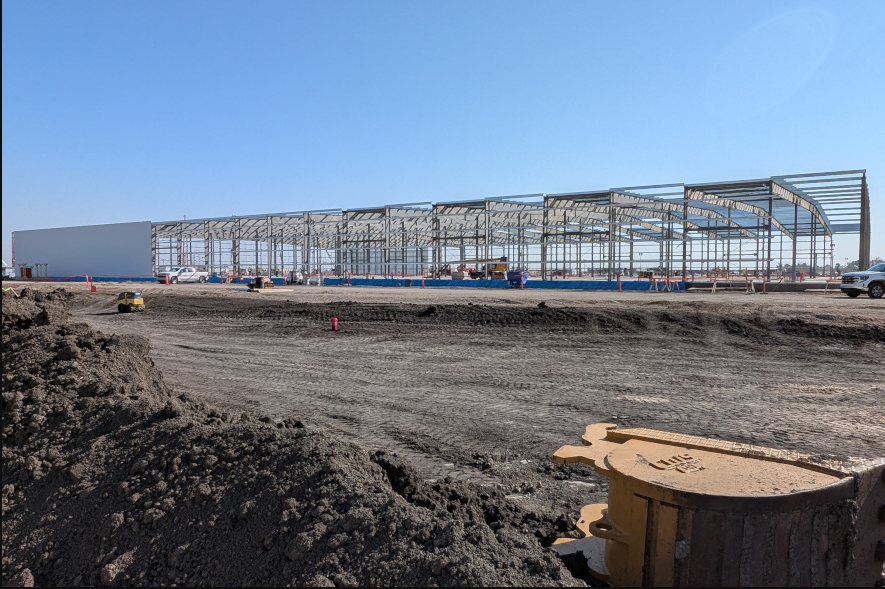
Bell Canada is addressing questions about its massive AI data centre project south of Regina as the company moves ahead with plans to significantly expand the development.
Bell and the Government of Saskatchewan announced earlier this month that the project could grow from its initial 300 megawatts to a 1.2-gigawatt AI infrastructure hub. The additional capacity would be powered separately from the provincial grid, with Bell planning to use natural gas generation developed by a partner.
Read more:
John Watson, president of Bell Business Markets, joined The Evan Bray Show on Friday morning to answer questions about the project, with the topics ranging from government incentives to water use, environmental concerns, farmland, power generation and jobs.
The following questions and answers have been edited for length and clarity.
EVAN BRAY: The announcement was made in the spring, and you and I had a good talk on the show about that. Not that many months later, we’re hearing about a very significant expansion. What changed in that time to drive this expansion?
JOHN WATSON: I think there was a maturation of how the province, how Bell, how we could go about expansion.
I think the clarity was that it would require a set of strict guidelines that the province was thoughtfully crafting. Most of Canada had not established guidelines around these activities, including the federal government, so I think the province established those in advance of federal documentation of it. I think that had to mature.
I also think in any relationship, the core of a relationship is trust. If you look at what we’ve been able to do with the local communities, with the local tradespeople, with the 14 unions, 32 local companies, and what’s been done in five months at the site, it’s absolutely extraordinary. It’s the fastest time to build. It’s the fastest construction with an all-Canadian, all-Saskatchewan team in every domain we can.
There was the maturing of guidelines that were strict and clear, and there’s the maturing of a relationship. Any business comes down to trust in the relationship that you deliver on what you said you’d do, and I think we benefited from that.
BRAY: Why Saskatchewan? There’s been a number of people asking the question. Were there any incentives given? I had Minister Jeremy Harrison on the show, who assured us there were not. But I’m going to ask you the same thing. Is Bell getting any public money to build here? Any kind of subsidized power rates, break on PST or taxes? Is there anything that was a government-driven incentive for you to build here?
WATSON: There were absolutely zero incentives of any kind.
The incentive is simply a government and a group of business leaders and Indigenous leaders at George Gordon who want to create jobs. That was the incentive on the province’s side.
On our side, it was the ability to work together to do something in a bold fashion that led the entire country, and one where the time to creating value for the province and for Bell wouldn’t be stuck in red tape and wouldn’t take us years to bring about.
There was zero from a financial, monetary, tax, et cetera perspective.
BRAY: There are protests against AI and AI data centres across Canada and around the world. Some of that is opposition to AI itself, but the other part is environmental concerns around data centres. What sort of environmental impact assessment will and should alleviate concerns people have about water use, heat, light and the other environmental impacts?
WATSON: Those are all very important questions, and it’s an important dialogue to make those clear with the community, with the city, with the province.
What we’re building is a closed-loop cooling system. It uses something called technical water. It doesn’t use any evaporative cooling. It’s very different than the stories you’ll hear about the southern U.S. and what folks created there and the impact.
We’ve built a 14-foot-plus berm around the perimeter. We’ve got enclosures in terms of noise.
We’ll follow every guideline, every requirement that’s set forth. The expansion has to go through an environmental assessment. It’s got to go through all of the steps to become an active project, an active site.
BRAY: You talked about the water. It’s a closed-loop system. Eventually, that water has to be changed out and disposed of. How is that done?
WATSON: It will last for a long period of time. It’ll be monitored, of course, and then you’ll take it and recycle it. If you think of all of our automobiles, you’ll have an automotive oil change facility. That water gets captured, oil gets captured, it gets cleaned, processed, renewed and utilized again. This water will be restored to active use again, and it will not be disposed of.
BRAY: What’s the lifespan of an AI data centre?
WATSON: These facilities should be good for many, many decades.
The relationships we want to secure from our customers, we like to get at least 20 years from them as a commitment, so this is not something you do lightly. If you think of the initial phase that’s underway, that’s costing $2 billion thereabouts. With that kind of investment, this has a long lifespan. It’s decades and decades in terms of useful industrial use. The need for computing capacity, the need for Canadian computing capacity, for our data to remain here, we think it’s going to be viable for many, many decades.
BRAY: Some people are questioning the location close to a large centre, just outside of Regina. Many people are saying it’s using good farmland. We have lots of land in Saskatchewan that is not farmable, so that might have been a better choice. Any particular reason why that location was chosen?
WATSON: Absolutely. The key ingredients for a data centre are access to power, and in the first phase there was some available grid power. But the primary one was access to natural gas. Much of the power in the province for consumption is natural gas.
This particular piece of land has close proximity to some very important natural gas pipeline assets, and as we envisioned BYOP – bring your own power – it’s very important to have that access. This is where the pipelines were, and this was where the intersection of the grid power was as well.
BRAY: Let’s talk about natural gas, because my understanding is that you will be building a new natural gas plant. Is that correct, or where will you get the energy you need to power the expansion from?
WATSON: We will need to build a natural gas power plant.
We will have a partner do that who specializes in that activity. We haven’t figured out the location of it at this point. We know that we have to be very thoughtful in terms of where that is, and that’s an active discussion. There are no plans currently as to where it would go. We’re going to have an active, open discussion and figure out how that best suits and where it should be.
BRAY: Another question that came up on the text line a lot was around data sovereignty. Why is this important? And if you’re bringing in clients from outside of Canada, how does data sovereignty play into that?
WATSON: There are two really important levels. One is that we need sovereign infrastructure. If everything we do, every time we pick up our cellphone, every time you punch a key on your computer, your tablet, if all that’s done in a different jurisdiction, a different country, we’re completely vulnerable to them in terms of whether that continues to happen there.
The core concept of having infrastructure in Canada that Canadians can use is very, very important. We’ve been active for 20 months, probably spent thousands of hours speaking to Canadian companies and talking specifically about how we can grow their business, how we can build it. There’s a very strong sovereign, made-in-Canada, made-in-Saskatchewan opportunity.
BRAY: You and I were chatting off-air a bit about the jobs, and you had a pretty staggering number.
WATSON: If we add up all the jobs, all the construction, the head office, the ongoing work, the secondary roles, one out of 20 households in the greater Regina area will have a new job created before we finish this project. One out of 20.
There’s a few F-150s in the province. In 1906, autos were introduced to Saskatchewan. Saskatchewan thought about a total ban on automobiles. They chose not to, but they brought 10 rules in place around automobiles. Speed was limited to 16 kilometers an hour. If you came upon a horse, you had to exit your car, turn it off, and help the horse if it was nervous. It’s OK for folks to be nervous at this point. Keep the open dialogue. We’re doing something amazing. We should be proud of what we’re creating with the trades, trade unions and George Gordon and Regina. It is Canadian world-class.