

Murray Wood: Does anger at Carney on trade extend across the political spectrum?
Murray Wood says Stephen Harper and Scott Moe support Prime Minister Mark Carney's position on trade. Does the criticism...
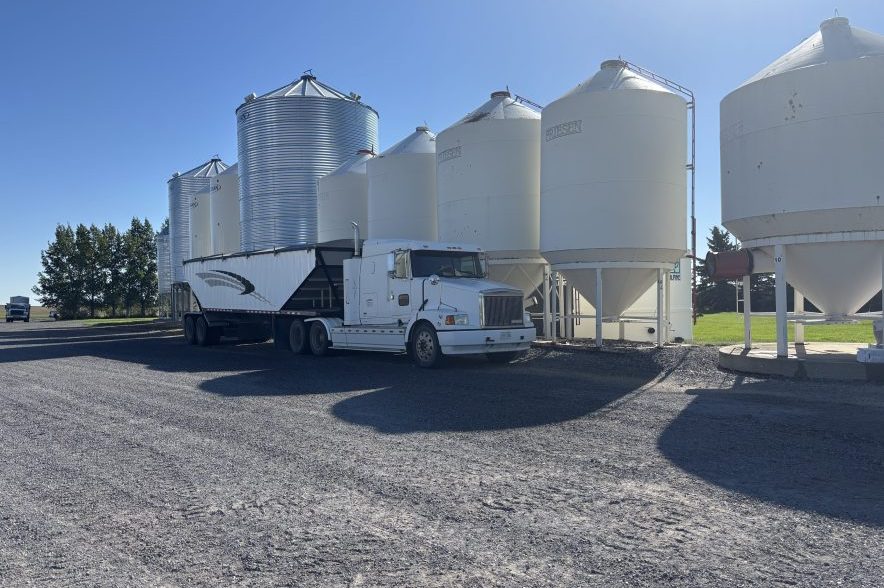
After spending more than a week watching wet fields instead of combining them, Jesse Ridgway can finally see the end of harvest.
Ridgway, who farms with her family at JACT Acres near Lang, said warm, dry weather has allowed the combines to get moving again after rain repeatedly interrupted harvest through September.
Read more:
“We got in on Saturday and have been going straight since,” Ridgway said. “They have been shorter days, haven’t really been getting in till after lunch, but it’s been awesome because equipment’s rolling and we’re getting stuff off, and you can see the end.”
The farm is more than 80 per cent finished harvest, with some canary seed still left in the field.
The biggest setback came earlier in September, when wet weather kept the farm out of the field for eight consecutive days.
“Sitting that long was tough on everybody, tough on morale,” Ridgway said.
Even when the rain stopped, damp mornings and fog sometimes prevented crews from starting until 1 or 2 p.m.
Now, Ridgway is watching the forecast closely.
“I checked the weather app just before this to see if it looks the same, and it looks like there’s some sun here for a solid week yet,” she said. “So (that) should allow us to finish up, and hopefully lots of the area too.”
The growing season had started with decent moisture and heavy rain near the end of June.
Then the weather changed.
“The tap shut off, and we didn’t get, you know, any rain in July and August,” Ridgway said. “Obviously that stressed things and hurt things a little bit.”
Despite avoiding most of the hail that hit other areas, Ridgway said yields on the farm are well below what the family has seen during several strong recent years.
“We’re probably pulling in, you know, two-thirds of the crop we would on a good year, what we’d call a good year,” she said.
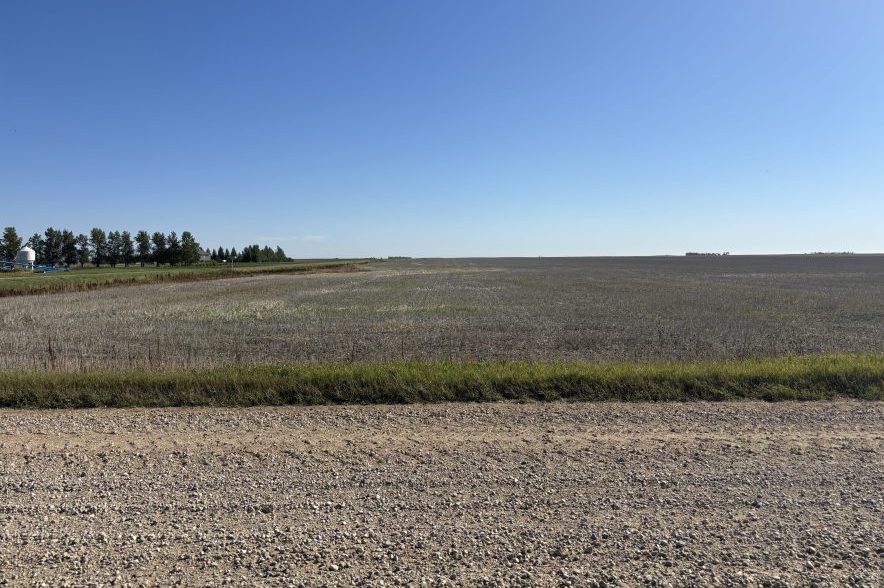
A harvested field near Lang, Sask. Ridgway says her farm is more than 80 per cent finished harvest after wet weather caused delays earlier in September. (Jacob Bamhour/980 CJME)
The smaller crop is not the only concern.
Ridgway said prices for many of the commodities farmers sell remain relatively flat while some input costs remain elevated.
Fuel has been particularly noticeable during harvest.
Ridgway said diesel is costing the farm roughly twice what it did at the same time last year, going from around $1 per litre to more than $2.
“You need the fuel no matter what, and you have to pay it to keep rolling,” she said.
That combination of higher input costs, weaker commodity prices and lower yields is putting pressure on the farm.
“It’s a tight spot. It’s a tight spot to be,” Ridgway said.
Tariffs and uncertainty in global markets add another variable as farmers plan for the future.
Ridgway said her family tries not to make major changes to its crop rotation based solely on short-term market movements.
“At the end of the day, we always like to come back to the basics and do what’s best agronomically, what’s best for the farm, what’s best for the soil,” she said.
There is also little flexibility when machinery needs repairs during harvest.
“If something breaks down, you need to replace it. You need to fix it, and lots of times there’s not a lot of options,” Ridgway said.
For now, the focus is on taking advantage of the weather and getting the remaining crop into the bin.
“This is a beautiful end of September. So we’ll take it,” Ridgway said. “We wish it would have kind of stayed this way most of the month, but at least it’s here now.”
She hopes the moisture that made September harvest difficult will at least help set up the farm for next year.
Read more: