

Evan Bray: What would 'associate' EU membership mean for Canada?
There's been a lot of talk about Canada possibly becoming an "associate member" of the European Union. Evan Br...
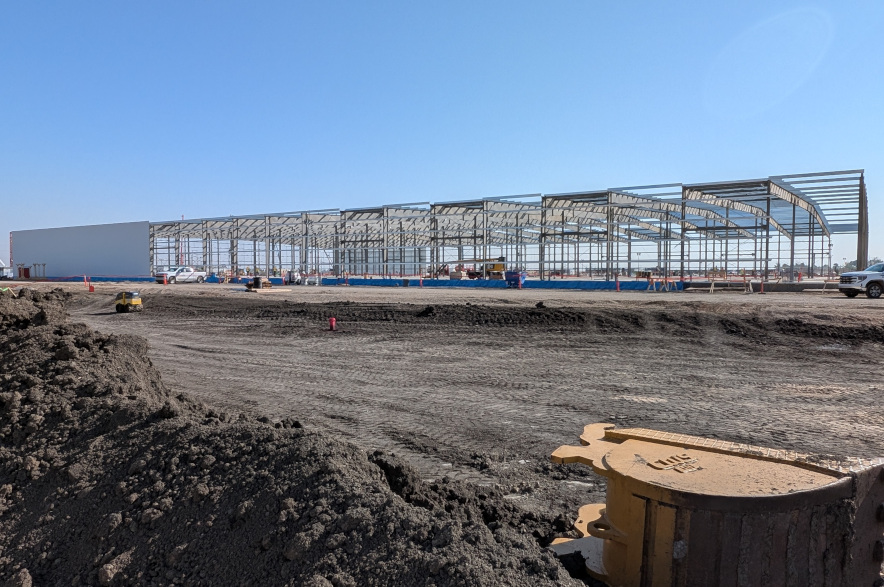
Bell’s dramatic expansion of its planned AI data centre south of Regina has left many residents of the province with unanswered questions.
The project will now potentially reach 1.2 gigawatts of capacity and more than $50 billion in capital investment.
Read more:
Jeremy Harrison, Saskatchewan’s minister of Crown Investments Corporation, joined The Evan Bray Show on Wednesday to provide some clarity around the announcement and what it means for the province.
This transcript has been edited for length and clarity.
EVAN BRAY: This expansion of the AI data centre, is it a done deal? Did you sign an MOU?
JEREMY HARRISON: This project is going forward. We had a very good series of discussions with Bell Canada, and this is really an enormously significant project for the entire country. The fact that we had the announcement attended by Prime Minister Carney, Premier Moe, Prime Minister Harper, Prime Minister Chrétien I think really speaks to the enormous national significance of having sovereign control of our AI and data framework, which is exactly what this is going to be, and enable the entire country to do. So, it was an enormously significant day when we were able to announce this. This is going to have enormously positive ramifications for the entire country, given the importance of AI and data security, which really will be, as we move forward, as significant as energy security is today, as food security is for many countries around the world. Having sovereign control over your AI and data infrastructure is going to be of enormous significance and central importance.
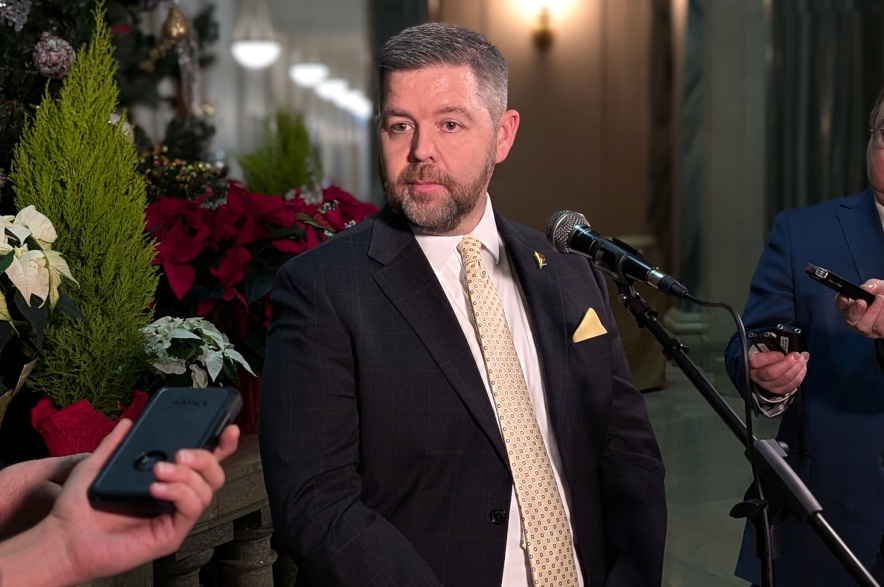
Jeremy Harrison, Saskatchewan’s minister of Crown Investments Corporation, joined The Evan Bray Show on Wednesday to provide some clarity around the data centre expansion and what it means for the province. (Lisa Schick/980 CJME)
We heard this spring about the original announcement. Then we’ve heard about the data centre framework. Does this expansion project fit within that new data center framework? And can I even go back and ask, does the original project meet the goals of this framework?
HARRISON: Without question, the project meets the criteria of the data centre framework. That was a major consideration of the government in approving the project to go forward. The first project was a little bit different as far as the allocation of power for the first 300 megawatts, and that was because we were in a unique position to be able to allocate that power to a to a large investment project. The next 900 megawatts, though, will all be produced by Bell with their partners behind the fence, so to speak, as far as power generation. But yeah, it absolutely fits the framework, the criteria.
I want to break this down into a couple of areas. Let’s talk power first. There’s still this underlying fear that this data centre, and now of course the expanded version of it, is going to have cost implications for everyday Saskatchewan people, whether it’s an increase in power costs or an increase in natural gas costs. Can you speak with any level of assurance that that won’t happen?
HARRISON: That won’t happen, with full assurance. In fact, the opposite is the case. I talked about this in estimates in the House a couple of months ago. This actually puts downward pressure on rates, because for the 300 megawatts that SaskPower was producing and in a position to allocate at the full industrial power rate, that actually is a very significant new revenue stream for SaskPower. So, it actually puts downward pressure on rates for the company because of the very significant revenue implications for the company. So behind-the-fence power generation, that will be the next 900 megawatts, really has no impact. And in fact, the gas that the facility will be using will be through the SaskEnergy system, for which we obviously get paid as well, so this actually is a huge benefit for SaskEnergy, SaskPower, and I would say even more significantly for SaskTel. We are in a position to utilize and have Bell pay to utilize our really world-class fibre network, which the data centre requires. This has really been very positive for all of the Crown corporations in Saskatchewan and, frankly, we couldn’t have actually got to the point of having this largest investment in the history of the country but for the fact that we have this family of Crown corporations, which we are very proud of and who have been great partners for and with Bell.
Why Saskatchewan? Why have they picked Saskatchewan? This expansion, some people have suggested or questioned whether we incentivized this. Did we subsidize this project in any way?
HARRISON: No, we did not. Mirko Bibic, who’s the CEO of Bell Canada, spoke to this very directly at the announcement news conference with Prime Minister Carney and Premier Moe and Chrétien and Harper standing, talking about the reason why Saskatchewan. It is because we are the best place in the country to do business. That is why. Where you can actually go from a conversation to a project in a reasonable time frame, which is something that the country, very frankly, has been struggling with as an investment destination. And I think, which Prime Minister Carney and Harper and others at the investment forum in Toronto very directly spoke to, that we need to be more like Saskatchewan in being able to get to proponents getting to a project under construction. So we are and have worked really hard at this over two decades to build our reputation around the world as a great place to do business, as a great place to invest. That was reiterated again by the CEO of Bell Canada and why they have chosen to make the biggest investment in the history of their company, the biggest investment in the history of Canada, right here in our Saskatchewan.
Let’s go back to the power generation. One of the pieces of the new provincial data centre framework is you’ve got to bring your own power. I understand they’re using natural gas to generate this power. Will it be Saskatchewan-based natural gas? Will it be coming from another province?
HARRISON: It’ll be coming through our system. Right now, over 90 per cent of the natural gas that we’re using in our power plants is imported, and this is a big part of the reason why we embarked in the direction we did in the energy security strategy of taking in all-of-the-above approach and diversifying our power generation fleet as much as we can, but really trying to use Saskatchewan resources. So that’s why I’m at a nuclear conference right now talking about our path to nuclear. Well, that’s a big part of the reason why – to use Saskatchewan uranium. But the objective in the bring-your-own-power scenario, which was best practice, I think, around the western world right now for data centres, we leave it up to the proponent about how they are going to be generating that power. For Bell, natural gas is what makes sense for them, but it’ll be coming through our pipeline system, which is owned by SaskEnergy and TransGas.
Will it be operated by one of our companies, like TransGas? My understanding is it’s a third party that’s going to run the power that comes in.
HARRISON: It will be. A significant component right now of our power generation is done by what we call independent power producers. Northlands Power in North Battleford is an example of that. Our renewable projects that are being constructed right now are all done through third parties, so independent power producers as well. It’s a model that’s not new to Saskatchewan, but it’s a model that will be pursued, I think, by Bell as a company. They can speak to that more directly than I, though.
Can we talk about what checks and balances that this has yet to go through? Given the size of this project, will it go through an environmental impact assessment?
HARRISON: There will be elements of the project that will have to go through an EIA. In the power generation component, there is a requirement for an environmental impact assessment. There’s a legal threshold for whether EIAs are required. That is something I’ll leave for the environment ministry and Bell to work through, but one of the things I would say, I think that there is concern, and part of what you’ve probably been hearing is concern around AI. And I think really that manifests itself in conversations about other things. I think there is legitimate concern around that amongst some folks. The reality, though, is that AI isn’t going anywhere. AI is an important part of our lives and economy right now. It’s going to become an increasingly important part of our economy. So really, the question is whether we are going to have sovereign control of our data and AI infrastructure. That is the central question. Because if we don’t, it’s going to be somewhere else, and that somewhere else is likely going to be either the United States or China. I want that AI and data infrastructure in our country, subject to Canadian laws and regulations. In Saskatchewan, even more specifically, because that is what is right for the country. That is actually what makes sense for our province as well, to have that sovereign data and AI infrastructure and control thereof located in our country. Because if it’s not here, it’s going to be somewhere else. And that is, I think, really a central question in all of this, and Prime Minister Carney spoke about it at the announcement. I think there is an understanding that if we are not able to do this and do this quickly, we are going to be in a very precarious position as a country going forward. So that is, I think, a consideration that really is very central to all of this as well.
Back to the environmental impact assessment, the RM, I know, has to do some sort of formal approval for this to go ahead. Is there any part of the process ahead that could put a stop to this?
HARRISON: Technically, I think that that would probably be the case. I would say, though, that the RM has been very closely a part of the process. The hundreds of people that are on the worksite right now for phase one, I think, gives a high degree of comfort as well about the professionalism of the working people out there, about the commitment to consultation and work that the company has had with the RM and with other stakeholders. The fact that you’ve seen such support for the project from municipal governments, from chambers of commerce, from First Nations, this is something that is of just gigantic importance for the country and the province. So we’re going to work through that process. I know the company will be working through that process, and there are technical elements that, obviously, are important, and those will be adhered to.
One of the things that comes up from everyday Saskatchewanians is lack of consultation. Was there ever thought given to consultation, if not on the first project, on the fact that this expansion possibility was coming up, knowing that there was some pushback the first time? Did you think maybe consultation might be a way to try and mitigate some of the fears people have?
HARRISON: We are very happy to speak to the facts, whether that be on water use, whether that be on power. There are very good answers, and those answers have been very clearly communicated through the entire process. There are going to be those who just don’t want to hear the answer, though, and we’ve been very transparent with all of those answers. Like I said earlier, I think a lot of the concern is conflated with concern about AI in general, and that’s really not what the central question is. It’s whether we are going to have sovereign control of that infrastructure, yes or no, in Canada. And we’ve chosen yes, and it is really important to move quickly. And that is why the company Bell Canada have moved quickly. We’ve worked with them very closely on all of that. The municipal government has worked closely with them as well. That’s going to continue. I think the calls for what we’ve heard some from the Opposition it’s really they want to stop the project. That’s the point which they’ve explicitly now come out and said. They’ve always been an anti-development party. They’ve always been an anti-investment party, and it’s not surprising. But that all being said, this is a generationally significant project that’s going to make an enormous difference for hundreds and thousands of people. And we’re talking literally thousands of direct and indirect jobs. We’re talking about Bell relocating their AI Fabric head office to Regina as well. I would say beyond that even, I think having this infrastructure located in Saskatchewan is going to position us in a unique position in the country to build even further investment around data storage, whether it be around AI applications or in the tech sector more generally. This is going to be a hugely important thing.
We talked a bit about that on the show the other day. I said when you have a big industry that comes in, it naturally benefits an ecosystem of businesses, of supply chain and management that feeds into that, and so I think that’s what you’re speaking to that is very likely to come from this first and initial move. I’m thinking that’s where you were going, correct?
HARRISON: That’s exactly what I’m saying, Evan. And I think that’s reflected in the fact that we have post-secondary institutions as supportive as they are of the project, and building trade unions as well, who have been incredibly supportive of the direction that we’re going in, vocally supportive of the direction that we are going in, and who have worked very closely on the project, understanding that this means thousands of jobs for their members over the next number of years and into the future – not even regarding the further and follow-on investments that are going to come in the space. So what we are doing is adding an entirely new industry to the province that is of enormous magnitude and significance, being the largest investment in history of the country, and because of that, you’re seeing very strong support from, like I said, post-secondaries, building trades unions, working people.
This original announcement that was made in the spring of this year for the original data centre, the 300 megawatt centre, we’re not that far from that announcement, and now it’s expanding exponentially. How did the business case change?
HARRISON: I think Bell would probably speak to that more eloquently than I. But what I’ve heard from from Mirko and from John Watson has been just incredibly strong demand signals in the market, and because of that, they were almost immediately looking at opportunities for whether it be possible to expand. And they came to us with this proposal over the course of the summer. We had some detailed conversations. We did a lot of work, including with stakeholder groups, including with the Crowns, about what was possible and what was realistic. And because of that, we were able to get to where we are here in the last couple of days. But Bell would, I think, say that it had to do with the overwhelming demand that is that they’re seeing in the data and AI processing side of the business.
We keep hearing the number over $52 billion. How does that come to the province? Can you give us a quick breakdown?
HARRISON: That would be the total estimated cost of the capital expenditure on the whole project. That includes the labour, that includes the building, that includes the materials. That’s kind of what all goes into that number. That is how that number was arrived at, and that was really Bell that arrived at that number, and what the government will derive real benefit from and real revenues from, which is how we pay for new schools and new hospitals. These things actually have to be paid for from revenue sources, and there will be very significant revenue implication for the Government of Saskatchewan in general. This is a very positive thing for SaskPower, which I’ve talked about. It’s a very positive thing for SaskEnergy, which I spoke to as well. So probably more detail over the coming months. You’ll hear about that, Evan. At the end of the day, this is how we do build new roads and build new hospitals, and how we how we pay for the things that are really just so important.
That revenue is going to be annualized every year. I’m assuming there will be a revenue stream from this that will be attributed to that bottom line for the province?
HARRISON: There’ll be probably more information as we move forward on that. But there is an enormously positive benefit for the people of this province as we are going to be in a position to reinvest significant resources into things like health care and education.
Read more: