

Murray Wood: Who's hot... and who's not
Every Friday, Murray Wood takes a look back at the week's news and decides who's hot... and who's not. This week's list ...

Father’s Day and National Indigenous Peoples Day are being jointly celebrated today at Saskatoon’s Wanuskewin Heritage Park.
Andrew McDonald, co-executive director for Wanuskewin, and Sasha Sasbrink-Harkema, chair of Wanuskewin’s board of directors joined guest host Brent Loucks on The Evan Bray Show on Friday.
Read more:
McDonald said Sunday was the perfect day to visit the park, celebrate dad and spend some time.
“This really is a chance for people to come out and sample all the things that Wanuskewin offers year-round,” he said.
Visual arts, “a fantastic culinary experience” and tours are available throughout the day, which is sponsored by Nutrien. Admission is by donation.
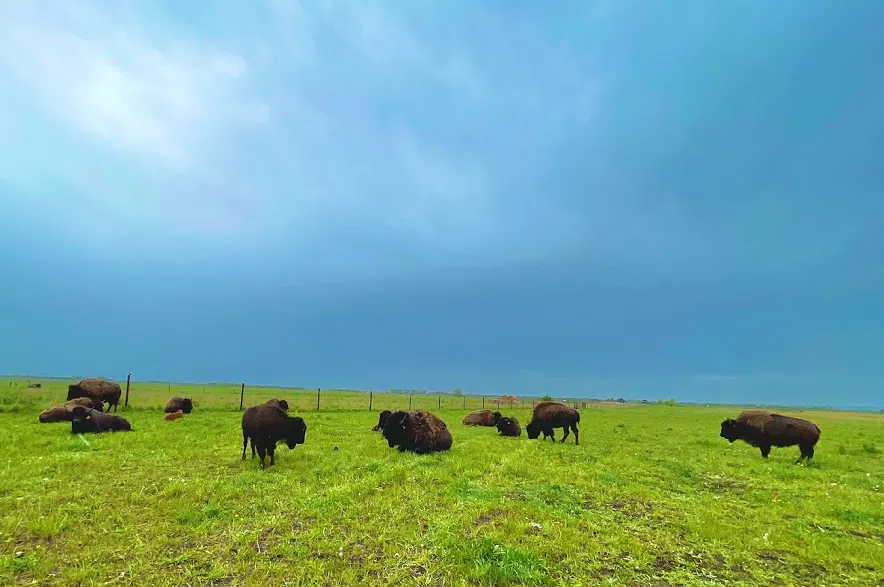
The bison herd at Wanuskewin. (Alex Brown/650 CKOM)
There are also bison.
According to the park, plains bison nearly became extinct in the late 1800s. Wanuskewin partnered with Parks Canada in 2019 to reintroduce the animals to the same region where they once grazed nearly 150 years ago.
Six calves from Saskatchewan’s Grasslands National Park established the herd, followed by an additional five animals from the United States with ancestral ties to Yellowstone National Park. The herd has been growing ever since, and now numbers over 60.
“There’s some work happening out in the paddock right now. We actually have 15 bison born this season so that herd is growing, and they are so special, not only to the Northern Plains Indigenous culture but to the programming and experience that we have at the park,” McDonald said.
“What’s special about this herd is that these are the direct descendants of those last 1000 bison, and so, short of having a time machine, this is as close as you can get to the year 1870.”
Sasbrink-Harkema said becoming a UNESCO heritage site was one of the “big pushes” for the park’s board, too.
The process is a long one.
“It will be summer of 2028 when the official adjudication would happen. If we are successful in that endeavour, we would be the first in Saskatchewan’s history and only the 23rd in Canadian history to get that designation, that’s a big deal,” McDonald said.
“We’d be recognized the same as the Great Barrier Reef in Australia, or the Great Wall of China — these kind of picture postcards, singular places on the planet.”
The park encourages people from Saskatchewan to make repeat visits.
“I can’t emphasize enough that this is born out of the community. Elders, knowledge keepers, representatives from the University of Saskatchewan, Meewasin Valley Authority, the City of Saskatoon and the province all participated in building this place together,” McDonald said.
“Now this site is ready to become a world heritage site, so I really hope that our entire community feels a lot of pride around Wanuskewin and they feel like they are part of part of this really incredible epic Canadian story, one that is embracing embracing cultures and people coming together to make our community better.”

The visitor centre at Wanuskewin Heritage Park. (Wanuskewin Heritage Park/website)
Sasbrink-Harkema said Indigenous People’s Day is an opportunity to recognize and celebrate the cultures, the history, languages of the Indigenous people of Canada. It’s also an opportunity to learn and reflect and build stronger relationships between our communities.
“In a world that’s really divided right now, it’s an opportunity to bring those people together.”
She said Wanuskewin had historical significance.
“For over 6400 years this place has been the gathering place on the northern plains. So every nation on the northern plains has come there for three major reasons: one would be for trade, the second would be for ceremony — the most northerly medicine wheel in the world is located at Wanuskewin — and then the third would be for hunting bison,” she said
The park features two bison jumps within the valley, and 19 archeological points of interest, including teepee rings and petroglyphs, Sasbrink-Harkema said.
“What was amazing about this is not only that there are these ceremonial pieces, these artistic pieces, but the fact that the petroglyphs were found by the bison. They really were uncovered by the bison scratching away at the earth, rolling around, eating the vegetation.
One of the petroglyphs is on display at the park on Sunday.
“Found right next to it was the tool that was used to make that carving. That never happens,” she said.
Archeological work at the park had finished, Sasbrink-Harkema said, with about 200,000 artifacts unearthed over the last 41 years.
The park also features over seven kilometres of hiking trails.
Read more: