

Sarah Mills: Alberta's referendum is Canada's wake-up call
Sarah Mills says Canada needs better collaboration between Ottawa and the provinces. She says what's good for Quebec sho...
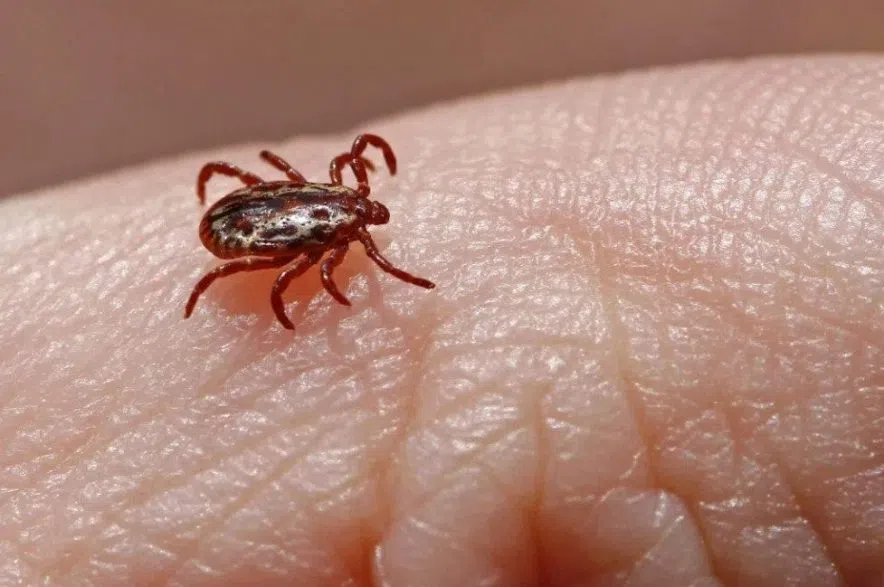
Dr. Janet Sperling, an entomologist and president of the Canadian Lyme Disease Foundation, says though Lyme disease is more common in Ontario and Quebec, it is still a concern in Saskatchewan.
Sperling joined The Evan Bray Show to talk about wood tick population growth and why people should be wary of Lyme disease if bitten.
Read more:
This interview has been edited length and clarity.
EVAN BRAY: What do you consider tick season?
SPERLING: Tick season depends partly on the type of tick that we’re talking about. When we’re talking about ticks in Saskatchewan, mostly we’re talking about wood ticks. June is the high point here.
If we’re talking about Lyme disease ticks, I’d be talking about spring, where maybe they came up on a migratory bird, or maybe in the fall.
BRAY: How many different types of ticks do we have in Saskatchewan?
SPERLING: At least 12, and most of them are going to be found (on) wildlife, so we’re not going to run into them very often. If you’re a hunter, of course it’s going to be different, and if you’re a trapper, you’re going to run into some really interesting ticks.
Trappers and veterinarians send me the most interesting ticks, and the most exciting and sort of dramatic ticks come from B.C. In Saskatchewan, you don’t have a huge number of really wicked ticks, which is nice.
BRAY: What are Lone Star ticks?
SPERLING: Lone Star ticks come up on the migratory birds. They’re a nasty little tick. I don’t think you would expect to get more than one or two a year in Saskatchewan.
If you go down in the East Coast of the U.S, they can end up being an extremely important tick, and can cause Alpha-gal syndrome, and that’s terrible because that means you can’t eat red meat.
BRAY: Is there anything that is contributing to the growth of the population of ticks right now?
SPERLING: We used to have fewer deer. If you had a farm and a deer walked across it, you probably shot it and ate it. We had much smaller farms. There was a lot more control of the farmers just eating the deer that came past.
Things have changed. The farms are more spread out, they’re bigger farms. We’re tolerating deer in cities. I can tell you (that) deer and coyotes in the city where I live are commonplace, where as it used to be pretty unusual.
BRAY: Does spraying for mosquitoes do nothing for ticks?
SPERLING: Correct. Ticks are basically little tanks.
Often people will say, “Oh, I think it’s dead. I’m sorry. I’m sending you a dead tick.” And all I have to do is open up the little baggie and breathe on it, and the carbon dioxide in my breath and the warmth is enough for that tick to wake up and start swinging its arms around.
They are tanks, they can live a long time, especially wood ticks. They’re really tough, and hard to kill.
BRAY: How common is it that humans come into contact with a tick and it results in Lyme disease?
SPERLING: Much less often than in Ontario and Quebec. They have a much bigger problem, but there is definitely a problem in Saskatchewan.
One of the confusions is that the tick that carries the Lyme disease (blacklegged ticks) is more unusual. Wood ticks are more likely to give you something like rickettsia or tularemia. There are other diseases, but they’re all treated with the same antibiotic.
But there’s this idea that the wood tick does not transmit Lyme disease. It doesn’t transmit it as often as the other tick, but there are examples of people who have removed a wood tick and test positive for Lyme disease, and then the doctor says, well, you must have got Lyme disease from a different tick bite. It’s possible, but I also think it’s possible that they got Lyme disease from a wood tick. I still think it’s an open question.
BRAY: What is Lyme disease and what are the complications?
SPERLING: Lyme disease is a bacterium (that) responds to antibiotics. It’s one of these bacteria that’s very unlikely you’re going to get it unless you have a tick bite, and that’s because the tick and the bacterium have co-evolved for millions of year, since the time of the dinosaurs.
The tick saliva helps the bacteria get past the immune system of the human or whatever animal it’s feeding on. You feel like, ‘oh, I’m tired, I got the flu, I’m just not quite right.’ But if it’s not treated and it goes on long enough, you can become incredibly sick.
It can get into your nervous system. It can make you so exhausted that you can’t get off the couch. It can cause problems with your heart if it ends up in your heart, problems with your brain if it ends up in your brain.
It’s a very difficult diagnosis to make in the first place, and up until recently, there was a feeling that you can’t get Lyme disease in Saskatchewan, so the doctors weren’t even thinking about it, which means if you’re not looking for it, you certainly aren’t going to find it.
BRAY: Are there any symptoms someone should get checked out? Or anything else that people should do?
SPERLING: If you have a tick bite take a picture of it and draw a circle around where the edge is. If the edge of that rash starts going out, then that’s called Erythema migrans. It’s a rash that expands out from where the tick bit you. It doesn’t have to be a perfect circle, it can be kind of a jagged circle, it can be just kind of an angry red rash, but generally the rash itself isn’t the big problem.
The problem is that over time, maybe 30 days later, you suddenly feel like you’ve been hit by a truck. You had the infection, but your body was able to fight it off for a while, and then something else tipped you over the edge.
Whenever you remove a tick, throw it into a little baggie, record the date and where you think you picked it up, and put it in the freezer. If you end up getting some sickness, then you can test the tick, and that would then allow the doctor to know what you were exposed to.
Maybe it’s Lyme disease, maybe it’s one of the other tick-borne diseases, and there’s certainly a lot of them, but it gives your doctor a lot more information, knowing how to go forward.
Read more: