Murray Wood: It's getting better all the time
Even if it seems - as the rejoinder in the Beatles' song observed - 'it couldn't get much worse,' Murray Wood suggests w...

The Snowbirds Alumni Association is raising its own concerns about the iconic airshow being grounded until the early 2030s.
David McGuinty, Canada’s Minister of Defence, visited 15 Wing Moose Jaw to make the announcement on Tuesday.
Read more:
The federal government will replace the Snowbirds’ long-serving CT-114 Tutor jets with propeller-driven CT-157 Siskin II aircraft.
The air demonstration team’s aging Tutor jets are wearing out, having first taken flight in the 60s.
Lieutenant Colonel Dan Dempsey, a former commanding officer, team leader with the Moose Jaw Snowbirds and part of the Snowbirds Alumni Association, joined the Evan Bray Show to talk about what the airshow may look like with its new aircraft and concerns over the lengthy pause.
Listen to the full interview, or read the transcript below:
This interview has been edited for length and clarity.
EVAN BRAY: When did you actually become part of the Snowbirds yourself?
DAN DEMPSEY: Yeah, I got selected to the team. It’s something I always wanted to do. I was motivated by the RCF Golden Hawks and was a very young boy. Then, of course, the Snowbirds. I joined the team. I was selected to be one of the sole pilots of team in the fall of 1979 and then in the fall of 1988, I was selected to come back and command the team in the air. That’s my two tours on the team.
There’s a strong emotional connection to the Snowbirds. Your thoughts on the announcement that you were there for yesterday?
DEMPSEY: Well, sadness, obviously some disappointment. It’s tough to see after 55 years, this wonderful legacy that we’ve had with the Tutor Canadian-designed and -built airplanes that have served the RCF and the Canadian Forces so well, come to a close. So, that part of the announcement was very sad. We were hopeful that perhaps we could keep the Tutor going a little bit longer, but it is what it is. That was the first emotion, was sadness and disappointment. But by the same token, I have to say that I think everybody, I hope, was impressed with what the Minister of National Defence and the Commander of the RCF had to say with respect to how important the Snowbirds are to our country. Those of us, over 1000 of us, who have served on the Snowbirds and as pilots and ground crew, we’ve all seen this firsthand. We know how important the team is to the country, and we know that the province of Saskatchewan is proud to have us here on their home base in Moose Jaw. It just goes without saying that there’s going to be another chapter in the future and I think that’s the positive thing that comes out of this.
Originally, we heard plans to keep these current Tutor jets in the air until 2030. Now, they’re saying 2026 will be the last season because of safety concerns. Are the Jets still safe?
DEMPSEY: I want to assure everybody there that Tutor is a perfectly safe aircraft. We have no qualms about the aircraft, whatsoever. It’s being very well maintained, not only by the RCF technicians on 431 Squadron, but our industry partners at L3Harris, IMP Aerospace, Magellan Aerospace, who overhauls the engines. These are all highly professional, dedicated people. This is a perfectly safe aircraft.
One texter was asking this morning, could they be flying F-18s in the interim? Is that a possibility?
DEMPSEY: No, it’s not, and the reason for that is we have a tremendous shortage of pilots and technicians in the RCF right now. The F-18, of course, is a much larger airplane, much more sophisticated, and that requires a lot more maintenance. The right now we have a great cadre of pilots flying the Snowbirds, but there’s only one or two of them that have flown the F-18 before.To fly the F-18, you’d have to be a fighter pilot, and we just don’t have the people to do that. Plus, it would be really too expensive. We’ve looked at that in the past, and the government has ruled that out.
Can you talk about this new plane that they’re moving towards, the CT-157 Siskin II? Is it a comparable plane? Some people are suggesting, because it’s propeller driven, it feels like a step down from the Tutor.
DEMPSEY: Well, I think that’s a fair statement. You can’t really compare a turboprop with a jet aircraft in many respects. But having said that, I will say this about the Siskin II – and, of course, I haven’t flown it but I’ve flown in the Harvard II – and I know that these are very capable training aircraft, and I think that the Siskin II is going to be an excellent trainer for the RCAF in the long run, and we’ll have it for many decades. In terms of the Snowbirds adapting to that aircraft, the show won’t be the same. It just won’t be the same. I still think that they’ll be able to do a reasonable show once we get back up to nine aircrafts, but it’s going to take a very long time to do that. The biggest concern we have on the Snowbird Alumni Association is the fact that we’re going to be grounding the Tutor at the end of this year and not having anybody proficient in low-level aerobatics or large formation flying for four or five years. That is an issue, and to that extent, what we’re calling on is for the government – if at all possible, in any way possible – is to fast-track aircraft, so that that length of time can be reduced in five years to something much less than that.

The Snowbirds fly during an air show performance in Moose Jaw in 2024. (Gillian Massie/ 980 CJME)
You mentioned the show will be different. Can you give us a sense of what, what manoeuvres will they be limited to with these new planes?
DEMPSEY: I haven’t seen the Siskin II fly yet. Obviously, it won’t be quite as fast. I think the biggest thing would be some of the vertical manoeuvring that the Snowbirds are able to do now. You might not get the same kind of altitude with the with the Siskin II . I think it’s probably a good rolling airplane, so I don’t think there’s any difference there. I think the biggest thing that people will be concerned about, or notice the differences, it’s just a different type of show. It’s a different type of status, if you will. The G7 countries all fly jet teams. Our hope would be that, in the fullness of time, that we can get back to a jet team like the other G7 nations. I think the Siskin II’s will just do the best we can with it. I still think it’ll be a reasonable show.
Will this hurt recruiting in the long term for the Air Force?
DEMPSEY: It’s going to certainly be a hole. The Snowbirds are the best recruiting tool we have. That is the other concern we have with this lengthy delay on the ground. We’re not going to have that outreach to all the different places in Canada where the Snowbirds are known to fly, and sometimes that’s the only exposure that young kids and the youth of our nation get to the air force just to a snowbird show. It is going to hurt. There’s no question about that.
Donna Fritzke, the executive director with Tourism Moose Jaw, said the Snowbirds bring in airshow fans from far and wide to Saskatchewan.
She spoke with the Evan Bray Show on the decision to pause the air demonstration teams performances.
EVAN BRAY: I feel like Moose Jaw has so much going for it. How big of a role does 15 Wing play in that overall tourism message?
DONNA FRITZKE: Oh, there’s such a huge part of our community. Obviously, we have so much pride in the Snowbirds, and we’re so happy that this is their home. We’re very proud of that fact. The Snowbirds have brought national coverage to our city and to Moose Jaw, and it’s just such a unique aspect of our community, and having them here and what they do, it’s incredible. The Snowbirds are part of our heritage, our culture and that’s what tourism is all about, and the storytelling. We’re just so, so blessed to have them in this community and we’re happy that they’re staying, for sure.
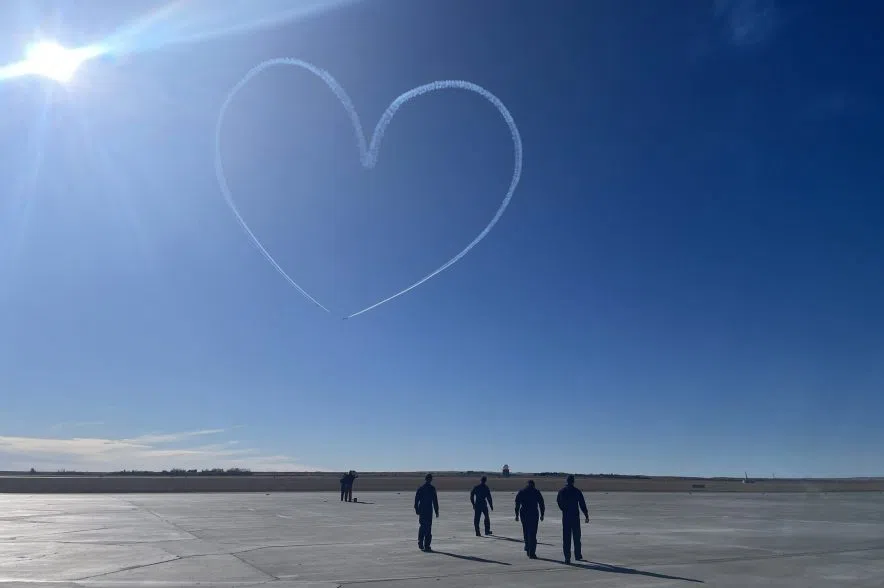
The Snowbirds white smoke trails form a heart in the sky in 2024. (Gillian Massie/ 980 CJME)
Are you able to ever quantify the tourism in terms of economic impact it has on Moose Jaw? Is that something that is that hard to measure?
FRITZKE: That’s a number that I don’t have, but I do know that this past year, the tourism spending in Moose Jaw was $140 million, and obviously the Snowbirds are a big part of that. They are part of our history and our culture and it’s that’s incredible to think that a community of our size generates that type of revenue. That’s incredible for our economics, and we’re just very blessed to be able to have them here, for sure.
Do you worry about the years after 2026 and before 2030? Is that a going to be a challenge for you at Tourism Moose Jaw?
FRITZKE: Obviously we’re concerned about that as well. We love the Snowbirds, and we want to see them. I think of even my own family of being able to go to the air show and to be able to enjoy watching them. And to not see them flying is obviously going to be completely different. But tourism in Moose Jaw, we have so much to offer. The Tunnels of Moose Jaw is just an amazing tour. Everyone needs to come and see that. It’s just so much fun. Temple Gardens Hotel and Spa, they’re putting in $12 million renovation on their building and the spa is an incredible place to go. We have trolley tours, we have true crime daytime tours, we also have ghost tours, and they’re very, very popular. We just got the trolley up and running. Hopefully, the weather stays nice, because that’s always a consideration in May. But, there’s so many things to do here, and we’re just so blessed to live in this community. Our downtown is absolutely charming. You can walk everywhere. There’s quaint cafes and retail, and really, for me, I’m very blessed to have this job. I’m very honoured to be able to represent the tourism in our community, because it’s actually pretty easy. There’s just so much to see and do.