

Murray Wood: Is it fake, or just stolen?
People looking for news on Facebook need to watch out for fake content. And even if it's true, it may have been stolen. ...

Images of last year’s wildfires and the destruction they caused are still burned into the minds of many residents of northern Saskatchewan. And as another wildfire season looms, some are worried history will repeat itself.
Jordan McPhail, the Saskatchewan NDP MLA for Cumberland, said Saskatchewan’s fleet of water bombers is not ready as the wildfire season approaches. On Friday, McPhail told reporters that two water bombers in Saskatchewan are “not going to be ready until mid-July or later,” with “another one that’s not showing up until August,” and a fourth “totally unaccounted for.”
Read more:
Those issues will mean a reduced fleet of water bombers in the province for the first few months of the wildfire season, McPhail said.
“We will not have a full fire-fighting fleet until August, if at all,” he said. “That’s not just unacceptable, it’s dangerous.”
The provincial government disputed McPhail’s claims about the readiness of the water-bomber fleet, accusing the NDP of spreading misinformation “without consideration of the facts.”
In 2025, Rhonda Werbicki lost her family home of 26 years at Denare Beach to wildfires. Her home was one of around 200 in that area that was destroyed.
She described the surreal feeling of getting a call from her home alarm company, letting her and her husband know their house was on fire.
“You know that your house is burning down at that exact moment,” Wibicki said.
“It’s just horrible.”
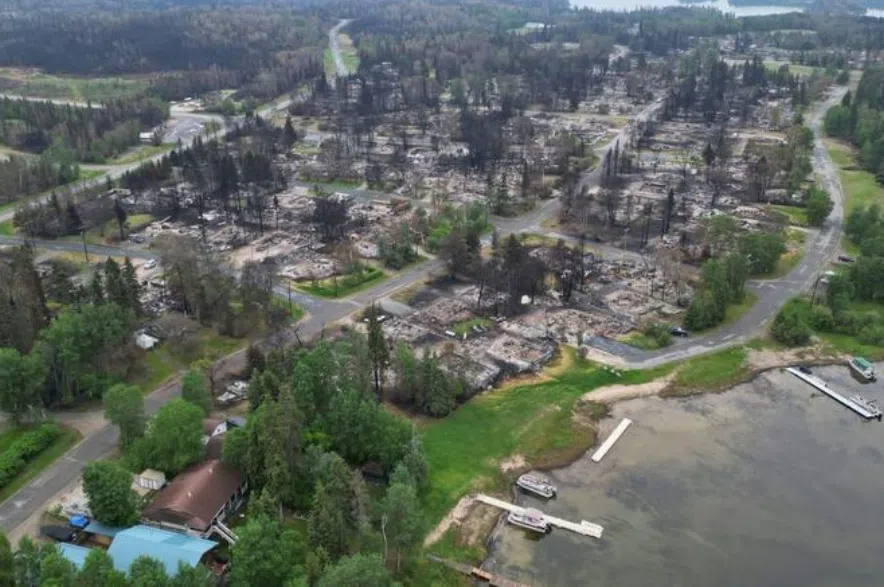
An aerial view of the wildfire damage at Denare Beach in 2025. (Linda Lowe/Facebook)
Werbicki and her husband lost their home on June 2, less than a week after they were evacuated from the community.
“That’s just why I’m so passionate about this, is because I never want this to happen to anybody again,” she said.
McPhail claimed the Government of Saskatchewan is “not prepared, yet again, for wildfire season,” which he said is infuriating to those who lost homes and property last summer.
“We all remember what happened last year,” McPhail said. “Entire communities were threatened, homes were lost, families were displaced and, frankly, we’re lucky that nobody died. The fire that destroyed Rhonda’s home ripped through Denare (Beach) in June. So how can this government justify not being able to have their full fleet ready until August or at all?”
McPhail said people in the northern parts of Saskatchewan are feeling deja vu over the “same lack of preparation, same talking points from the minister (and) same refusal to take responsibility.”
He said accountability and transparency from the province is lacking, with a report that was promised in February still not available as of Friday.
“My constituents are angry. They are anxious, and they have every right to be,” McPhail said.
“They lived through this already. They watched their homes burn. They were forced out of their communities. They dealt with the trauma of losing so much, and now they’re being told the province still isn’t ready. That is an insult to those families, and it raises a bigger question. What has this government learned? Because from where people sit, the answer is ‘Not enough.’”
In the fall, Werbicki and others visited Regina to meet with Saskatchewan Premier Scott Moe and Tim McLeod, Saskatchewan’s justice minister and attorney general.
“I sat right across from (Moe), and I told him exactly how I felt,” Werbicki recalled. “He was somebody I voted for, and I told him that. I said, ‘I really respected you. I really trusted you as a government official.’ I looked at him right in the eye, and I said, ‘You disappointed us in the north.’”
Werbicki said she was touched when Moe took his glasses off, looked at her and responded by saying “I know. And for that, I’m really sorry.”
She said Moe approached her after the meeting, gave her a hug and promised her he would “do better.”
Werbicki said the apology and promise meant the world to her, but she expressed disappointment that the premier hasn’t visited Denare Beach to hold a community meeting, though he did visit the community in September, and that he did not support a public inquiry into last year’s wildfire season, instead opting for an independent review. She said that decision “was just a slap in the face” to her and residents of the area.
“If you really wanted to do better, actions speak louder than words,” she said.
Wibicki, who was involved in a class-action lawsuit against the province that ultimately did not proceed, said she is still planning to rebuild her home. She presently is living in Gimli, Man. – about an eight-hour drive from Denare Beach – and returns frequently for work. She said she has two residences rented so she can go back and forth for work as needed.
“So many people have commented that you should expect wildfires because you live in the trees. That is true,” she acknowledged. “I also expect that we are going to be protected by a government that we pay taxes to, regardless of where we live.”
Wibicki said she wants the province to learn from its mistakes and improve its response.
“It doesn’t seem like they’ve learned from it, and it just makes me so angry,” Wibicki said.
Wibicki remembered her community’s last public meeting, held on June 23. She called the gathering “embarrassing,” saying the province had no answers for residents. She said another community meeting has been promised as the wildfires season looms, but expressed frustration that Saskatchewan Public Safety Agency (SPSA) president Marlo Pritchard and vice-president Steve Roberts are not expected to attend.
“We’re going to just get the run around that they don’t have the answers,” Wibicki stated. “I just feel like everybody’s avoiding us. I would just like some accountability of what happened last year, and I really, really, really would like lessons learned.”
“They deserve answers,” McPhail said, “and they deserve a government that takes their safety seriously. Instead, they’re getting delayed deflection, a firefighting fleet that won’t be fully ready until halfway through the season, and that’s not good enough, not for the people that I serve, which is almost the entire northern half of this province.”
The provincial government said the Saskatchewan Public Safety Agency has “one of the largest and most capable aerial firefighting fleets in Canada,” with 17 aircraft positioned across the province for quick and effective wildfire deployment.
“It is disappointing the unserious NDP continue to politicize this matter without consideration of the facts, spreading misinformation on matters of public safety,” the province said in an emailed statement. “The Government of Saskatchewan deeply appreciates the heroic efforts of our first responders, pilots and support staff to ensure Saskatchewan families and communities are safe and secure.”
The government explained that updates were made to the public safety agency’s website on Oct. 20.
“The old content listed the Convair count as 4 aircraft and the Q400s were not mentioned,” the government explained. “The SPSA updated the website to reflect the new Q400 that entered the fleet and reduced the Convair count to three, to reflect the previously announced retirement of one Convair 580 that was retired from the fleet in 2025.”
The government clarified that with the announcement of the airtanker renewal program in April 2024, “it was noted that the Q400s would be replacing the aging Convair 580s” when the new aircraft arrived.
The province stated that the government and public safety agencies used “all available resources… including a fleet of water bombing aircraft” during the 2025 wildfire season.
The current SPSA fleet includes three Convair 580A land-based air tankers, a Q400 land-based air tanker, six Cl 215T turbine-powered water-scooping air tankers and seven turbo commander bird-dog aircraft.
“Due to the critical conditions of where these aircraft operate, there are times when planes will be temporarily removed from service for repair, a federally regulated inspection, maintenance and other issues,” the province noted.
“If availability is hindered, the SPSA will request additional aircraft through its existing mutual aid agreements and compacts. The Government of Saskatchewan will not compromise the health and safety of our pilots and aircraft crews and will ensure that all air assets are in compliance with safety standards and regulations.”
The province said the public safety agency brings its air groups into service in two phases, with the first already prepared for deployment as of April 20.
“This approach ensures aircraft are available throughout the entire wildfire season, while maintaining flexibility to address fleet readiness and maintenance requirements,” the government said.
Wibicki said she’s concerned that people in her community and other northern parts of the province where fires might spread will take matters into their own hands this wildfire season. She said people are installing sprinklers and pumps in preparation for the season.
“I’m really fearful that if there is another fire, that people are not going to leave their homes,” she said.
“Last year, people left, and I don’t think people will leave (again) because of the lack of help that we had last year. And that’s scary, because thankfully, there (were) no deaths this last year, but that could be something that is different in the years coming.”