Murray Wood: Is it fake, or just stolen?
People looking for news on Facebook need to watch out for fake content. And even if it's true, it may have been stolen. ...
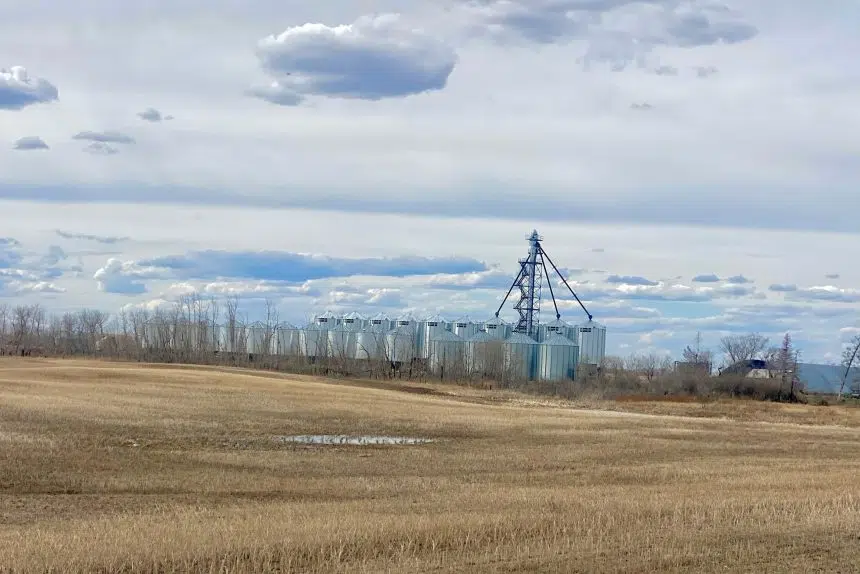
A spike in fertilizer costs may be hurting some farmers worse than others.
“Well, obviously, any huge surge in energy prices drives fertilizer prices up,” Kristjan Hebert, a farmer from the Moosomin area, said Tuesday.
Read more:
“So any producers that don’t have fertilizer positioned have seen 30, 40, 50 per cent increase in their cost of production from an input standpoint.
“It could virtually wipe out the bottom line.”
Hebert was at the Food, Fuel, and Fertilizer Global Summit in Regina, where he interviewed the head of Bunge in Canada, Kyle Jeworski.

Head of Bunge in Canada Kyle Jeworski, left, is interviewed by Moosomin-area farmer Kristjan Hebert at the Food, Fuel, and Fertilizer Global Summit in Regina. (Geoff Smith/980 CJME)
He said the higher input prices are being partly offset by higher crop prices.
“I’m not saying there isn’t margin still there, but at the same time for a lot of producers it’s pretty risky to buy high-priced fertilizer and then go lock in all of that crop with the current risk management structures we have out there,” Hebert explained.
The situation is something Jeworski is keeping an eye on.
“The profitability of our Western Canadian farmer is critically important to us, right?” Jeworski said. “I think, in terms of the timing of the fertilizer increases, the Canadian farmer probably has benefited more than some other jurisdictions of the world.
“That being said, as we’ve seen, inputs just in general continue to rise. You know, it’s something that we watch very closely.”
Jeworski said a diverse mix of crops is something that helps Canadians weather a storm like this.
“We have farmers that are able to switch in and out of multiple commodities depending on economic signals,” he explained.
“That same can’t be said with farmers in a lot of other places of the world. They’re quite limited in terms of what crop rotations they can do.
“We’ve seen time and time again — if the window gets short in terms of seeding, they’re able to switch to something else. Where, again, in some other parts of the world, you know that land will just sit idle.”
Speaking on the same day Cargill announced its Regina canola crush plant is now operational, Jeworski said a proposal for a conola crush plant by Bunge back when it was still Viterra is still being looked at with a feasibility study under way.
“We’re updating essentially all of the factors, so looking at from the supply situation to the demand to the costing,” he said.
“We just need to make sure that, you know, eyes wide open, that we go into it and we’re looking at it. So it’s not a yes, it’s not a no, it’s we need to continue to study to make sure — these are assets that are around for decades — that it’s the right decision to make.”
Jeworski said that also includes competitive dynamics.
“It’s really unprecedented in my career, for what we’ve seen in the province in terms of demand for canola,” he said.
“The province of Saskatchewan, for additional growth, we need to make sure we continue to work on seed varieties, farming practices, acreage expansions, all those things that are needed to continue to have supply match what some of the opportunities are in the crush sphere.”
He wouldn’t speculate on how much more the cost of construction would be compared to when the project was first announced in 2021.
The Cargill plant, announced only days before with a price tag of $350 million, has just become operational according to a news release by the company.
It has a capacity to process one million metric tonnes of canola a year, less than half of the proposed Viterra/Bunge plant.
Read more: