
Murray Wood: Watch out for the pump pirates!
Gas prices shot up last week, even though crude prices didn't. And now that war is pushing crude prices up, Murray Wood ...
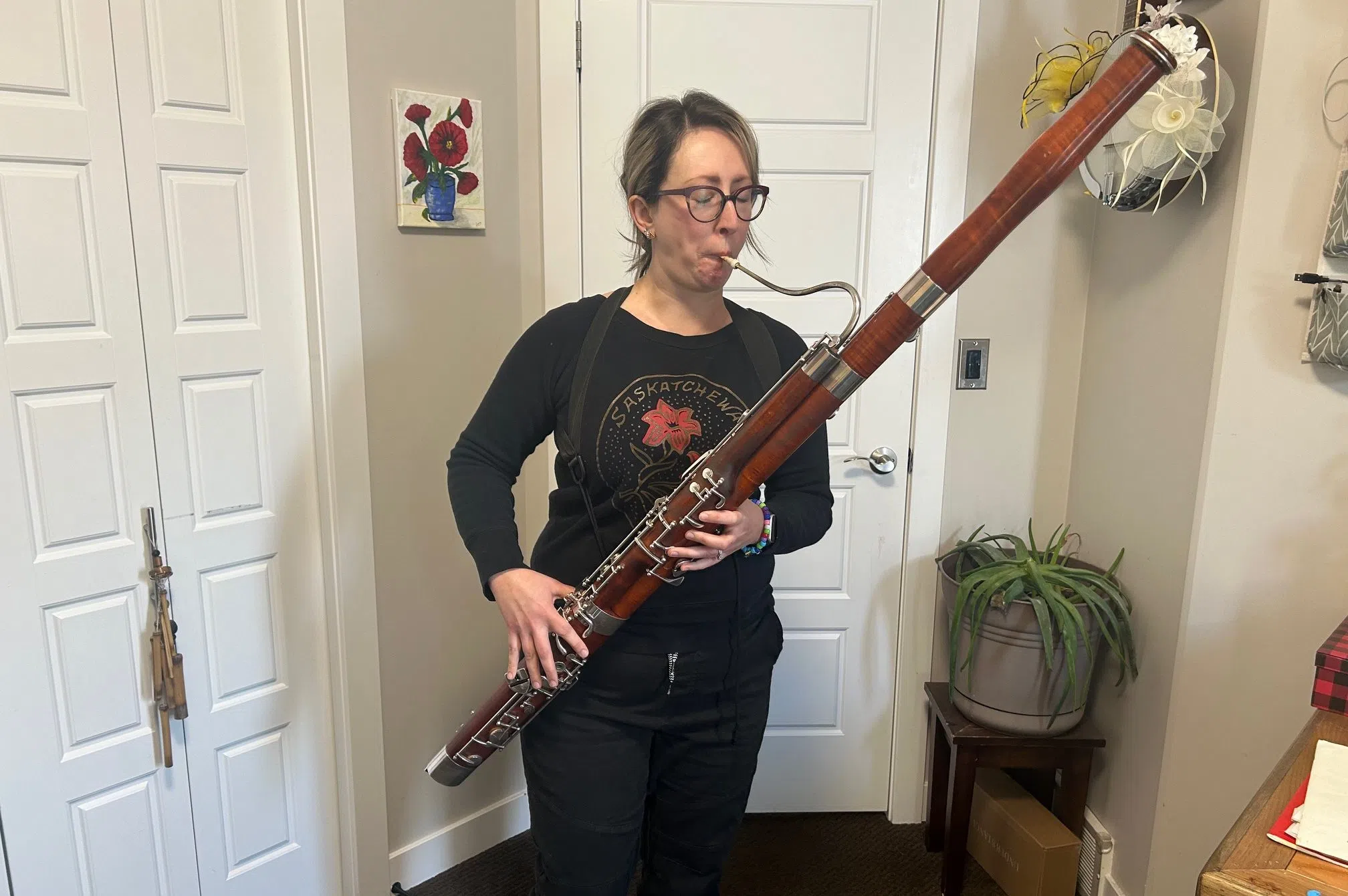
Stephanie Unverricht was once a Grade 6 student staring down one of childhood’s most consequential decisions: Which instrument should I pick?
For most 11-year-olds, band sign-up day is about choosing something familiar. Flute, clarinet, trumpet, perhaps a tuba. But Unverricht didn’t grow up in “most” households.
“Both my parents were musicians,” she explained. “My dad plays trombone in the Saskatoon symphony, and so when it came time for picking a instrument for Grade 6 band, I thought ‘I can’t pick anything normal. I need something that’s challenging.’”
While other kids reached for instruments they recognized, Unverricht reached for something taller, stranger and undeniably distinctive.
“They gave me a bassoon and the rest is history,” she said with a smile.
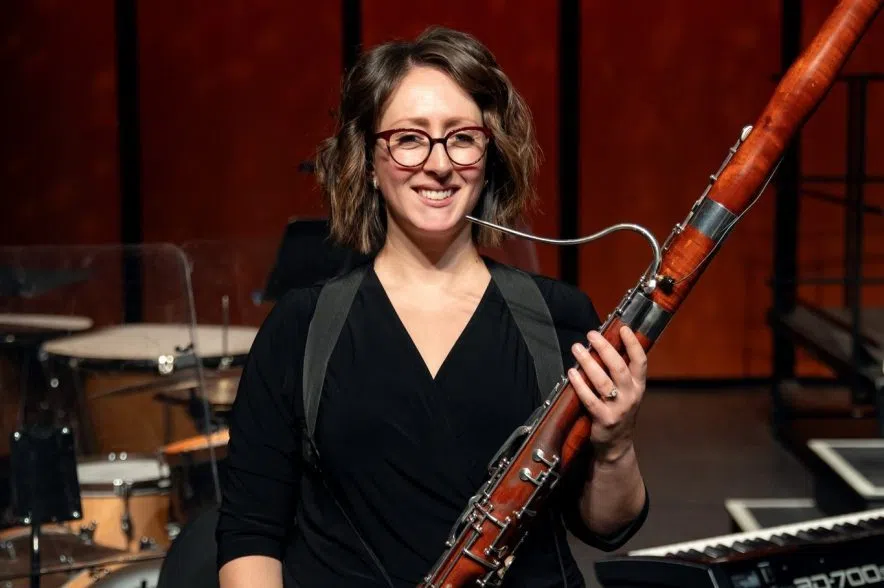
Unverricht first picked up a bassoon in Grade 6, spurred on by her parents’ passion for music to make an unusual instrument choice. (Saskatoon Symphony Orchestra/Facebook)
Her decision to avoid “normal” instruments eventually placed her in the middle of the orchestra, and this spring she’ll be right at the front of it.
On Saturday, Unverricht will step forward as a soloist with the Saskatoon Symphony Orchestra, performing Wolfgang Amadeus Mozart’s Bassoon Concerto in B-flat Major, one of the rare works that puts the bassoon squarely in the spotlight.
If you ask Unverricht, it’s easiest to start with what audiences notice first. The size.
“It is the largest member of the woodwind family,” she explained. “If you’ve ever been to one of our concerts, you’ll see me in the middle of the orchestra and I stick up like a giraffe.”
For years, that’s been her vantage point with the Saskatoon Symphony Orchestra as the principal bassoonist — planted at the centre of the ensemble, the tall silhouette rising above the strings.
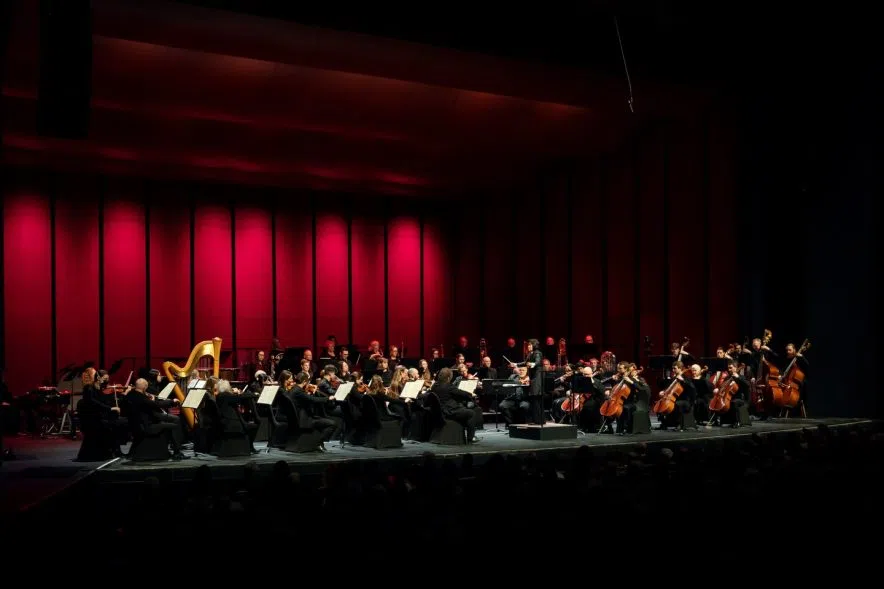
Unverricht sits in the middle of the group and describes herself as the “giraffe” of the orchestra. Can you spot her? (Saskatoon Symphony Orchestra/Facebook)
But the bassoon isn’t just about height. In fact, it’s more about depth.
“The bassoon has very dark, deep, low sound,” she said. “What it adds to the orchestra is sort of like that umami flavour. Something you might not notice, but if it’s not there, then you definitely notice.”
It’s the undercurrent. The richness beneath a melody. The quiet glue holding everything together.
Up close, though, the instrument feels less like a warm bowl of soup and more like a puzzle box. Silver keys criss-cross its body in elaborate patterns.
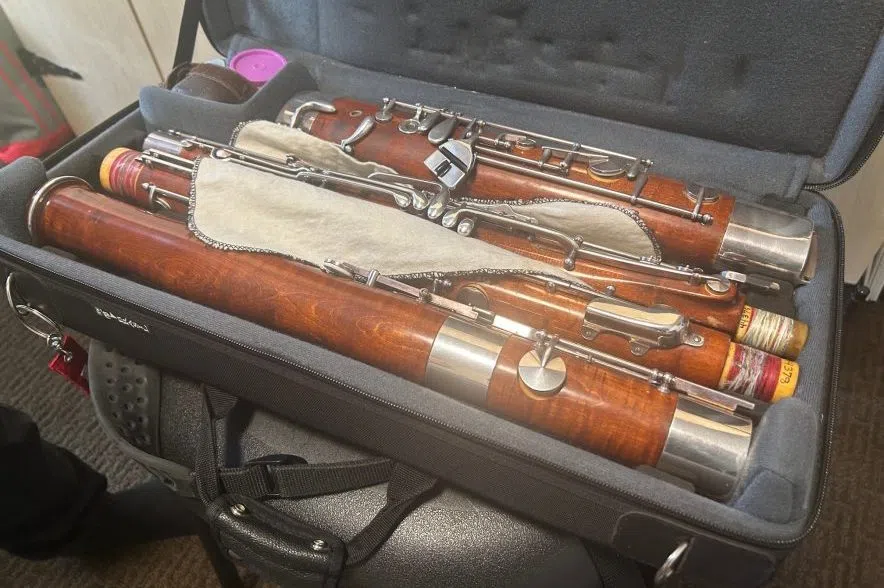
Unverricht said her bassoon is worth more than her car! (Brittany Caffet/650 CKOM)
“It’s a pretty unique instrument. It has a lot of keys,” Unverricht noted. “I have nine keys for my left thumb and four keys for my right thumb.”
Playing the bassoon isn’t easy. It isn’t cheap, either. Unverricht gave a wry smile when asked about the price tag for her instrument of choice.
“More than my car,” she revealed. “This one is insured for about $40,000 right now. I paid, I think, $23,000 for it in the early 2000s.”
But despite all the polished wood and intricate metalwork, the sound begins in two thin blades of cane.
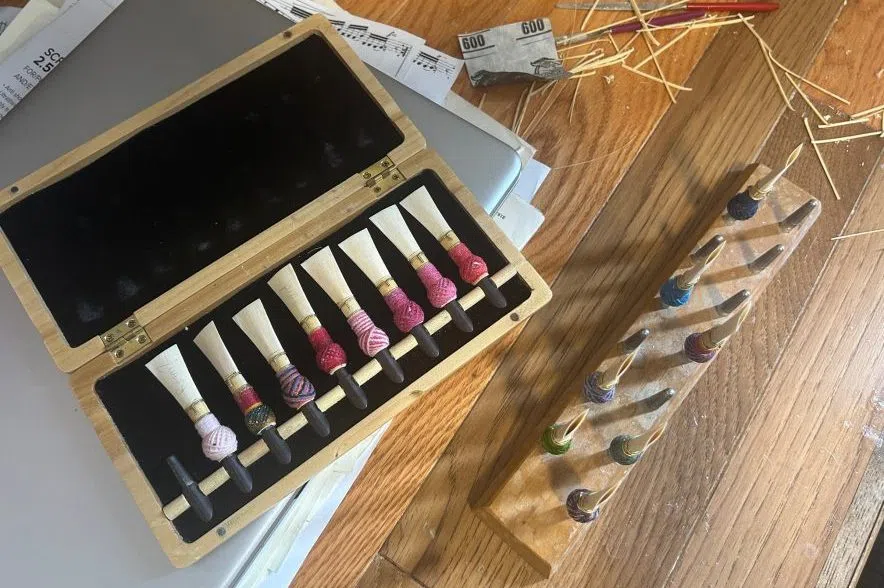
Unverricht’s carrying case holds nine reeds. She often has that many on hand during a practice or performance, as the effectiveness of each reed can change with the slightest shift in temperature or weather. (Brittany Caffet/650 CKOM)
“When I blow through, these two blades will vibrate against each other and open and close and open and close very quickly to create my sound,” she explained, holding up a reed to test its crow — the little squeaky noise it makes before ever meeting the bassoon.
Those little blades are temperamental divas. Handle them right and they sing. Handle them wrong and they let you know.
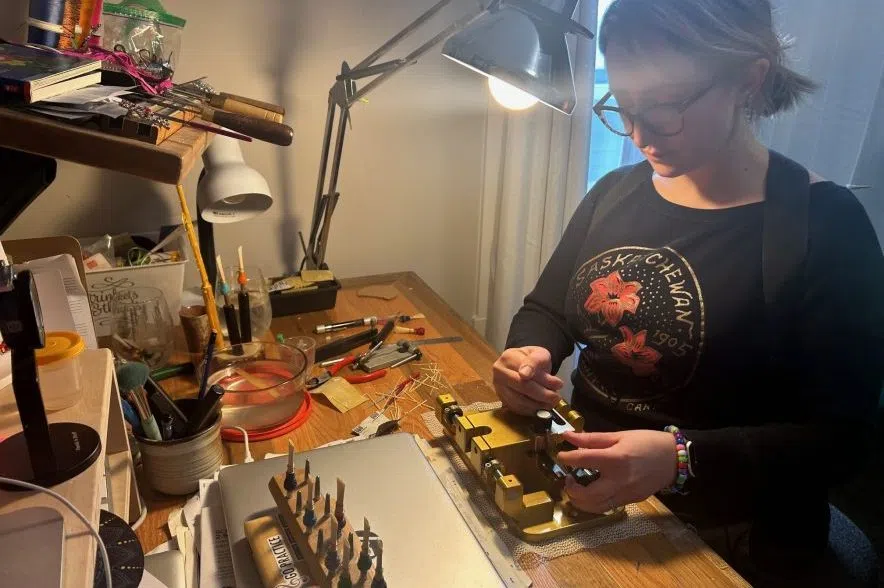
Unverricht said making reeds is a time consuming, labour-intensive process. It’s a ritual that she both loves and loathes. (Brittany Caffet/650 CKOM)
“Our reeds are so finicky. We have to spend a lot of time adjusting our reeds, tweaking them,” Unverricht said. “If the weather changes day to day, our reeds can change day to day.”
She doesn’t just adjust them — she makes them herself. From a single piece of cane, she soaks, shapes and scrapes each reed until it vibrates just the way she wants. It’s a painstaking, hands-on process.
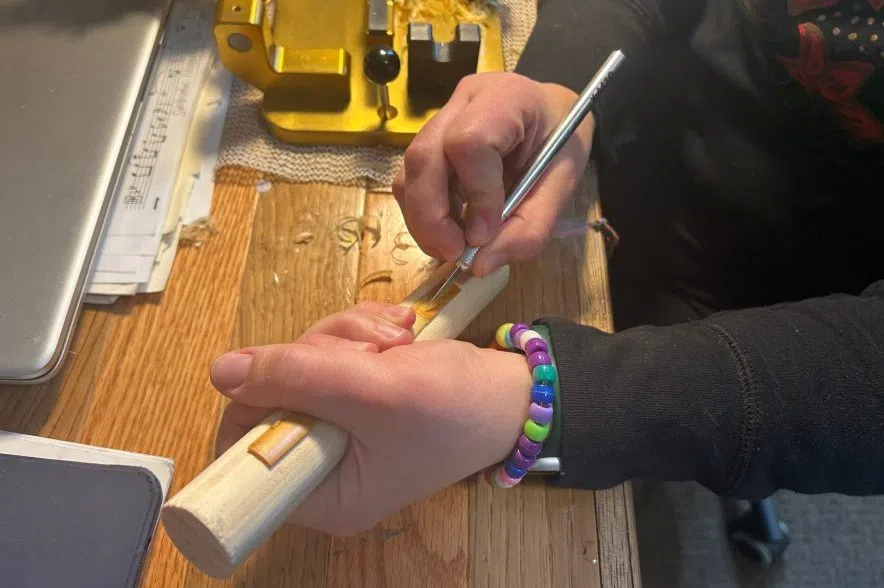
Each reed is made from a single piece of cane, with Unverricht shaping and scraping the wood to the perfect size and shape. (Brittany Caffet/650 CKOM)
“I love and loathe that I have to make reeds for my instrument because it’s time consuming. It’s annoying. It’s expensive.” she said.
“But it also gives me the control to create the sound I want on my bassoon with my own hands.”
And that sound she wants? It takes more than just a good reed.
“It’s a balancing act of good breath control, good embouchure control. That’s the way that we hold our lips when we’re playing,” she said, summing up the delicate choreography behind every note.
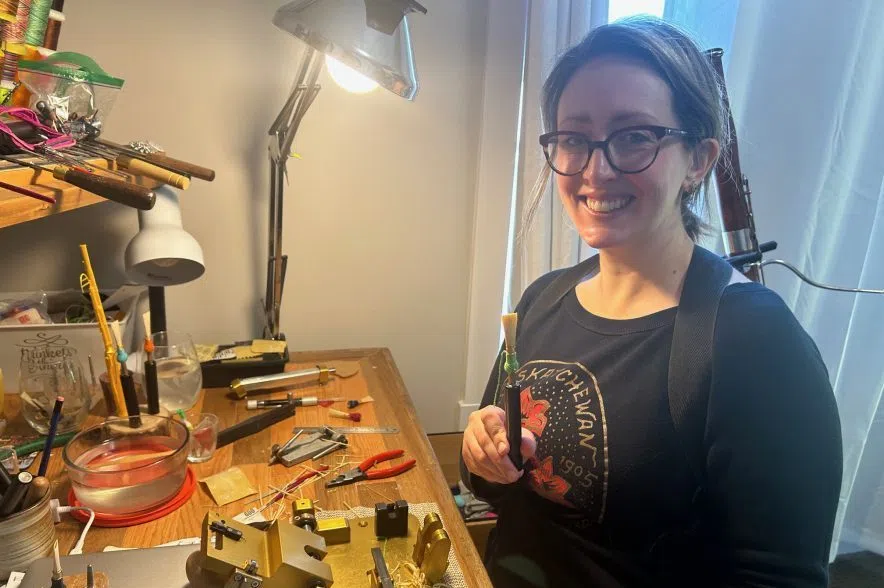
Unverricht finishes each reed with coloured thread. They act both as decoration and as a way for her to differentiate between the many reeds she keeps on hand. (Brittany Caffet/650 CKOM)
The bassoon is equal parts strange, demanding and magical. The giraffe of the orchestra. Not exactly “normal.”
Which, of course, is exactly why a determined Grade 6 student chose it in the first place.
From daring to pick the strangest instrument in the band to a soloist commanding the stage, Stephanie Unverricht is ready to show Saskatoon just how bold a bassoon can be — and you won’t want to miss a single note.
Stephanie Unverricht is the principal bassoonist for the Saskatoon Symphony Orchestra. While she typically sits in the middle of the group, she is preparing to step into the spotlight for a rare solo performance on Saturday, March 7. (Brittany Caffet/650 CKOM)