

Wood file: Canada can lose occasionally and still be No. 1
Canada was snakebit in the gold medal hockey game, and sometimes, even when you dominate the other team, you come up sho...
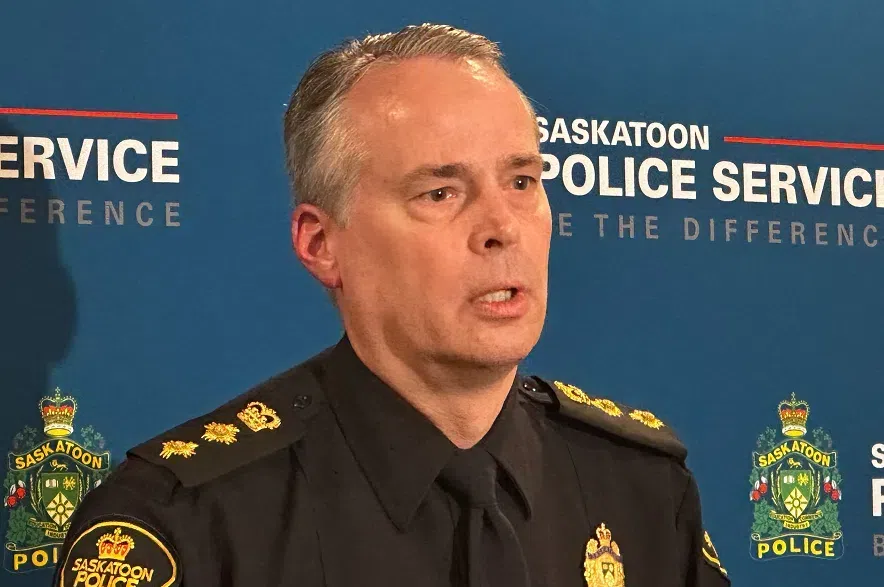
A new wellness strategy will be released by Saskatoon Police Service (SPS) in the coming weeks in the wake of condolences pouring in from community members over the death of an officer.
The Saskatoon Police Service (SPS) has been in the news a number of times over the past week, from several bear spray incidents in the same weekend to a man just released from prison being arrested again on the same day.
Read more:
SPS police chief Cam McBride joined Taylor MacPherson on The Evan Bray Show on Monday to discuss these recent events, mental health in policing and the latest in Saskatoon crime statistics.
The following transcript has been edited for length and clarity.
Taylor MacPherson: The force lost an officer suddenly last week. Are you able to share anything about that passing?
Chief Cam McBride: We did lose an officer last week. We’re grieving that, and one of the things we struggle with in a public service is making sure that we give the public the information that we should while respecting the fact that each officer is a human with family and friends and connections, and so we are not releasing any details right now.
MacPherson: Have you noticed any trends recently in the Saskatoon crime statistics that stood out to you?
McBride: There’s been a lot of attention around the downtown area. We’ve heard from downtown business people and residents.
We saw a significant change over the COVID environment and now what we’ve seen in 2024-25 and into 2026 is a restoration back to numbers that we saw back then.
The only exception is with regard to some of our violent crime types, which continue to be on the rise. We see predominantly those increased numbers in the realm of assaults. Anytime you’ve got a growing population of individuals who might be in crisis or suffering from mental health challenges or addictions, that’s what we see.
So we’ve got our downtown resources working hard to understand what’s happening there. We’ve got our alternative response officers and bike units assigned full-time to those areas but we’re trying to stay really connected, trying to determine how we can make a significant impact for the better, and listening carefully to hear what the people in Saskatoon are telling us.
MacPherson: Is bear spray still a big problem in Saskatoon? Has recent provincial legislation helped?
McBride: We’ve been watching that very closely, and what we saw was a trend of bear spray possession and bear spray use increasing over the last number of years, and that was a steady progression year-over-year.
Taking a close look at 2025, we saw around summer those numbers hit the top of the graph, and they’ve been steadily coming down over time. I think some of the legislative changes and additions have made an impact, some of our own concerted efforts towards enforcing the bear spray possession and use has been impactful.
I can say that for those who are prolific or repeat offenders when it comes to bear spray, we’re very diligent, we’re very proactive and our mission is to ensure that those individuals know — especially when they’ve got court appointed or court imposed conditions — that we are watching, that we are doing our best to enforce those conditions and they can’t just continue to do that behavior. We’re all over it.
MacPherson: Are police still struggling with issues around bail and repeat offenders?
McBride: Unfortunately, yes. I know the federal government has made some legislative changes, and we see some policy change over time.
I think many people were wondering, ‘How in the world is a prolific person involved in voyeurism and the victimization of predominantly women within Saskatoon … being released?’ There’s legislation, there’s rules, there are things that have to be followed, but certainly from a policing perspective, we knew it was only a matter of time upon his release that he would go back to his old ways. So in this case, certainly we anticipated that. I think it was within four hours he had breached the conditions and he was returned to custody.
Locally, provincially and federally, police are lobbying to see more strict guidelines and legislation. That’s not to say that incarceration is the answer, but it is to say that for individuals who are repeatedly involved in crime and constantly victimizing our communities, we need to be more proactive, and we need to take steps to ensure that our community is safe.
Listener question:
Alex: In regards to the pro-Palestinian and pro-Iranian protests that I see around the city, does one or the other require more security work?
McBride: We do our very best when we know there’s a protest happening to reach out to the organizers to find out what they’re anticipating, what they’re thinking, what they would like to do. Then we have a look at social media to see what kind of attention that protest is receiving, and then we do our best to respond according to what we anticipate might happen.
In terms of the protests that you’ve mentioned, we do have a very good working relationship with organizers from several of the communities that are represented. There is the Charter of Rights and Freedoms provides everybody with the right to freedom of expression and the freedom to gather and so we need to follow that.
Our mission is to do a bit of a threat assessment, find out what we might expect to see, and then respond as best we can, knowing we can’t predict the future. Anytime there’s protest activity, there’s the potential for counter-protest and the potential for things to get out of hand, even if the original group is intending to be completely peaceful.
MacPherson: Have you seen any clashes at protests here in Saskatoon?
McBride: We’ve seen a little bit of tension rising but the citizens of Saskatoon who are gathering to express themselves predominantly have been respectful, and following the rules.
We are also going to enforce the rules, especially where protest activity could lead to the victimization of an innocent person or counter protester; we need the respect there.
MacPherson: How big of a factor is mental health care when it comes to policing, and how much could we reduce the crime rate if we paid a little more attention to mental health?
McBride: There are studies going on all the time. A lot of the times when we see increases in crime that’s directly related to mental health, often it’s also in that social disorder-realm where we have individuals in the community who are challenged, struggling, and their behaviour changes.
They have this outward manifestation of what’s happening internally, and quite often the police are called to address that behavior that sometimes can be violent, but when it comes to root issues and support at the front end, police aren’t the right ones to be doing that work.
We work very closely with our service providers, health providers, and those involved in the support at the front end, so that it lightens the load for us when it comes to those behavioral things in the community.
Listener question:
Charles: What about issues around officer burnout and mental health?
McBride: We’ve seen an increase in mental health challenges when it comes to first responders generally. We’ve also seen a changed environment where staff in emergency services are more tuned-in to those feelings, to those changes, more willing to talk about it and to accept help.
Although the challenges are increasing, our responses are getting better in proportion. Saskatoon Police Service is right on the cusp of releasing a very robust wellness strategy that we’ve been working on for several months, and I’m very proud of that work.
It comes as a result of a sense of urgency that we have to be addressing the mental health and wellness of our staff, and that’s staff across the board. We’ve got staff who are typing reports or handling information who are not sworn police officers but, by virtue of their work, having to see and hear and do things that are difficult, and so we are trying to develop a strategy to ensure our staff are healthy across the board.
We’re just putting the finishing touches on it and doing what we need to do to make sure it’s edited and complete, and then we’ll be releasing it. It comes as a result of a lot of hard work by many people within our organization.
Read more: