

Sarah Mills: My World Cup ticket hopes are dashed once again
Sarah Mills just received another email telling her she hasn't been successful seeking World Cup tickets. The dream is d...
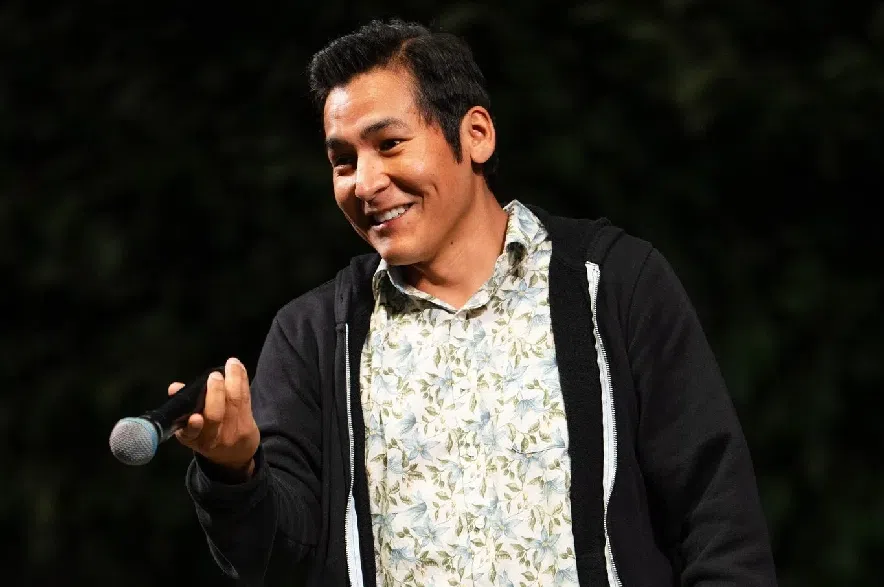
The first stage Ryan Moccasin ever stood on was not in a theatre. It was a mall playground.
He said his parents would often leave him and his older brother to their own devices while they shopped.
“Which is just crazy, if you think about it,” he said, laughing at the memory. “You couldn’t do that now, because they’ll call social services on you!”
But for the young Moccasin, what could have been idle time became something else entirely.
“My brother, who’s two years older than me, he’s got a better imagination,” he said. “He’d always create these elaborate stories for me and him to act. We would play, almost like we were doing theater, but we didn’t know it was theater at the time.”
There were no scripts and no audience beyond each other. Just two boys building worlds out of thin air.
“Here I am, over 30 years later, sharing stories like that with the world,” Moccasin said.
“Storytelling has always been with me through every stage of my life. I think it really started as kids, making up those imaginative stories. Storytelling, it’s always just been in the backdrop of everything.”
That backdrop has carried him through television, film and onto stages where laughter rolls like thunder. And in 2026, it’s carried him into a new role at the University of Saskatchewan as Indigenous storyteller in residence.
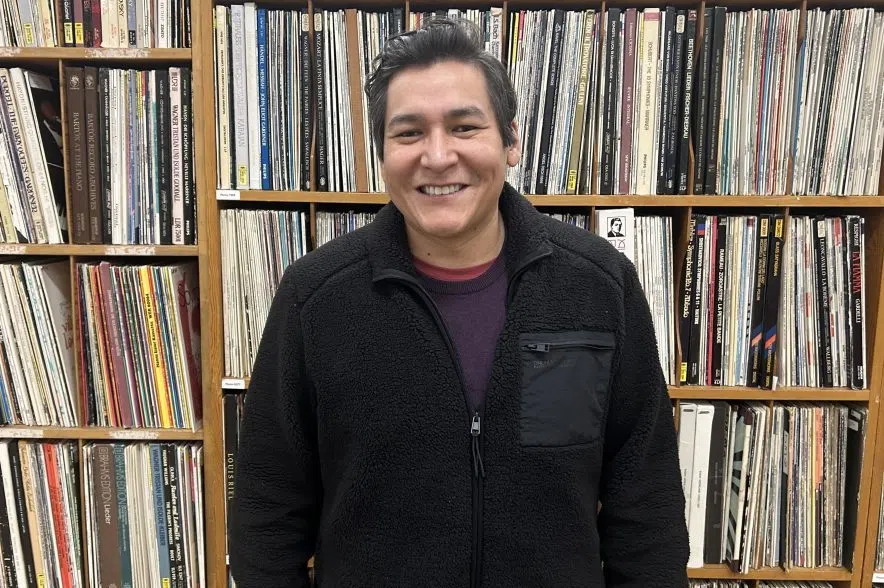
Ryan Moccasin is an accomplished storyteller with a background in film and television. (Brittany Caffet/650 CKOM)
For Moccasin, the title is not about prestige. It’s about exchange.
“A storyteller in residence is somebody who shares their craft with the world. Specifically here, it’s with the students at the U of S,” he explained. “It’s also somebody who’s curious about stories of other people. I’m not just here to teach people how to write or tell them how I address my craft or my art. I’m here to gather stories, too.”
As a kid, before he understood structures or themes, he understood the feeling of stories, like the ones that flickered from a television after school.
“One of the stories that we all relate to is movies. We all have our own favourite movies growing up. I remember just watching movies as a kid, you know, like the Disney movies and all that, and then TV shows like Fresh Prince of Bel Air and Family Matters.”
Those shows were funny. Big. Warm. They made ordinary life feel cinematic. And somewhere in between sitcom punchlines and animated soundtracks, a lesson was forming: stories could hold joy.
Today, Moccasin said his own comedy draws directly from his own experience.
“Some of the best jokes I tell on stage is something that I’ve experienced in the past, but I add hyperbole and all this stuff. I exaggerate to make it funny on stage,” he said.
“You can draw upon that energy you’re feeling at the time, whether it’s confusion, anger, happiness… You can turn that into like a good piece. A good joke or a good story.”
That alchemy — transforming confusion into clarity and anger into laughter — is not accidental. It is cultural.
“Our humour is very specific, Indigenous humour,” he said. “You go out and visit the rez, you know, where I’m from, Saulteaux First Nation. We have a specific kind of humour, and we really like to inject that into our stories and just have fun with it. It’s kind of like the medicine, you know, like the healing salve that puts it all together.”
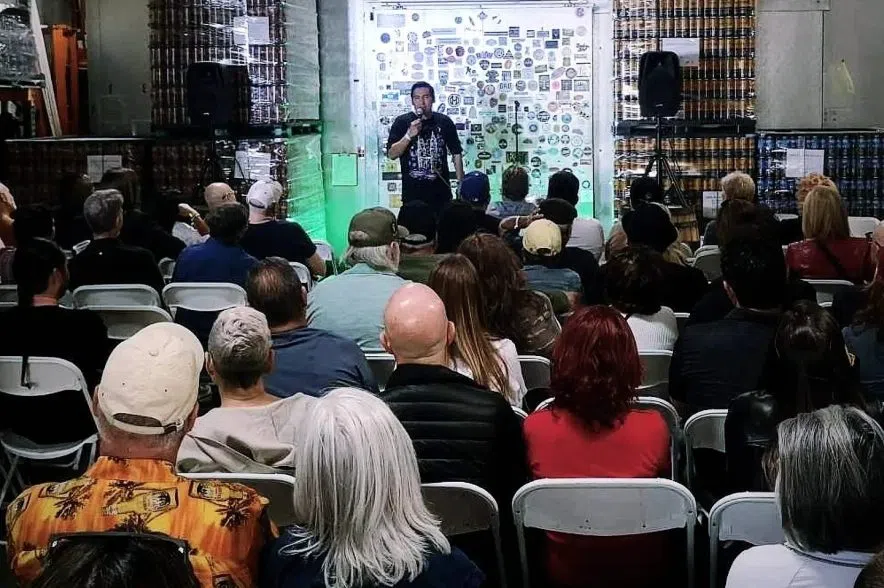
Ryan Moccasin says storytelling has been a part of every aspect of his life. (Ryan Moccasin/Facebook)
He remembers attending one of his first sweat lodges with an elder, Harvey Knight. He said he was nervous, expecting intensity and solemnity. Instead, he found the opposite. During the ceremony, jokes rippled through the lodge. Knight teased him about livestreaming on Facebook — immediately clarifying he was kidding.
“He made the ceremony very entertaining,” Moccasin recalled. “And he used humour to disarm us.”
The lesson was immediate and lasting.
“That’s what I find with what humour does: disarms the audience so you can make a connection with them,” Moccasin said.
“I think that’s the power of humour and how Indigenous people address the many tragedies we’ve had in our communities so we can enter that space and talk deeper about it. If we’re funny about it, we can disarm the people we’re in that space with.”
Laughter doesn’t erase history. It makes it bearable.
“Somebody asked me one time ‘When Indigenous people make their stories on screen, why is it so dystopian?’ My answer to that was ‘Well, the past is very dystopian.’ We have a lot of history here in Canada, and we’ve experienced many dark chapters,” Moccasin explained.
Humour, for Moccasin, is not a detour around pain. It is a way through it. Because even within dystopia, there are many moments of joy.
“We have a lot of stories to tell, and every genre, whether it’s horror or comedy,” he said. “There’s a lot of space for Indigenous people to tell those stories, because we’ve experienced a lot. But also many good chapters going back in history, and even now we’re experiencing good chapters. We’re reclaiming our stories, reclaiming that space for us.”
That reclamation is what he brings to the University of Saskatchewan. Not just technique, not just punchlines, but permission.
Through film masterclasses and comedy workshops, Moccasin said he will invite students to excavate their own backgrounds, their own playground stages and their own inherited memories.
“A marker of success for me is to see somebody perhaps take what I’m doing, or what I’ve learned in this industry, to share their story with the world,” Moccasin explained.
“If I can do that, even for one student, you know, that’s a success for me.”
In a mall playground decades ago, two brothers built imaginary worlds because they had time and each other. Today, in a university library in Saskatoon, Ryan Moccasin will help others build theirs.
The setting has changed. The audience has grown. But the story — the one about imagination, resilience and laughter as medicine — has been there all along, just waiting to be told.
Ryan Moccasin is bringing comedy, cultural truth and lived experience to the University of Saskatchewan as the Indigenous storyteller in residence. (Ryan Moccasin/Facebook)