

Sarah Mills: My World Cup ticket hopes are dashed once again
Sarah Mills just received another email telling her she hasn't been successful seeking World Cup tickets. The dream is d...

There’s a hot commodity that’s proving difficult to get your hands on at the Milano Cortina Winter Games, and it’s not a medal.
Tina and Milo are the sibling stoats whose plush look-a-likes are selling out.
Read more:
Olympic mascot Tina, whose name comes from host city Cortina, features white fur while her younger brother Milo is brown and named after Milano. Milo is the Paralympic mascot, with his backstory detailing how he was born without one paw and learned to use his tail as a leg, according to the Milano Cortina 2026 website.
The stuffed animals of Tina and Milo come in four different sizes ranging in price between roughly $24 to $81 (€15 to €50). As of Feb. 20, the two larger versions of both Tina and Milo were sold out on the Olympic Shop website.
But, while the stoats are representing Italy’s Olympics, they’re a common creature in Saskatchewan.
“They cover almost the entire entire province,” Todd Smith, executive director of the Saskatchewan Wildlife Federation, said.
More commonly known in North America as short or long-tailed weasels or ermines, stoats live from the southern border of Saskatchewan all the way up to the boreal forest, and span east to west according to Smith.
The animals change colour depending on the season to help with camouflage and hunting.
“So in winter they tend to be white with a black tip on their tail and in the summer they turn brown,” Smith said.
Although they look cute, “they are known as some of the fiercest little critters you will find in the province,” according to Smith.
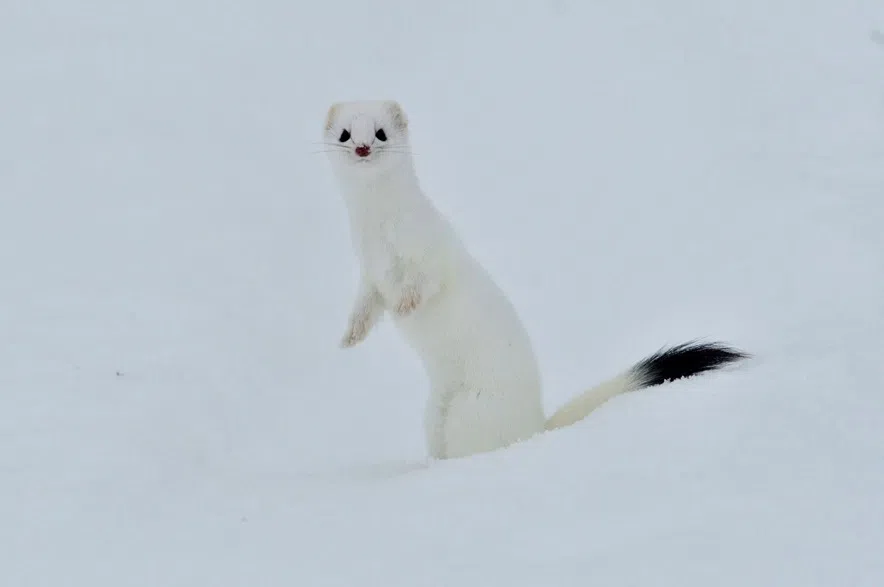
Nature photographer Twyla Beier said she sees a stoat in Saskatchewan about once a year. She caught this photo while taking pictures of snow buntings, a type of small bird. (Twyla Beier/Submitted)
It’s something Saskatchewan nature photographer Twyla Beier has experienced firsthand.
“I honestly have seen one take down a gopher before, so I guess they are pretty vicious,” Beier said.
Stoats are great at taking care of rodents, with the long-tailed weasels also going after animals twice their size, like snowshoe hares and cottontail rabbits.
But, just as with the plush versions of Tina and Milo, stoats in Saskatchewan are hard to come by.
“They’re a fairly common species, but they are pretty elusive. So it’s rare to see them,” Smith said.
Beier shared the same sentiment, explaining how anyone who grabs a photograph of a stoat in the wild usually “just lucked out.”
While you may have never seen a stoat alive, you’ve likely seen parts of one in photos since the animal is royally fashionable.
“If you ever get a chance to look at the Queen of England, the King of England, the royal cloak that they wear that’s all white with the little black dots on it, those are all ermine tails,” Smith said.
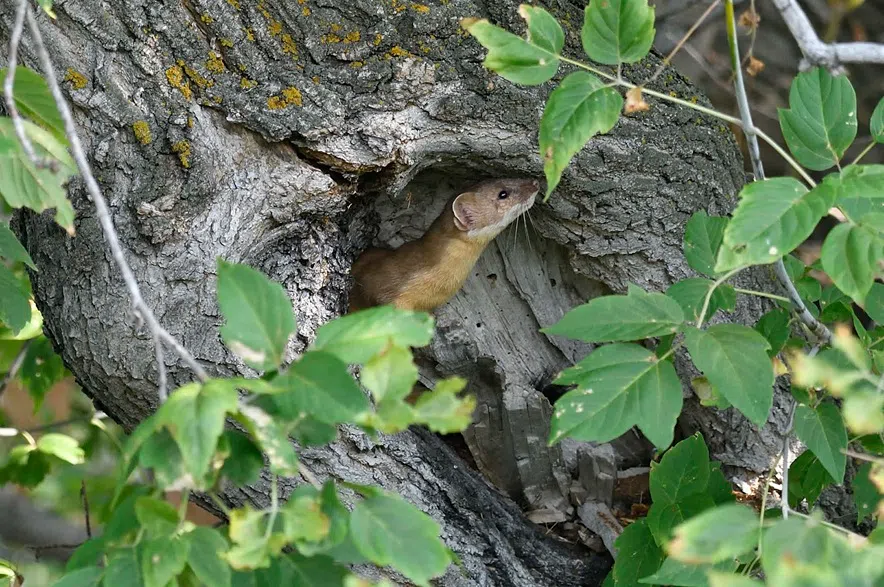
A stoat in summer, with a brown coat. Saskatchewan Wildlife Federation’s Todd Smithss aid stoats are common around farms but those in Regina can look for them in Condie Nature Refuge while people in Saskatoon could try Blackstrap Provincial Park. (Twyla Beier/Submitted)
Given stoats’ reputations as “pugnacious,” Smith said he initially thought the choice of mascot was interesting. But, after talking with his son, he sees it as a good representation of the Olympic athletes.
“They’re very, very flexible and adaptable creatures. They have a very tenacious spirit, and they do not give up,” he said.
While not everyone loves stoats, both Smith and Beier hold positive views of the rodent-killer.
“You can befriend them quite easily. We used to have one that would hang out around the cabin where we would snowshoe all the time, and it would live in the wood pile. We never had any issues with with mice whatsoever,” Smith said.
Smith loves seeing them, saying, “they’re so adorable but they can be kind of photogenic, too, because they’re curious, so they’ll stand up and take a look at you.”
Although stoats aren’t anywhere near extinction in the province, Smith still has hope it can raise the profile of an animal rarely seen on the world stage.
“They’re not big like a moose or a bear. They’re not necessarily as charismatic as a wolf. But, they are a species that we have within the province and they can be very, very interesting if you get out and actually have a chance to observe them,” he said.
Read more: