Evan Bray: What would 'associate' EU membership mean for Canada?
There's been a lot of talk about Canada possibly becoming an "associate member" of the European Union. Evan Br...
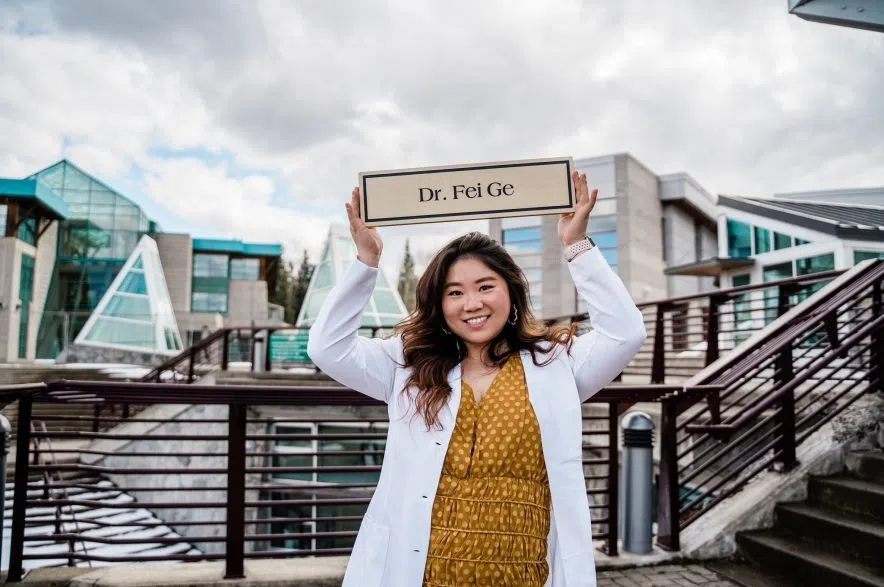
A doctor from B.C. has chosen to give up the mountains to care for the bumps and bruises of people in Saskatchewan.
Despite the many criticisms and hiccups Saskatchewan’s health-care system is facing, Dr. Fei Ge said she’s had a very positive start to her career in the province.
Read more:
Ge is a family physician in Saskatoon who spends part of her practice at West Winds Clinic and part doing obstetrics work with low-risk patients throughout their pregnancies.
She graduated from the University of British Columbia’s Faculty of Medicine — prided on its website for being “ranked among the world’s top medical schools” and the faculty being a “leader in both the science and practice of medicine” — in 2022, then moved to Saskatoon to complete her residency, which she did in 2024.
Ge was excited to come to the province because of the “great reputation” of the family medicine program at the University of Saskatchewan’s College of Medicine. She had never visited Saskatchewan previously.
“I was really happy when I matched here,” Ge said. “It’s a great place to train.”
For Ge, family medicine was an easy choice. The work is hard but meaningful and flexible. She enjoys the long-term relationships she is starting to build with her patients.
“You feel like you’re able to know them really well,” Ge explained. “You know their life, their motivations, so it makes it feel like you’re working on the same team with them, because you understand each other.”
Ge said she knew she wanted to include obstetrics in her practice when she was still in medical school. She said she works in a call group with a “really great team” of doctors and from intrapartum through delivery, finds the work rewarding.
“When I would meet patients for the first time, I don’t think I expected the amount of like gratitude just for taking them on before I had even done anything. They didn’t even know if I was good or not at that first meeting, but they were all so kind, so excited,” Ge said.
Now a year and a half into her independent practice, Ge has no plans to leave.
Ge said the increase in level of responsibility and independence from residency to independent practice is a significant transition.
“I appreciated that because I was going to start working in Saskatoon, the same place where I trained, I felt like I was really well supported, especially working at the clinic where I did my training,” Ge said.
She called the Saskatoon medical community — and Saskatchewan, generally — very collegial and supportive.
“It’s scary and stressful, and there’s always a big learning curve, but I felt like I had the skills needed to navigate those transitions to practice,” she said.
The first six months have been the hardest, she said — an apparently common experience among young doctors finding their footing in the system.
“There’s definitely a bit of imposter syndrome, like, ‘Oh, why isn’t anybody watching or supervising me?’” she said. Adjusting to taking on more responsibility and having less oversight to the care she is providing has been part of the journey in her own practice, as well as navigating scheduling and how she wants to balance her practice.
“There’s, luckily, lots of job opportunities in family medicine, so it can be overwhelming how much choice there is,” Ge shared.
Having the flexibility to work as a general practitioner and pick up other specialized skills is one of the benefits to her position, Ge said. It gives more exposure to those practising family medicine and helps provide other pathways for care that people can seek through their family doctor, where appropriate.
It also means Ge is able to continue to grow her skills and pursue other areas of interest throughout her practice. Emergency medicine, rural medicine and addictions and mental health are other areas family doctors might branch into.
She said her practice’s “bread and butter” tends to be mental health concerns like depression, anxiety and ADHD.

Dr. Fei Ge sits at her desk at West Winds Primary Health Centre in Saskatoon on Jan. 26, 2026. She says she’s had an extremely positive start to her career and highly recommends the University of Saskatchewan’s family doctor training. (Libby Gray/650 CKOM)
Ge now sees about 300 patients on her panel – a smaller load, because she works at an academic clinic. Now having spent some time starting her practice in the province, Ge has had time to become acquainted with the Saskatchewan health-care system.
There is generally declining access to maternity care in rural communities, which is a Canada-wide concern, Ge said. Instead of being able to access care in their own rural communities, many women are travelling to main urban areas like Saskatoon or Regina for care during their pregnancy and delivery.
Ge said she has a number of pregnant patients who travel into Saskatoon for care. Co-ordinating travel plans to ensure a patient will be able to make it to the city in labour when they live an hour away or planning around future weather conditions with scheduling an induction, Ge explained, are some of the logistical barriers her patients have to consider.
“We’ve had a couple of really cold days, some snowstorms, so sometimes that affects people being able to access care,” Ge said.
Further, with many people in the province without a family doctor of their own, Saskatchewan emergency rooms remain overwhelmed, affecting the health of anyone who might be in need of urgent or life-saving health care.
Ge said there’s an improper reversal happening where more people who do have family doctors might try to get a same-day appointment with their physician instead of attending the ER, sometimes in situations where the ER would be the appropriate place to go with their ailment. Patients know they will be seen by their family doctor sooner and with less hassle than spending hours in the ER waiting room.
Similarly, she suggested it’s likely many of those reporting to the ER may not have their own family doctor and may have situations where a family physician would be the more appropriate place for their concern, but aren’t sure where else to go for help. She said most people want a family doctor of their own and try to find one, but that remains difficult in Saskatchewan.
She noted that people who are going to the ER are usually not at their best, being in pain, upset and often scared going into a stressful and “overstimulating” environment, to wait for care.
Ge called the situation a “complicated problem,” and said colleagues and friends of hers who work in emergency medicine have noticed worsening conditions over the past few years.
“I think, in a perfect world where everybody had a family doctor that they could access in a timely manner … there would be a lot less people having to go to the emergency room,” Ge suggested. “That would decrease the strain on the system a lot.
“It’s frustrating, because you want to take care of everyone, but the demands on the system don’t allow that.”
Ge also noted that some specialties don’t exist in Saskatoon or the province, leaving patients to travel or find another way to seek the care they need.
In her past year and a half, Ge has seen a few of those cases personally – a “handful” that she described as people who needed to seek care in another province. Other services are available in Saskatchewan but require a wait time.
“Usually people are completely understanding and willing to wait,” Ge said, listing pediatric allergists and psychiatry as specialties with long waits in Saskatchewan.
Dermatologists used to have long waits, too, but Ge has seen improvement in that speciality.
“The allergists that do work here try their very best to see what they can, but there’s only a few of them. They can’t meet that demand, unfortunately,” Ge said.
The wait to see a pediatric allergist in Saskatchewan can be a year or more, at present. Medical school prepared Ge, though, for these realities and challenges in the system.
“The difference was that I had to deal with them myself now, instead of always having staff or somebody to consult with and get help managing,” Ge explained.
She sees those challenges as another opportunity to help a patient.
“It adds to the satisfaction when you can overcome some of those barriers,” she said.
Ge understands the concerns patients might have with the system and not being able to receive the care someone needs in a timely manner. Her patients, however, have not taken those frustrations out on her.
“I’ve never had anybody be mad at me. They’re all very nice about it,” Ge shared.
Knowing how frustrating the situation can be, though, Ge works to set realistic expectations, communicate clearly and stay on top of follow up with her patients.
“I think it’s important to … set those realistic expectations and say, the wait times for this are long. You can expect it to take a year or more, but obviously, I’m on top of it,” she said. “(Patients) do definitely appreciate that.”