Murray Wood: It's getting better all the time
Even if it seems - as the rejoinder in the Beatles' song observed - 'it couldn't get much worse,' Murray Wood suggests w...
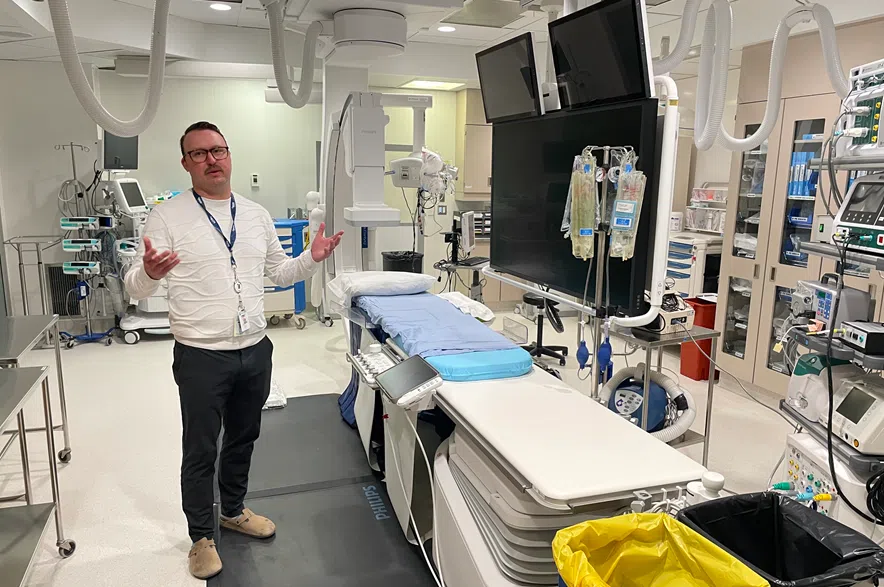
Upgrades at Saskatoon’s Royal University Hospital (RUH) are already cutting down wait times for patients with heart problems.
As part of the end of last year’s renovations, the newly named Walter and Margaret McNabb Interventional Cardiology Suite had its aging equipment replaced with modern technology for the diagnosis and treatment of life-threatening cardiac conditions.
Read more:
It was a project two years in the making.
Though it’s only been fully operational for a short period, interventional cardiologist and division lead of cardiology at RUH, Dr. Jason Orvold, said it’s “dramatically” changed patients’ access to care, “which has reduced wait times.”
For instance, with the previous equipment Dr. Orvold said he, “was only able to do one artery at a time, do one stent at a time and then we’d have to wait six weeks and do another one.”
That was in part because the older technology limited what he was able to do in a procedure and also imposed safety constraints, like X-ray exposure.
But now, Dr. Orvold said he “was able to fix three arteries in one setting and the patient was able to go home the same day, because I could do it through a small incision in the wrist compared to what we did before.”
In another example, Dr. Orvold talked about the electrophysiology lab, saying prior to the renovations the lab could only do two cases a day, but now that number’s grown to five.
“So, it’s more than doubled,” he said.

Dr. Jason Orvold, an interventional cardiologist and division lead of cardiology at RUH, said the renovations have “dramatically changed the patient journey.” (Marija Robinson/650 CKOM)
Walking through some of the technology that’s shortening the wait times, cardiac electrophysiologist Dr. Chris Pekrul spoke about the fluoroscopy X-ray camera.
It provides a “perfect visualization of the heart and enables me to do that with low doses of radiation,” he said.
Having less radiation lowers the risk and makes procedures “much safer” for patients and the team, according to Dr. Pekrul.
Without this camera and the other new technology “and without having the integration of the technology that complements itself, we’re always hindered to do the next thing,” he said.
Now, he’s able to do the gamut of procedures, ranging from the common ones to the more sophisticated – more quickly and safely.
The benefits extend beyond the patients.
“Part of what we have to do … is balance our wait list and try to find the best people, the most appropriate people, that need to come and it’s a difficult decision,” Dr. Pekrul said.
But, with less people waiting for care, “that burden, at least in part, is alleviated,” he said.
Even though wait times have been reduced, it doesn’t mean they’re short now.
“Wait times are still high,” Dr. Orvold said.
While the technology has helped reduce the length of procedures, the other side of having these advancements, is that doctors have the tools to recognize in more people when care is required.
But, though the list of patients continues to grow, Dr. Orvold said wait times have noticeably improved since he began working – lowering from one year down to two months.
“Waiting two months instead of a year to restart your life means a big difference,” he said.