
Adding insult to injury at tax time
Murray is feeling 'taxed' that the Canada Revenue Agency doesn't provide tax return software for us to use each year, fo...
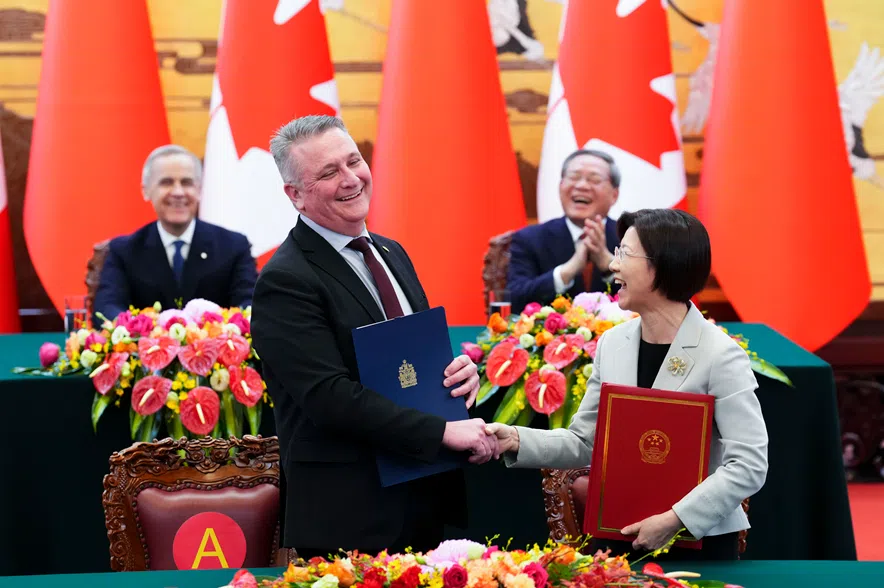
Last week, Prime Minister Mark Carney secured a preliminary trade deal with China, sharply reducing tariffs on Canadian canola seed and lifting other agricultural duties.
In exchange, Canada will allow up to 49,000 Chinese electric vehicles into the country at a reduced tariff rate.
Read more:
Saskatchewan Premier Scott Moe called it a “tremendous, landmark agreement,” and others have noted that Ottawa appeared to prioritize Saskatchewan agriculture over Ontario’s auto manufacturing sector in the agreement.
Heath MacDonald, Canada’s minister of agriculture and agri-food, joined the Evan Bray Show on Tuesday to share more details about the deal and why he feels trade diversification is necessary.
This transcript has been edited for length and clarity.
EVAN BRAY: So, you’re back in Canada from China, no doubt with a little bit of jet lag. You went over there with some expectations of what you hope to accomplish. Did you meet those? Did you fall short?
HEATH MACDONALD: We went over there with a lot of hope. Obviously there was a lot of work done prior to us getting there and the negotiation side. So our expectations were fully met, I believe, and we were very pleased with the results.

Federal Minister of Agriculture and Agri-Food, Heath MacDonald, said while he doesn’t know the details, he thinks “there was a heads-up provided” to the U.S. on the tariff deal. (THE CANADIAN PRESS/Sean Kilpatrick)
Can you talk about the certainty that this provides or doesn’t provide for the agricultural sector? You’ve got a background in agriculture yourself, so you can imagine how happy the ag sector is with the removal or reduction of tariffs. But knowing that this is, in some cases, ‘till the end of the year and it’s to be determined how much further it goes, what do you say to the certainty that this is providing?
MACDONALD: I think just the collaboration between the two countries and the initiation of the discussions, you know the mood in China was quite different than it has been in the past. I think when I was there in the fall and returned back to Canada, talking to the prime minister I said “I think we’re leaning on an open door,” and certainly we capitalized on that. I think the certainty around the whole process is, I mean, we’re in a different world than we were even a year ago, and we need to do as much as possible, as fast as possible, to ensure that we diversify our markets. Getting China back open for canola, for beef, for seafood is extremely important for us, and we need to keep working, though. This is not the end of it, and we’ll continue to build that on that relationship that we have seen was very collaborative when we were in China.
I’m wondering if you can talk about the role that Premier Scott Moe played over there in the discussions. Why was it important for him to be part of the delegation?
MACDONALD: Scott’s a great guy and he’s passionate about what he does and he’s passionate about his province. I think when you bring that passion to the conversation, it helps. It helps me as advocating on behalf of agriculture across the country, but specifically in Saskatchewan. It brings another positive attitude. I think he was very pleased with the situation. I spoke to him on the Friday night we were together and we were very happy with the way things have gone. But again, I think the work’s not done. I think we need to keep pushing forward and working extremely hard to make sure that we maintain that collaboration and communication. I think that’s key right now in China, is to ensure that we continue to keep the lines of communication open.
When you talk about happy premiers, it appears there is one in the country that’s not. Doug Ford talked about his frustration with this deal, particularly the Chinese EV tariffs. Some people are calling this a rare moment where Ottawa’s trade priorities align better with the prairie provinces than Ontario’s auto sector. How do you respond to that? What does that balance look like for the country?
MACDONALD: Look we’re going to have a lot of highs and lows over the next few months. Whether it’s dealing with China or whether it’s dealing with the U.S., we have to stay steady. We have to make decisions. That’s why we’re put into these positions. This was an opportunity for us to do something relatively quickly in a $4.5 billion industry, basically, and we did it. I think we have a good working relationship with Ontario and Premier Ford. I’ll be in Dubai next week with the minister of agriculture from Ontario, along with RJ Sigurdson from Alberta, doing more trade talks. We’ll get through this. I think it’s positive for agriculture and agri-food. Look, EVs have been coming from China for a long time and I think we have to recognize that. We’re talking on cell phones – they’re coming from China. There’s not too many households you walk through that you don’t have products from China, so we have to keep that in perspective as well. But we’ll certainly work with Mr. Ford and the province of Ontario to ensure that the driver of investment continues in that sector.
Is there such a thing as putting in safeguards to protect Canadian producers so that they’re not left vulnerable again if, for example, relations with China cool? We’ve seen that happen before. Often it is in response to something that Canada’s done on the world stage that they don’t like. That is when their counter-tariffs come on. Are you able to put safeguards in place?
MACDONALD: Well, the biggest safeguard I think we have is trade diversification. I think it’s extremely important to continue to do that work and continue to open up new markets or increase existing markets. With the world we live in today, Evan, I think that’s basically the biggest safeguard that we could have. What we’ve seen in Dubai, obviously Pakistan and Mexico, we need to keep pushing the envelope to ensure that farmers have access to those markets in the best way possible. Our job as a government is to do that, but also to ensure that the logistics make sense as well, and so we’ll continue to push forward. But to your question, diversification is certainly going to be the issue that we have to accomplish to ensure that farmers have markets for their product.
One of the counterpoints is this uneasiness about deepening our ties with China. When it comes to things like foreign interference, or even their history, their track record with labour and human rights, there’s a lot of people concerned. Is this the right thing to do?
MACDONALD: We’re always, as a government, concerned about human rights, and that’s not going to change. That’s part of who we are as Canadians. I think we’re living in a different economic times right now and we need to ensure that everything that we do, we’re doing for the just of Canadians – and in this particular case, farming and the farming community. So we’ll continue to do that. I think as far as human rights, we’ll deal with the situations as they arise. I think we have a prime minister now that is very aware of the situation that you’ve talked of. We’ll deal with the situations as they arise.
Was there a heads up given to the United States? Was there ongoing talks that this was imminent, this deal between Canada and China?
MACDONALD: I believe there was. I don’t know the particulars of the conversation, but I think there was a heads-up provided. Everybody’s in business right now and the opportunity is there for us. We’re leaning on many open doors and we need to capitalize on, with the perspective of making sure that we have capacity to fill those orders for new markets. So we’ll keep pushing hard as far as agriculture and agri-food goes. I can’t speak to every other industry that are on the move, but certainly I know we’re going to continue to work hard to ensure we have markets for our products.
Where are we at with a deal with the United States that can give some certainty, not only to the ag sector, but all that supports it –manufacturing, steel and aluminum – all of those important industries? Are we getting close?
MACDONALD: Well, Dominic LeBlanc has been the lead on that file. We spent a lot of time in the last little while basically on the China file, as far as agri-food and agriculture go. But communication is open and we’ll continue to work on that file as well. As we move forward and get closer to June, there’ll be a lot more attention put on it, obviously. But, you know you need to you need a partner in the communication aspect of it as well, but Dominic LeBlanc is working extremely hard on this file.