
Murray Wood: Watch out for the pump pirates!
Gas prices shot up last week, even though crude prices didn't. And now that war is pushing crude prices up, Murray Wood ...
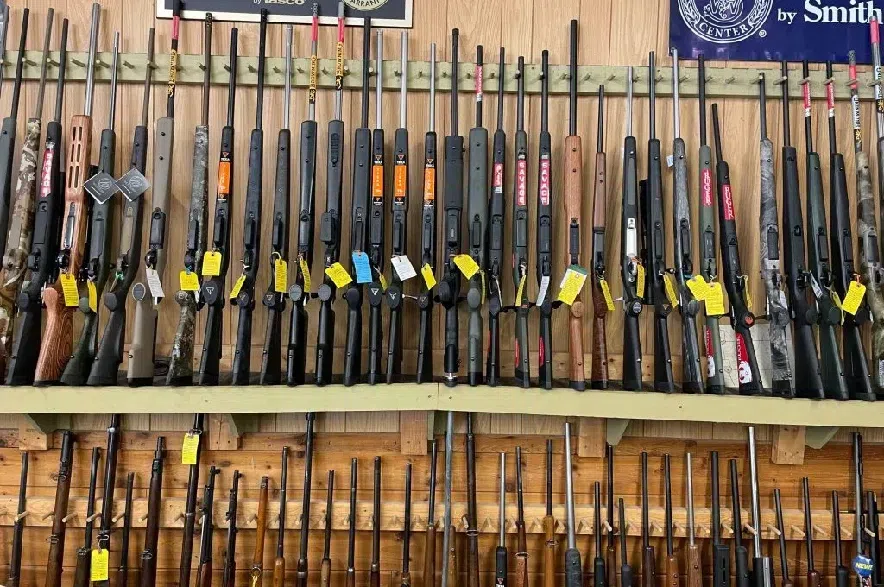
The first stage of Canada’s federal gun buyback program has officially begun, but Saskatchewan firearms experts remain leery of the initiative and unconvinced of its effectiveness.
From Monday through March 31, gun owners can express interest in receiving compensation from Ottawa for turning in or permanently deactivating their firearms.
Read more:
Robert Freberg, commissioner for the Saskatchewan Firearms Office, said there is a lack of facilitators to collect the banned firearms across Canada.
“As recent as last week, Manitoba indicated that they didn’t have any interest, nor did they want to divert law enforcement folks away from their important work to be couriers picking up firearms,” Freberg said.
On Thursday, Matt Wiebe, Manitoba’s minister of justice, declared that Manitoba will join other provinces in pushing back against the program after only 25 guns were collected and destroyed during the pilot phase.
During a news conference on Saturday, federal Public Safety Minister Gary Anandasangaree said the buyback is a national program and RCMP has a nationwide presence.
“We have the capacity, we have the ability to ensure we have nation-wide coverage, with the exception of Saskatchewan and Alberta where there are some technical, legal challenges that we’re working through,” Anandasangaree said.
Freberg said it’s concerning to hear that despite provinces voicing clear objections to the buyback, the federal government is planning to move forward using the national police service.

Robert Freberg, commissioner for the Saskatchewan Firearms Office, says he has serious concerns about the efficacy of the federal buyback program. (Government of Saskatchewan/Submitted)
Freberg said there isn’t enough money in place to purchase all the firearms the federal government is hoping to take in.
“There’s no guarantee if you register that you’re going to get paid anything, other than the fact that they’ll know now that you have the firearm, so I’m concerned about all that,” Freberg shared.
“There’s a lot of contradictions that I saw that I found quite concerning.”
The $250 million set aside by the federal government is expected to cover the payments for up to 136,000 guns. Freberg, however, estimated that the number of eligible guns in Canada far exceeds that total.
Since 2020, the federal government has outlawed about 2,500 types of firearms over a number of phases. Freberg said after the first round of Canada tightening its gun restrictions, manufacturers began to sell other firearms that also later became prohibited.
“The numbers have exponentially increased by a great deal,” Freberg said.
The Saskatchewan commissioner noted that the federal government has labelled these guns as “assault-style firearms,” but he said in many cases the banned guns have the same purposes – hunting and sport shooting – as any other firearm licensed to the vast majority of law-abiding gunowners. Freberg said “modern sporting firearms” would be a more appropriate label.
While the federal government has said that the firearms now prohibited and being collected in the buyback program are guns that only belong on the battlefield, Frebeg referenced Ukraine’s limited interest in Canada’s offer to donate guns collected through the buyback program to help that country’s war effort.
“They weren’t battlefield-ready firearms and they didn’t want them,” Freberg said. “I don’t know how you can stipulate that they’re battle-ready firearms when you’ve got countries that are in those situations that don’t even want to take them.”
In October, the Canadian government announced it was no longer planning to donate any fireams collected during the gun buyback program to Ukraine, saying that doing so would be neither practical nor effective in supporting the country’s defense during its ongoing conflict with Russia.
According to Public Safety Canada, after declarations are approved, owners will be invited to finalize their claims in the spring and schedule appointments to turn in their firearms to the RCMP, local police or a mobile collection until.
Canada’s federal gun buyback amnesty for newly prohibited assault-style firearms means owners of those guns will have amnesty until Oct. 30.
Freberg said one of the reasons the Government of Saskatchewan has put forth amendments to its provincial gun legislation is to ensure fair compensation is paid to owners surrendering their guns.
“It shouldn’t be first come, first served,” Freberg said. “If you’re going to confiscate someone’s property then, in all fairness, you need to pay them for it and pay them fairly… If you don’t do that, I don’t see how you’re going to get compliance.”
Freberg pointed out that people wouldn’t be expected to turn in their vehicles or homes or other property for no guaranteed compensation.
“Why would they turn their guns in for nothing?” he asked.
Though he is anticipating reluctance from gun owners to participate in the buyback, Freberg said he doesn’t believe the situation is becoming another face-off between Saskatchewan and the federal government.
Freberg said he has concerns about how the Canadian government is running the program, with compensation to owners and resources to carry out the buyback being two of the key issues.
“How are you going to do this without taking away police resources, making sure that it’s done in a manner that you’re not actually getting the opposite effect and actually creating more of a problem than you’re solving?” Freberg asked.
Freberg said the federal government has not complied with Saskatchewan’s firearms legislation during the process, and has not approached the Government of Saskatchewan to license any agents in the province in order to perform seizures.
“I don’t know how we could possibly be in compliance or move the program forward when they’ve made zero effort to try to do anything to comply with what we say are common-sense legislative items to make sure it’s done properly,” said Freberg.
The firearms commissioner said the province will be studying the legislation released over the weekend and will look to open a dialogue with Ottawa about how to proceed on the contested points.
The province’s own firearms legislation, introduced in November, would allow individuals in the province some options to store firearms legally while in discussions or litigation with the federal government over payments through the buyback program.
Freberg said the intention in Saskatchewan is to ensure no one encroaches on the Criminal Code by the time the amnesty period ends.
“We are taking measures to make sure that that doesn’t happen,” he said.
–with files from 980 CJME’s Geoff Smith