
The province has a new health plan. But you know the old saying about the best laid plans o' mice and men ...
In today's Wood File, Murray appreciates everyone has good intentions regarding health care, but notes it's been a long ...
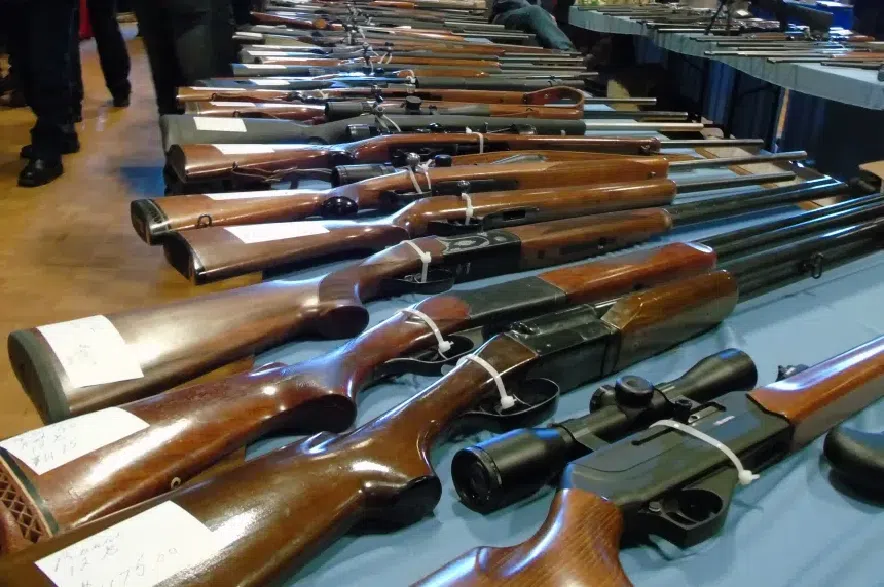
Gun experts are weighing as the federal gun buyback program begins.
The long-promised program officially kicked off on Monday, and gun owners have until March 31 to declare interest in the program offering compensation for turning in or permanently deactivating firearms that have been banned in Canada.
Read more:
About 2,500 gun types have been banned in Canada since May, 2020.
Rod Giltaca, CEO and executive director of the Canadian Coalition for Firearms Rights, joined the Evan Bray Show on Monday to discuss what the program rollout means for Canadians and share his concerns about how the program will affect law-abiding, licensed gun owners in Saskatchewan and across the country.
The following transcript has been edited for length and clarity.
EVAN BRAY: It’s suspicious to me also that this was rolled out on the weekend. Am I wrong? Is it weird that this was announced on a Saturday? And is that just an indication of their uncertainty or recognition of the lack of popularity about this program?
GILTACA: Yes, that’s exactly how they do it. They’ll roll out bad news on us on a Friday or Saturday, because the mainstream media has skeleton crews on during the weekend. It’s interesting how they rushed out this program, which is clearly designed, I guess you could say, to fail. We can debate that, but they rolled it out right on the heels of the announcement that they lost their appeal trying to protect themselves against the use of the Emergencies Act being illegal and against the Charter. So that’s what they do. It’s funny, because if you look at the last 35 years, whenever the Liberals are in scandal, they break the glass and pull out gun control.
We saw the pilot project being held up by the government as a success story – 25 guns over a fairly long period of time. To me, that speaks to the lack of willingness of firearm owners wanting to participate in this program. How did you see that?
GILTACA: There was a dismal failure. There were 3,100 firearm owners in that area, in the jurisdiction of that pilot program. We don’t know exactly how many firearms were previously non-restricted that are now prohibited, but as an organization we did our own research project. We think there’s over two million previously non-restricted, now-prohibited firearms in circulation.
Is that in Canada?
GILTACA: Yeah, across the country. And oddly enough, there is a group of people that know exactly how many of these guns are in the country. It’s Global Affairs Canada. So for the government to say they don’t know how many, or that they think that if they pay for 138,000 guns, that should cover it, it’s very disingenuous. The pilot project didn’t work. They saw the willingness of Canadians to take the blame for the Liberals’ failures on public safety, but they’re going to march forward anyway.
There’s lots of different avenues we can take on this, but the compensation piece is one that’s got lots of people talking. They’ve only got a limited number of dollars, so it is going to fall quite short of being able to adequately compensate all firearm owners that choose to participate?
GILTACA: This is the biggest thing that Canadians should be talking about. When the Liberals banned the first tranche of all these firearms that they’re calling “assault style,” even they had to back off of the “assault weapon” language, because it just wasn’t true. So they called it “assault-style.” But back in 2020 when they rolled this thing out, they admitted that licensed gun owners aren’t the problem. They admitted that licensed gun owners are good people that deserve to be treated fairly, and they were going to compensate everyone fully and fairly for these firearms. Now, six years later, they’ve decided that with over two million of these guns in circulation, they’re going to pay for, a few months ago, 152,000 firearms, which is less than one per cent of what’s in circulation. The real question is, if this has always been about public safety, if this is just that these guns are just so dangerous they have to be removed, why wouldn’t they just pay for them? Why wouldn’t they do exactly what they promised to do for six years and just pay for them? Because that’s the only way to get the maximum number of people to participate in this project. But instead you are competing with your fellow gun owners, because there’s only a small pot of money and everyone else is going to get ripped off. And then they tell the gun lobby that they tell us that so that we spread that information around. It’s almost like they don’t want people to participate. This is quite a scandal.
I’ve had this conversation with a few people over the last little while and it’s around the actual guns that are on the list. Help me understand. If they’re not a person that owns firearms, they maybe don’t have a strong, vested interest in this discussion one way or the other. What is the use of military-style weapons? The number of guns that are on this list that may look like or have some sort of physical features of a military weapon, but yet are .22s or shotguns is quite high and quite alarming.
GILTACA: You are absolutely right, and this is why it felt outrageous. I think that people need to remember all of the firearms on this list were classified as restricted or non-restricted for the better part of a century in Canada. Some of them are newer models, but many of them are older. There are bolt-action rifles on this list. There are an enormous number of .22-calibre rifles on this list. There are single-shot rifles on this list. When you look at it, this is very arbitrary, but these are all guns at the RCMP Canadian firearms lab and every government that came before, including previous Liberal governments, have said “We’ve got the full autos out. We’ve got things that are easily converted to full auto; those are all prohibited, and have been since 1977.” Liberals get in. They look at electoral gains maybe as a possibility for gun control, and they have not taken their foot off the gas since.
I think people that don’t own firearms don’t understand how important guns are to the people that own them. They’re for hunting, target shooting, collecting, inheritance, recreational shooting. These are all good and sufficient reasons to own firearms. The culture around firearm ownership is just as relevant to the people that own them as hockey is to Canadians. We’ve owned guns since before Confederation. There are 800 fish and game clubs around the country. There are more people licensed to own handguns than play organized hockey in Canada. You just don’t see it. You’re looking at destroying an entire culture that is as old as this country, and you’re looking at taking property away from people who – legally and responsibly – have owned it forever. That’s why it’s so outrageous.
I’m wondering if you can talk about the impact it’s having and how it’s different across Canada. I was just at one of the big gun shows that goes on in the province in Regina, and it was packed, both days. It seems to me those that use firearms, whether it’s for sport, hunting, recreation, are still strong, certainly in our province. Have you seen a major swing in support for firearms across Canada?
GILTACA: I’m always shocked at how resilient gun owners are. I’ve been doing this for more than a decade, trying to get these people to have a reasonable, honest, mature conversation about firearm-related violence and its connection, whether that’s true or false, with legal firearm ownership. It’s tough to keep going, whereas the community, they keep getting these hits, they keep getting blamed for everything that has nothing to do with them, and they keep trying to support the community and trying to keep their culture and their relationships. That’s really incredible. But the amount of gun store closures, family businesses that have been destroyed by this… We’ve lost, I think, five or six gun clubs across the country. There’s still a lot left, but it’s only a matter of time. We’ve had people that have died and then have all of their firearms confiscated, with no compensation, taken from their families, all that investment. I personally have $30,000 tied up in firearms that were OK to own before and and now are not OK. We’re all trying to keep going. We’re trying to weather the storm, either through an election or maybe just talking some sense into these people, but it’s not about public safety.
Do you have thoughts about how Saskatchewan has been responding as a province to this legislation?
GILTACA: It’s phenomenal. God bless Saskatchewan ,and Alberta too, and now Yukon and at least Manitoba is saying “We’re not going to help you.” This is all fantastic, and Saskatchewan has led the charge, I will tell you. It’s really interesting, and I think Bob (Freberg) probably explained how the most recent legislation that is on the table actually works. Every province in Canada should be implementing what Saskatchewan has done, because Saskatchewan didn’t say “We’re not going to interfere with the compensation program” – or confiscation program, as we like to call it – in this particular piece. “We’re just going to make sure that the federal government fulfills its promise to compensate people.” And I think even if you’re a province like British Columbia, where I am, where they think this is the best thing ever and are going to co-operate any way they can, even at the cost of public safety, they should still pass legislation like that, because you’re protecting your citizens against being ripped off by the Liberals’ policy choices. So I really hand it to Saskatchewan and other provinces that have opposed this, because it’s unfair, it’s ineffective, it’s wasteful and it’s divisive.
I’m just going to question you on one point you just made, because there will be listeners that heard you say B.C. is doing this “at the cost of public safety.” How do you see that? Because there are some people that support this program that will say it’s the program that’s enhancing public safety. Why are you suggesting that participating in the program could not do that?
GILTACA: There’s a couple of different ways. For one, you need police to administer this program. It’s not safe. It is a threat to public safety to try to have bureaucrats handling all these firearms, and the vast majority of these bureaucrats being unlicensed individuals, you just can’t do that. That’s not right. Just like Canadians accept that we need a license to own a firearm in the first place. Then, in a time in Canada where you have a massive deficit in the required number of police officers in almost every province, now you want to carve off all these police resources for collecting guns not from criminals, not from crime. Neither of those things qualify for this program. This is only for licensed gun owners and legally held guns, and that’s what you want to push your resources to. Especially in the case of British Columbia, where we have cartels operating in the open, we have extortion rings, we have foreign gangs and interestingly enough, the feds see what’s going on in British Columbia, so much so that the FBI wants nothing to do with Canada because of the obstruction that we’ve seen. Ottawa sends $4 million to fight international cartels in British Columbia, and they earmark three quarters of a billion to take my firearms away. So this is why it’s an impact on public safety. Every dollar spent on this boondoggle is a dollar not spent solving our problems.